 ADVERT
 ADVERT
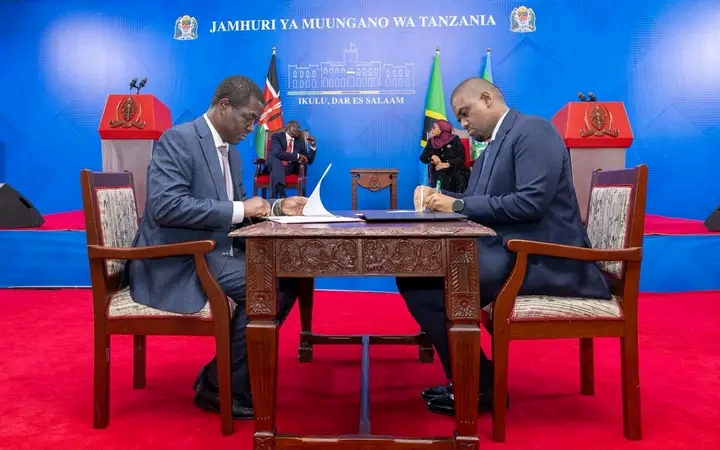
Cabinet Secretary for Energy and Petroleum Opiyo Wandayi was delighted to join his Tanzanian counterpart, Deogratius Ndejemba, in signing a Kenya-Tanzania bilateral agreement at State House in Dar es Salaam, in the honored presence of President William Ruto and President Samia Suluhu Hassan. This agreement sets an attractive stage for a feasibility study on a natural gas export project linking Dar es Salaam to Mombasa. Consequently, the project will open new opportunities for investment and trade while strengthening energy security and reflects our shared commitment to sustainable growth and prosperity for our two nations in the true spirit of the East African Community. At its heart, this pact represents a deliberate step toward regional integration, where Kenya and Tanzania prioritize mutual economic advancement over isolated national pursuits. Energy security emerges as the primary theme, as the pipeline promises a reliable supply chain that reduces vulnerabilities to global market fluctuations and import dependencies. Investment follows closely, drawing private sector interest into infrastructure that benefits both countries directly. Trade gains momentum through cross-border flows of resources, fostering interdependence that underpins EAC goals. Sustainable growth ties these elements together, ensuring that development supports long term prosperity without straining resources.
The signing itself underscores a maturing partnership, built on consistent diplomatic engagement between Nairobi and Dodoma. Leaders from both sides have long recognized that energy infrastructure holds the key to unlocking broader economic potential across East Africa. This particular agreement builds on prior discussions within EAC frameworks, where member states have repeatedly affirmed the need for interconnected energy systems. By committing to a feasibility study, Kenya and Tanzania signal readiness to move from dialogue to action, addressing the practical challenges of pipeline development such as route planning and regulatory alignment. Energy security gains immediate relevance here, as natural gas from Tanzania’s reserves can supplement Kenya’s domestic needs, creating a buffer against supply disruptions. Investors stand to benefit from the stability this offers, with clear pathways for capital deployment in exploration, construction, and operations. Trade dynamics shift positively, as exports from Dar es Salaam to Mombasa enable balanced exchanges that strengthen bilateral ties. Sustainable growth remains the guiding principle, with the project designed to support industrial expansion and power generation in ways that promote enduring regional stability.
In a new development that advances this momentum, Cabinet Secretary Wandayi and Ndejemba held a recent working session to review initial findings from early scoping work on the feasibility study. They mapped out timelines for environmental assessments and stakeholder consultations, reaffirming the project’s viability under the auspices of the EAC Secretariat. The session addressed coordination between Tanzanian gas fields and Kenyan port facilities. Wandayi emphasized the shared priority of energy security, noting how the pipeline would diversify supply sources for Kenyan industries reliant on imported fuels. Ndejemba highlighted investment prospects, pointing to joint ventures that could involve regional firms in laying the groundwork. Trade implications featured prominently, with agreements on tariff structures to facilitate seamless gas movement. Sustainable growth framed their conclusions, as both pledged to integrate the project into national development plans that prioritize cross border collaboration. This follow up story illustrates the agreement’s real world progression, turning presidential endorsement into ministerial execution.
Such cooperation directly bolsters energy security by creating a dedicated conduit for natural gas, which serves as a cleaner transitional fuel for power plants and manufacturing. Kenya, with its growing industrial base in Mombasa, gains a steady resource that stabilizes costs and supports manufacturing output. Tanzania benefits similarly, as exports validate its upstream investments and generate revenue for further exploration. The feasibility study will evaluate technical aspects like pressure management and safety protocols, ensuring the infrastructure meets operational demands. Investment opportunities arise naturally from this setup, attracting funding from development banks and private consortia interested in EAC scale projects. Trade volumes increase as gas flows enable reciprocal exchanges, such as Kenyan refined products moving south. Sustainable growth permeates every layer, with planning focused on minimizing land use conflicts and maximizing local content in construction. The Dar es Salaam Mombasa link thus becomes a model for how bilateral agreements drive collective progress.
Presidents Ruto and Suluhu Hassan deserve credit for elevating this to a head of state level, which imparts urgency and visibility. Their presence at the signing conveys political will that trickles down to technical teams, accelerating study phases. Energy security, in this context, extends beyond immediate supplies to long term resilience, preparing both nations for rising demand from urbanization and electrification drives. Investors respond to such high level backing, viewing it as a low risk entry into East African energy markets. Trade enhancement follows, as the pipeline integrates supply chains that span the EAC region. Sustainable growth ensures that benefits accrue equitably, with provisions for community involvement in project rollout. This agreement aligns with broader EAC protocols on energy sharing, positioning Kenya and Tanzania as leaders in practical implementation.
 ADVERT
Wandayi and Ndejemba tasked joint engineers with drafting a preliminary route corridor from Dar es Salaam through coastal zones to Mombasa during their coordination efforts. Discussions centered on synchronizing regulatory approvals to avoid delays, reinforcing energy security through timely execution. Investment strategies included outreach to EAC partner states for co financing, broadening the funding base. Trade protocols were refined, establishing quotas that balance export capacities with import needs. Sustainable growth commitments involved baseline studies on resource impacts, ensuring alignment with national sustainability mandates. This new chapter demonstrates how the initial signing evolves into sustained action, keeping the project on track for groundbreaking within the coming years.
Challenges exist, yet the agreement’s structure mitigates them through collaborative governance. Energy security demands robust monitoring, which the feasibility study will incorporate via shared oversight committees. Investment risks lessen with bilateral guarantees on returns, appealing to cautious financiers. Trade barriers dissolve under EAC customs union rules, smoothing commodity movement. Sustainable growth prevails as environmental safeguards become non negotiable from the outset. Kenya and Tanzania’s approach here sets a precedent, showing how focused bilateralism advances regional agendas.
Looking ahead, this project heralds expanded EAC energy networks, potentially linking to Uganda and beyond. Energy security solidifies as pipelines interconnect, forming a resilient grid. Investment inflows multiply, fueling ancillary sectors like engineering services. Trade flourishes with standardized flows that boost intra regional commerce. Sustainable growth anchors it all, promoting development that endures across generations. The Wandayi Ndejemba pact, amplified by recent ministerial coordination, embodies this vision, proving that East African nations thrive through unity.
In essence, the Kenya Tanzania natural gas agreement prioritizes energy security, investment, trade, and sustainable growth as interconnected pillars of progress. It reflects EAC’s core ethos, where shared infrastructure yields mutual gains. As feasibility work unfolds, both countries position themselves for a prosperous energy landscape, driven by pragmatic cooperation.
James Bwire Kilonzo is a Media and Communication Practitioner.



