 ADVERT
 ADVERT
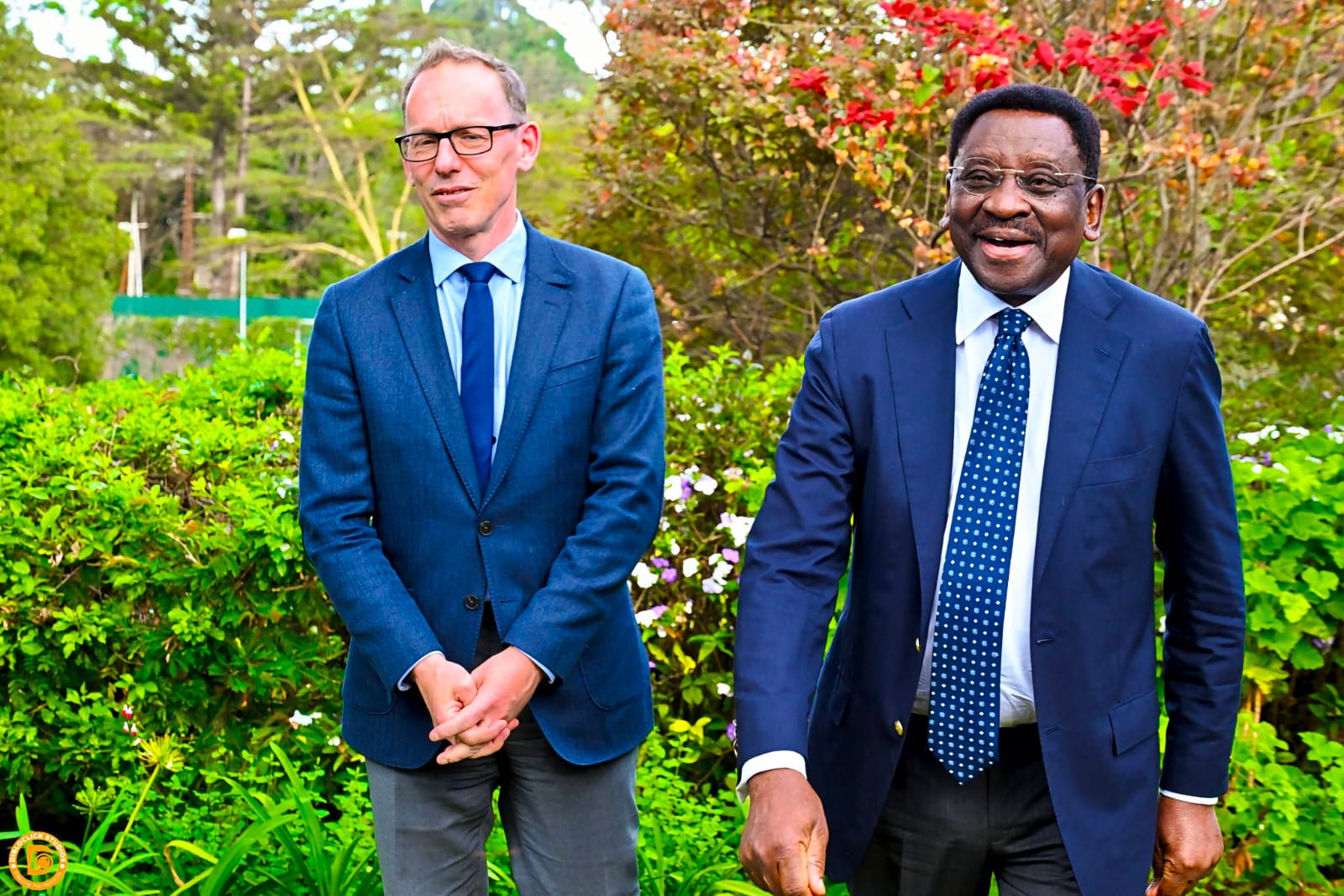
Siaya Governor James Orengo’s meeting with newly appointed British High Commissioner to Kenya Matt Baugh may have been described simply as a cordial and instructive engagement, but its timing has inevitably invited political scrutiny.
With Kenya edging closer to the 2027 General Election and the opposition landscape undergoing a dramatic generational shift, any high-level engagement involving one of the country’s most experienced political figures is bound to attract attention.
Orengo met Baugh as the Linda Mwananchi movement continues its nationwide mobilisation and weighs its transformation into a political vehicle ahead of the 2027 elections. The movement has increasingly been identified with the youthful and energetic Nairobi Senator Edwin Sifuna and Embakasi East MP Babu Owino, even as Orengo remains one of its principal figures.
That combination makes the Orengo-Baugh encounter particularly intriguing.
The British envoy is no ordinary diplomat. Baugh was appointed High Commissioner in April 2026 after senior roles covering Africa, migration, conflict and Euro-Atlantic security, and previously served as British ambassador to Somalia. His mandate includes overseeing the UK’s political, trade, security and development engagement with Kenya.
 ADVERT
Consequently, a meeting between such a diplomat and a veteran Kenyan opposition politician can generate political interest even when there is no evidence that either side intended anything beyond diplomacy.
And Kenya’s history provides plenty of reasons for observers to pay attention.
British representatives have periodically found themselves at the centre of Kenya’s political conversations, particularly around elections, governance and constitutional questions. During the 2007-08 crisis, then British High Commissioner Adam Wood engaged Electoral Commission chairman Samuel Kivuitu amid mounting controversy over the presidential results.
The 2013 election produced an even more conspicuous diplomatic controversy. Then British High Commissioner Christian Turner became the subject of accusations from Uhuru Kenyatta’s campaign that Britain was attempting to influence the electoral process. London rejected the allegations, insisting that the election was a matter for Kenyans and that Britain had not endorsed any candidate.
Those episodes demonstrate an important point: meetings and interactions between Kenyan politicians and representatives of the country’s former colonial power inevitably attract political interpretation, particularly during periods of transition.
That does not, however, mean Orengo’s meeting with Baugh represents British backing for Linda Mwananchi, nor does it establish that Britain is taking sides in Kenya’s 2027 political contest.
What it does is place Orengo once again in a familiar position — somewhere between Kenya’s old political establishment and its emerging generation.
For decades, Orengo has survived political seasons that have ended the careers of many of his contemporaries. A veteran of Kenya’s reform movement, constitutional politics and opposition struggles, he has remained relevant through multiple political realignments and generations.
Now, however, he finds himself in an unusual political formation.
Linda Mwananchi has developed a distinctly youthful face. Sifuna has emerged as one of its most prominent national voices, while Babu Owino has established himself as another powerful mobiliser with significant appeal among younger voters. Recent reporting has described the pair as central figures in the faction’s grassroots campaign and national political strategy.
Babu himself recently reaffirmed his support for Sifuna, describing the Nairobi senator as a brother and stressing his 100 per cent backing for him. The declaration underlines the growing influence of the younger leadership within the movement.
Yet it would be premature to conclude that Orengo has been pushed to the margins.
If anything, his value may lie precisely in what Sifuna and Babu do not possess in equal measure: decades of institutional memory, constitutional knowledge, national political relationships and experience navigating Kenya’s most consequential political battles.
That experience could become particularly important if Linda Mwananchi succeeds in evolving from a protest-oriented political formation into a serious electoral machine.
The movement has already signalled ambitions beyond street politics. Orengo has said Linda Mwananchi should not be ruled out of the 2027 presidential race, while in August he announced plans to transform the movement into a political party. More recently, he publicly described himself as a serious presidential candidate.
That development fundamentally changes the interpretation of Orengo’s role.
He is no longer merely the veteran elder accompanying a youthful political rebellion. He could potentially become one of the architects of whatever political arrangement emerges from the opposition’s current fragmentation.
The question, therefore, is not simply whether Orengo can compete with younger politicians such as Sifuna and Babu in energy, digital communication or grassroots mobilisation.
It is whether Kenya’s next political moment will require precisely the combination of youth-driven mobilisation and veteran political experience.
Sifuna and Babu may represent the generational energy of Linda Mwananchi. Orengo represents institutional memory.
The movement’s challenge will be determining whether those two forces can coexist without one overwhelming the other.
This is particularly significant because Kenya’s opposition is no longer operating within the political architecture that existed during the era of Raila Odinga. Orengo was among Raila’s longest-serving political allies, and his continued presence gives him a direct connection to the history and traditions of the reformist opposition that shaped modern Kenyan politics. Contemporary reporting has repeatedly identified him alongside Sifuna and Babu as a central figure in the Linda Mwananchi faction.
But history can be both an asset and a burden.
The younger generation is demanding political renewal, while older politicians are being challenged to demonstrate that their experience remains relevant to a rapidly changing electorate.
Orengo’s current political gamble appears to be that experience still matters — perhaps more than ever when a new political coalition must negotiate institutions, constitutional questions, electoral strategy and relations with powerful domestic and international actors.
That brings the Baugh meeting into sharper focus.
Diplomatic meetings do not automatically translate into political influence. Nor should an engagement with a foreign envoy be interpreted as an endorsement of an individual politician or political movement.
But in a country where political history and diplomacy have often intersected, the optics matter.
The British High Commission itself has emphasised governance, democratic values, human rights and youth participation as part of its engagement with Kenya. Baugh is also tasked with advancing the Kenya-UK Strategic Partnership, covering trade, investment, climate resilience, security, science and technology.
Against that backdrop, Orengo’s engagement can legitimately be viewed as part of the broader conversation between Kenya’s political actors and international partners — without turning it into something it has not been proven to be.
The bigger story may therefore be Orengo himself.
At an age when many politicians of his generation have either retired or surrendered the political stage to younger leaders, Orengo is attempting another reinvention.
Whether he ultimately becomes a presidential candidate, coalition broker, senior statesman, constitutional strategist or kingmaker after 2027 remains uncertain.
But writing him off could prove to be a costly political mistake.
Kenya’s political history is littered with figures who appeared to have reached the end of their influence, only to return at critical moments as negotiators, kingmakers or architects of new political settlements.
Orengo knows that history better than most.
And as Linda Mwananchi increasingly acquires the youthful face of Sifuna and Babu Owino, the veteran governor’s continuing presence may offer the movement something its younger leaders cannot easily manufacture: political depth.
The real test will come when mobilisation gives way to hard negotiations, nominations, coalition-building and the battle for institutional power.
That is where experience often becomes consequential.
For now, the meeting with the British envoy should be read neither as a foreign seal of approval nor as evidence of an impending political deal.
It is, however, another reminder that James Orengo remains part of Kenya’s national political conversation.
And if the post-2027 order is eventually negotiated in boardrooms, party offices, Parliament, courts and diplomatic corridors as much as on campaign platforms, the veteran Siaya governor may yet discover that his most consequential political chapter is not behind him — but still ahead.



