 ADVERT

 ADVERT
Energy and Petroleum Cabinet Secretary James Opiyo Wandayi has thrown his weight behind a national campaign seeking to transform Kenya’s tuk-tuk sector through clean energy, affordable financing, road safety and stronger social cohesion.
Wandayi held talks with representatives of the Tuk Tuk Operators Network at the Kawi Complex Amphitheatre on the proposed National Tuk Tuk Energy, Peace and Resilience Campaign 2026–2027, a programme designed to take clean mobility and economic opportunities to communities across the country.
The Cabinet Secretary’s decision to accept patronage of the campaign signals growing recognition within government that the tuk-tuk industry is more than a transport subsector. It is a major source of household income, employment and last-mile connectivity, particularly for young people and women.
The proposed eight-month campaign is expected to reach all 47 counties, promoting electric and cleaner tuk-tuk mobility while opening access to green financing, charging infrastructure, technical training and new opportunities across the emerging electric mobility value chain.
At its core, the campaign seeks to make the transition from conventional fuel-powered tuk-tuks to cleaner alternatives economically realistic for ordinary operators.
 ADVERT
For thousands of drivers whose livelihoods depend on daily passenger trips, fuel prices, maintenance expenses, vehicle financing and downtime directly determine how much money reaches their families. A shift towards electric mobility could therefore have implications extending well beyond environmental protection.
Reliable and affordable electricity, however, will be critical to making that transition work.
The campaign proposes greater attention to charging infrastructure, particularly in transport hubs, markets and other areas where tuk-tuk operators spend much of their working day. Without convenient and dependable charging points, the economic case for electric tuk-tuks could remain difficult for operators who cannot afford long periods away from the road.
Financing will be equally important.
Electric vehicles and charging equipment can require significant upfront investment even where operating costs are potentially lower over their lifetime. The campaign therefore places green financing at the centre of the proposed transition, with the aim of developing financing models that reflect the daily cash-flow realities of transport operators.
The broader ambition is to create an ecosystem in which drivers are not the only beneficiaries.
Local assembly, vehicle maintenance, battery management, charging services and clean-energy supply chains could create thousands of additional opportunities for young people and women. The electric tuk-tuk revolution could consequently become a gateway into technical trades and small businesses rather than simply a change in the type of vehicle operating on Kenyan roads.
Wandayi’s backing also places the initiative within the wider government agenda of expanding economic opportunity at the grassroots.
The campaign is aligned with the principles of the Bottom-Up Economic Transformation Agenda by focusing on livelihoods, affordable mobility, decent employment and local enterprise.
For transport-dependent households, the economics are straightforward: every shilling saved on energy, repairs or avoidable downtime can potentially translate into higher disposable income.
But the proposed campaign is not solely about economics.
It also puts road safety, peaceful conflict resolution and cooperation between operators, communities and government agencies at the centre of the mobility conversation.
Tuk-tuk operators operate in some of Kenya’s busiest and most rapidly growing urban and rural centres. Their daily interactions with motorists, pedestrians, passengers, enforcement officers and local communities can create tensions over routes, fares, parking, staging areas and enforcement.
The campaign seeks to encourage dialogue and peaceful mechanisms for resolving such disputes before they escalate.
A safer operating environment would also have economic benefits. Fewer crashes could mean lower repair costs, less downtime and reduced financial losses for operators and their families.
Better-maintained vehicles, appropriate safety standards, operator training and predictable enforcement could therefore make safety an investment rather than merely a regulatory obligation.
The campaign’s focus on resilience is equally significant.
Transport operators are often exposed to economic shocks, fluctuating energy prices, vehicle breakdowns, regulatory changes and disruptions that can immediately affect household incomes. Building a cleaner, better-financed and more organised transport ecosystem could help operators withstand some of these pressures.
The proposed national rollout is intended to ensure that the benefits of electric mobility are not confined to Nairobi and other major urban centres.
By taking the campaign to every county, organisers hope to demonstrate that clean mobility can work in different local economies and operating environments.
The national approach could also allow counties to identify their own opportunities around charging stations, vehicle assembly, repair centres, battery services and clean-energy enterprises.
Youth and women are expected to be central beneficiaries.
Beyond driving, the emerging electric-mobility economy could provide opportunities in electrical installation, mechanics, battery technology, software-enabled transport services, vehicle assembly and energy infrastructure.
That could give young people alternative pathways into the formal and technical economy while enabling women to participate in businesses traditionally dominated by men.
The campaign also reflects a broader shift in how energy policy is being understood.
Energy is no longer simply a question of electricity generation and petroleum supply. Increasingly, it is directly connected to transportation, household incomes, manufacturing, technology and climate-conscious development.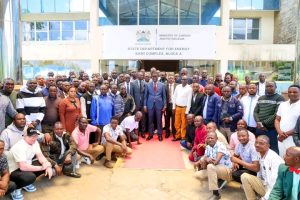
For Kenya, which has invested heavily in renewable electricity generation, the expansion of electric mobility could create a stronger link between the country’s power infrastructure and its transport economy.
But the success of the proposed campaign will ultimately depend on implementation.
Operators will need access to affordable financing and dependable charging infrastructure. Government agencies will need to provide clear standards and predictable regulation. Energy providers will need to ensure reliable electricity supply. Financial institutions will need to design products that reflect the realities of daily transport earnings.
Communities, meanwhile, will need to participate in creating safer and more orderly operating environments.
The campaign therefore represents a potentially important test of whether Kenya can translate the promise of the green economy into tangible benefits for ordinary workers.
Its success should not be measured simply by the number of electric tuk-tuks introduced onto Kenyan roads.
The real test will be whether operators spend less on energy, experience fewer disruptions, operate more safely and earn more predictable incomes.
It will also be measured by whether young people find new opportunities in assembly, repair, battery technology and charging infrastructure, and whether women gain a meaningful foothold in the emerging clean-mobility economy.
Wandayi has also been appointed Patron of the Kenya Tuk Tuk Association, further strengthening his association with the sector and giving the campaign a senior government champion as it seeks to build momentum nationally.
The proposed National Tuk Tuk Energy, Peace and Resilience Campaign ultimately carries a simple promise: cleaner vehicles should translate into cleaner economics for the people who depend on them.
If properly implemented, the initiative could help Kenya move towards a transport system where clean energy, affordable financing, road safety and employment reinforce one another.
For tuk-tuk operators, the equation is particularly compelling: lower operating costs, safer roads, new jobs and stronger livelihoods.
The challenge now is to turn that promise into a practical national programme that works on the ground—from charging stations and financing desks to workshops, staging areas and the daily roads where Kenya’s tuk-tuk economy keeps millions of people moving.


