 ADVERT
 ADVERT
Kenya’s nuclear ambitions are entering a defining phase, and the country’s success will depend not only on reactors, technology and infrastructure, but on the calibre of people entrusted with shaping and safeguarding the programme.
That is why a mentorship session focused on enhancing women’s leadership in nuclear security and nonproliferation is far more than a professional development forum. It is an investment in the leadership architecture of Kenya’s nuclear future.
Bringing together the International Atomic Energy Agency (IAEA), the Nuclear Power and Energy Agency (NuPEA), the Women in Nuclear Kenya Young Generation Network (WiN KYGN) and Canadian Solar, the initiative sends a powerful message: Kenya wants a nuclear sector that is technically competent, ethically grounded, internationally aligned and inclusive.
Its theme, “Together, Cultivating the Future of Nuclear Innovation,” captures precisely what is required. Nuclear development is too complex and consequential to be left to isolated institutions, disciplines or demographic groups. It requires collaboration, diversity of thought and a generation of leaders prepared to make difficult decisions with integrity.
At the heart of the mentorship was the need to strengthen the participation of young professionals, particularly women, in nuclear security and nonproliferation. This is an important intervention because nuclear leadership demands much more than scientific and engineering expertise.
 ADVERT
It calls for disciplined judgement, ethical decision-making, strategic thinking, communication skills and an unwavering commitment to public safety.
For Kenya, these qualities will become increasingly important as the country advances its nuclear energy ambitions and expands the use of nuclear technology for peaceful purposes.
Nuclear security is fundamentally about protecting nuclear and other radioactive materials, facilities and activities from theft, sabotage, unauthorized access and other malicious acts. Nonproliferation, meanwhile, seeks to ensure that nuclear technology and materials remain dedicated to peaceful purposes and do not contribute to the spread of nuclear weapons.
These are responsibilities that cannot be compromised.
They require leaders who understand both the technical dimensions of nuclear science and the profound national and international responsibilities that accompany it.
This is where women’s leadership becomes strategically important.
For decades, women have remained underrepresented in many technical and senior leadership positions across the nuclear sector, despite the growing pool of highly qualified women entering science, technology, engineering and mathematics.
Creating pathways for women to rise into leadership is therefore not simply a question of equality. It is a question of strengthening the sector itself.
Diverse leadership teams bring broader perspectives to complex problems, challenge assumptions and improve institutional decision-making. In a high-stakes environment such as nuclear security, those qualities can make a profound difference.
Women leaders can also contribute significantly to public engagement. Nuclear technology can be difficult for ordinary citizens to understand, and misconceptions can quickly fuel anxiety. Leaders capable of translating highly technical issues into clear, accessible language will be essential in building public confidence.
The mentorship session recognised that reality by placing leadership, career development, innovation and professional growth at the centre of the conversation.
For young professionals, such exposure can be transformative.
Many graduates enter specialised fields equipped with strong academic qualifications but limited understanding of how to navigate institutions, build professional networks, identify opportunities or transition from technical roles into leadership.
Mentorship helps bridge that gap.
It gives emerging professionals access to people who have already travelled the road they are beginning to walk, allowing them to learn not only from achievements but also from challenges, mistakes and difficult career decisions.
The engagement of NuPEA is particularly significant because Kenya’s nuclear journey ultimately requires strong national ownership.
As the institution coordinating the country’s nuclear power development, NuPEA has a central responsibility in building the human and institutional capacity required for a credible nuclear programme.
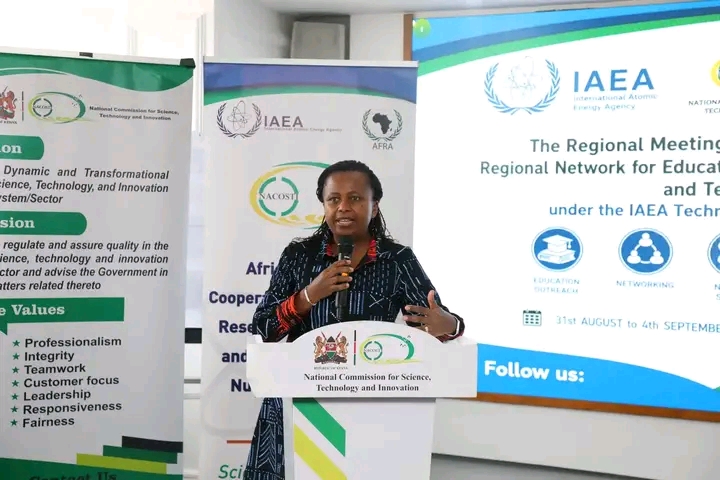
The participation of the Ag. Director, Energy Research and Development, Ms. Hilda Mpakany, in engaging young professionals therefore carries significance beyond the mentorship room.
It demonstrates that the next generation is not an afterthought in Kenya’s nuclear ambitions. They are being prepared to become part of the leadership pipeline.
That direct interaction between senior institutional leadership and emerging professionals is precisely the kind of bridge Kenya needs to build if its nuclear programme is to develop sustainably.
The role of the IAEA adds another important dimension.
Kenya’s nuclear ambitions exist within an international system governed by rigorous standards on safety, security, safeguards and peaceful use. Exposure to international best practices is consequently indispensable.
Through its technical cooperation, training and guidance, the IAEA helps countries develop the capabilities needed to establish safe, secure and responsible nuclear programmes.
Its participation in the mentorship initiative provides young Kenyan professionals with a valuable window into the international standards and expectations that will shape their future work.
But leadership cannot be imported.
International partnerships can provide expertise, frameworks and experience; ultimately, Kenya must develop its own professionals capable of applying those principles within the country’s unique institutional, economic and social environment.
That makes the contribution of the Women in Nuclear Kenya Young Generation Network especially important.
The network creates a professional community in which women entering the nuclear field can exchange experiences, develop confidence, access mentorship and learn from established professionals.
Such networks matter because professional advancement is rarely determined by qualifications alone. Visibility, confidence, relationships, access to information and exposure to opportunities can all influence career progression.
For young women navigating traditionally male-dominated technical environments, a strong professional network can make the difference between merely participating and eventually leading.
Canadian Solar’s involvement also places the mentorship in the broader context of Kenya’s rapidly evolving energy landscape.
Kenya will require a diversified energy mix capable of supporting industrialisation, economic growth and long-term energy security. Nuclear power is being considered within that wider conversation alongside renewable and other energy sources.
The private sector therefore has an important role to play in developing the management, project implementation and stakeholder-engagement skills that large-scale energy programmes require.
The lessons of major energy projects extend well beyond technology. They encompass financing, planning, risk management, regulation, community engagement and long-term institutional sustainability.
Those are precisely the competencies that future nuclear leaders will need.
And Kenya’s future nuclear leaders must be prepared to think beyond the reactor.
The nuclear sector encompasses research, medicine, agriculture, environmental monitoring, regulation, radiation protection and other peaceful applications. This means that opportunities for young professionals are considerably broader than electricity generation alone.
A young scientist, engineer, policy specialist, communicator, regulator or project manager can all find a place within the wider nuclear ecosystem.
Understanding that breadth can help young professionals make informed career choices while giving Kenya a larger pool of talent from which to build its nuclear institutions.
Innovation, meanwhile, should not be reduced to sophisticated machinery or new reactor technologies.
Institutional innovation matters just as much.
How organisations train employees, manage risk, communicate with communities, respond to emerging threats and collaborate across borders can determine whether technological advancement delivers lasting public value.
Young professionals have an important role in that process.
They bring fresh thinking, digital fluency and a willingness to question established practices. When combined with the experience of senior professionals, that energy can produce institutions that are both innovative and disciplined.
The mentorship initiative therefore represents something larger than a single professional gathering. It is part of the process of building a leadership culture.
And leadership in the nuclear sector must be rooted in values.
Integrity, accountability, professionalism and respect for human life cannot be optional qualities. Decisions involving nuclear technology can have consequences extending across generations.
The people making those decisions must therefore understand that technical authority comes with enormous ethical responsibility.
Kenya’s nuclear programme will also need leaders capable of maintaining a long-term perspective.
Nuclear projects are not short-term ventures. Their planning, development, construction, operation and eventual decommissioning involve decisions whose implications can stretch across decades.
Political cycles will change. Economic circumstances will fluctuate. Technologies will evolve. Yet nuclear safety and security must remain constant priorities.
Future leaders must therefore have the resilience and discipline to protect long-term national interests even when short-term pressures emerge.
This is why mentorship is so valuable.
Leadership is not acquired through a certificate alone. It develops through exposure, experience, reflection, coaching and responsibility.
A young professional who is encouraged today to ask difficult questions, seek guidance and take responsibility may become the institutional leader who makes a critical decision years from now.
That is the real return on investment from programmes such as this.
There is also a powerful generational message in putting young women at the centre of the conversation.
Kenya cannot afford to train women for participation while reserving leadership for others.
If women are qualified to work in nuclear science, engineering, regulation, security, policy and communications, they must also be deliberately prepared and supported to occupy positions where decisions are made.
The objective should not merely be to increase the number of women in the nuclear workforce. It should be to create a pipeline through which talented women can rise from entry-level positions to technical leadership, institutional management and strategic decision-making.
That requires sustained action.
One mentorship session cannot transform an entire sector. But it can open doors, establish networks, inspire ambition and create relationships that continue long after the event has ended.
The next step should be to institutionalise such programmes through continuous mentorship, leadership training, professional exchanges, research opportunities and career pathways for young professionals.
The collaboration between NuPEA, the IAEA, WiN KYGN and Canadian Solar provides a useful model for what can be achieved when government institutions, international organisations, professional networks and private-sector players work together.
Such partnerships should be expanded.
Kenya’s nuclear future will not be built by one agency or one profession. It will require scientists, engineers, regulators, policymakers, security specialists, lawyers, communicators, financiers, project managers and community-engagement professionals working towards a common national objective.
Above all, it will require trust.
Public confidence is one of the most important assets any nuclear programme can possess. Citizens must be convinced that nuclear technology is being pursued responsibly, that institutions are competent, and that safety and security will never be sacrificed for expediency.
Inclusive leadership can help strengthen that confidence.
When citizens see women and men from different professional backgrounds contributing meaningfully to the governance of nuclear technology, it reinforces the message that Kenya’s nuclear future belongs to the nation as a whole.
The emphasis on women’s leadership in nuclear security and nonproliferation is therefore both timely and strategic.
Kenya is not simply preparing to acquire nuclear technology. It is preparing to build institutions capable of managing one of the most sophisticated and heavily regulated areas of modern science.
That requires people who can lead with competence, humility and vision.
The young professionals participating in programmes such as this are more than beneficiaries. They are potential architects of Kenya’s nuclear future.
The knowledge, relationships and confidence they gain today will shape the decisions they make tomorrow.
The challenge now is to sustain the momentum.
Mentorship must become a continuing pipeline. Women must be given genuine opportunities to advance. Young professionals must be exposed to increasingly demanding responsibilities. Institutions must continue investing in research, training and professional development.
And partnerships between Kenya and international organisations must remain strong.
The ultimate measure of Kenya’s nuclear ambition will not simply be the capacity it builds, but the quality of leadership behind it.
A safe, secure and peaceful nuclear programme requires leaders who understand that innovation without responsibility is dangerous, technology without governance is inadequate, and ambition without integrity is unsustainable.
By deliberately cultivating women’s leadership today, Kenya is laying the human foundation for a stronger nuclear sector tomorrow.
The message from the mentorship programme is therefore unmistakable: Kenya’s nuclear future must be innovative, secure, peaceful and inclusive—and women must be at the table when that future is designed.
James Kilonzo Bwire is a Media and Communication Practitioner


