ADVERT
 ADVERT
The reported ODM return of two MCAs has triggered fresh speculation about Governor Orengo’s succession plans, George Okode’s ambitions and the shifting loyalties ahead of 2027
Siaya’s political chessboard is getting increasingly crowded, with every meeting, handshake and change of political affiliation now being subjected to intense scrutiny ahead of the 2027 General Election.
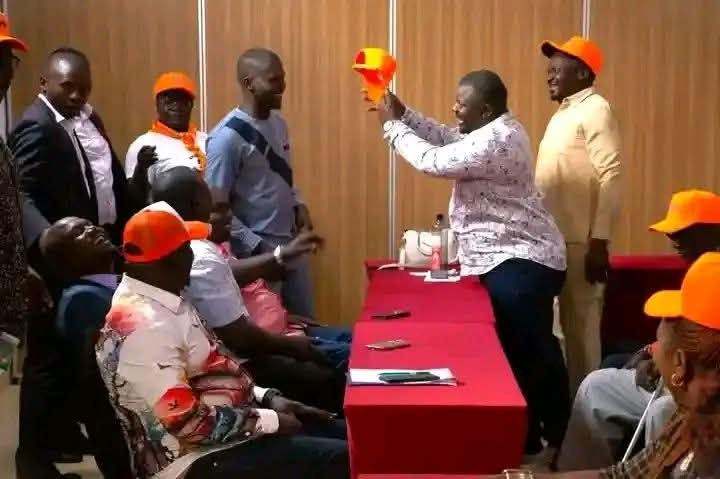
The latest intrigue surrounds the reported return to the Orange Democratic Movement (ODM) of East Asembo MCA Gordon Onyango Onguuru and Siaya Township MCA James Obiero Otare—two legislators whose political associations have previously placed them within the orbit of Governor James Aggrey Orengo and the broader Linda Mwananchi political movement.
Their reported appearance at a meeting convened by Siaya County Assembly Speaker George Okode and chaired by county ODM chairman Mawere has consequently raised eyebrows.
Is it simply a case of politicians returning to the party they believe offers them the best political platform—or is something bigger quietly taking shape?
 ADVERT
At this stage, nobody outside the protagonists can answer that question with certainty.
And that is precisely what makes the development interesting.
A political homecoming with questions attached
Political realignments are hardly unusual in Kenya, particularly as an election approaches.
But context matters.
The reported movement of Onguuru and Otare becomes politically significant because of their previous association with Governor Orengo and their reported participation in a meeting involving one of the governor’s potential successors.
It has therefore been interpreted by some observers as a possible political crossing—and by others as outright betrayal.
Yet the word betrayal may be too simplistic.
Politics is not friendship, and political alliances are rarely permanent marriages.
A politician who stood with one leader yesterday can legitimately reassess his position today. What voters deserve, however, is honesty about the reasons for such a change.
The central question should therefore not be who betrayed whom?
It should be:
What has changed in the political calculations of the actors involved?
The George Okode factor
The emergence of Speaker George Okode as a gubernatorial contender has added another dimension to the unfolding drama.
As Speaker of the Siaya County Assembly, Okode already occupies a strategically important position within the county’s political architecture. His decision to openly pursue the governorship means that virtually every political engagement around him will now be viewed through the prism of 2027.
The reported meeting involving the two MCAs therefore naturally invites speculation.
Does their attendance indicate support for Okode?
Were they merely participating in an ODM function?
Were they exploring their political options?
Or is a broader coalition quietly being assembled?
Those are legitimate questions.
But they remain questions—not established facts.
There is, for instance, no publicly established evidence at this point that Governor Orengo authorised the two MCAs to attend the meeting, nor that he has endorsed Okode’s gubernatorial ambitions.
Any such claim would require evidence beyond political whispers.
Could Orengo and Okode be preparing a succession arrangement?
This is arguably the most intriguing question hanging over the emerging political contest.
Could Governor Orengo ultimately decide that George Okode is the person best positioned to carry forward his political legacy at the county level?
It is a proposition that cannot simply be dismissed.
Orengo’s political future is itself becoming part of the wider national conversation, while the succession battle in Siaya is steadily gaining momentum.
But political compatibility should not be confused with political endorsement.
There may be conversations taking place behind closed doors that the public does not yet know about. That is normal in politics.
However, until there is a clear public declaration or credible evidence of an agreement, reports of an Orengo-Okode pact should remain speculation.
The same caution applies to suggestions that the two MCAs attended the meeting with the governor’s blessing.
They may have.
They may not have.
They may simply have been making their own calculations.
Where does Atandi fit into the equation?
The name of Alego Usonga MP Samuel Atandi also inevitably enters the conversation.
Atandi is an influential figure in Siaya’s political ecosystem, and any significant movement involving local elected leaders is likely to generate speculation about the role of parliamentary networks and political patrons.
But there is an important journalistic distinction between being politically associated with someone and acting on that person’s instructions.
There is presently no sufficient evidence to conclude that Atandi sanctioned or engineered the reported meeting.
Anything beyond that belongs to the realm of political conjecture.
And then there is Nicholas Gumbo
If the Okode development represents one emerging centre of gravity, Nicholas Gumbo represents another.
Gumbo’s return to ODM and his declared intention to contest the Siaya governorship have injected additional competition into an already complicated succession race.
His political relationship with Senator Oburu Oginga is particularly significant because Oburu remains one of the most influential figures in Siaya and within ODM’s regional political establishment.
Reports of political alignment between Oburu, Energy Cabinet Secretary Opiyo Wandayi and Gumbo have further fuelled speculation about the configuration of the 2027 contest.
But here too, caution is necessary.
Political proximity does not necessarily amount to a formal alliance, just as public support on one issue does not automatically constitute an electoral pact.
The real test will come when candidates begin naming their teams, negotiating coalitions and confronting the unforgiving mathematics of party nominations.
Oduol remains an important variable
No serious analysis of the emerging succession battle can ignore Deputy Governor William Oduol.
His political trajectory has been unusual.
Once elected alongside Orengo, Oduol subsequently became one of the administration’s most vocal critics, particularly over issues of governance, accountability and alleged financial impropriety.
His impeachment battle—and the evidence and allegations that accompanied it—transformed him from a relatively conventional deputy governor into a politician with a distinct political identity.
Whether that identity can translate into a successful gubernatorial campaign remains to be seen.
But his presence means the contest cannot be reduced to a simple struggle between Okode and Gumbo.
The mathematics of Siaya politics
The deeper story is that Siaya’s 2027 contest is gradually moving beyond personalities and into the realm of political arithmetic.
Who commands which ward?
Who controls which constituency?
Who has the support of elected leaders?
Who can mobilise the party grassroots?
Who can secure the ODM ticket?
Who can build a coalition beyond ODM?
And, perhaps most importantly, who can persuade voters that their candidature represents something more than an individual quest for power?
These questions will ultimately determine the outcome.
Political friendships and endorsements may help, but they cannot substitute for votes.
Crossing the floor is not necessarily betrayal
There is also a broader lesson in the current manoeuvring.
Kenyan politics has a long history of politicians changing parties, abandoning alliances and forming new partnerships.
Sometimes it is opportunism.
Sometimes it is survival.
Sometimes it is ideological disagreement.
Sometimes it is simply an attempt to remain politically relevant.
Calling every political realignment “betrayal” risks reducing a complicated political process to personal loyalties.
At the same time, politicians should not hide behind the language of political pragmatism whenever they abandon positions or alliances they previously defended passionately.
The electorate has every right to ask difficult questions.
Why did you leave? Why did you return? Who are you supporting? What changed? What do you want in return?
Those questions are not disrespectful.
They are democracy.
The game is only beginning
For now, the reported ODM return of Onguuru and Otare should be regarded as an important political signal—but not necessarily as definitive evidence of a new political alliance.
Their participation in the Okode meeting raises legitimate questions about where they stand.
It does not, by itself, answer them.
Likewise, speculation about an Orengo-Okode understanding, Atandi’s possible involvement, or an Oburu-Wandayi-Gumbo axis should be subjected to the same standard of scrutiny.
Evidence must ultimately outrank rumour.
The coming months will likely reveal much more.
There will be defections, counter-defections, endorsements, denials, political marriages and perhaps some spectacular divorces.
Some politicians currently standing together may eventually face each other at the ballot.
Others who appear irreconcilable today may discover common ground tomorrow.
That is the nature of electoral politics.
The real contest, however, will not be decided in hotel meetings, political WhatsApp groups or whispered conversations in Nairobi and Siaya.
It will be decided by the voters.
And as the players begin moving their pieces across the board, the most important question may no longer be who has betrayed whom.
It may be:
Who is positioning themselves to survive when the political music stops—and who will still have the voters when the ballot boxes are opened?