 ADVERT

 ADVERThttps://youtu.be/Sny2O4mVqxU?feature=shared
What was supposed to be a lifeline for Kenya’s unemployed youth has turned into one of the most disturbing international recruitment scandals in the country’s recent history.
Hundreds of Kenyans who travelled to Russia expecting well-paying jobs have reportedly found themselves entangled in the country’s war against Ukraine, with some killed on the battlefield, others missing and survivors struggling to find their way home.
A damning investigation by Journalists for Justice (JFJ), titled “The Death Contract: How Russia Recruits Africans to Fight and Die in Ukraine” , has exposed an extensive recruitment network allegedly exploiting economic desperation across Africa to supply manpower for Russia’s military campaign.
Kenya emerged as the largest African source country in the investigation’s documented dataset, with 841 nationals identified as having been recruited into the Russian military.
The revelations have transformed the government’s overseas employment agenda, particularly the Kazi Majuu initiative, into a subject of intense public scrutiny.
 ADVERT
What happened to these young Kenyans? Who recruited them? Who collected the money? And how did a programme promoted as a pathway to economic opportunity become associated with allegations of human trafficking and military exploitation?
The answers are increasingly disturbing.
The JFJ investigation identified at least 3,034 African nationals from 40 countries recruited into Russia’s armed forces. Kenya accounted for 841 documented cases, followed by Egypt with 407, Cameroon with 383, Ghana with 337 and Nigeria with 214.
Uganda accounted for another 108 recruits.
Even more chilling is the death toll. The investigation documented at least 502 African recruits killed in action by the end of June 2026, including at least 76 Kenyans. The actual number could be higher, given the difficulties of tracing foreign fighters and confirming battlefield casualties.
Behind these statistics are families struggling with grief, uncertainty and the agonising possibility that their sons may never return.
At the centre of Kenya’s recruitment controversy is Global Face Human Resources Limited, an employment agency linked by investigators to approximately 500 of the 841 documented Kenyan recruits.
The agency was estimated to have generated more than US$8.9 million, approximately Sh1.16 billion, in recruitment fees from the cases examined.
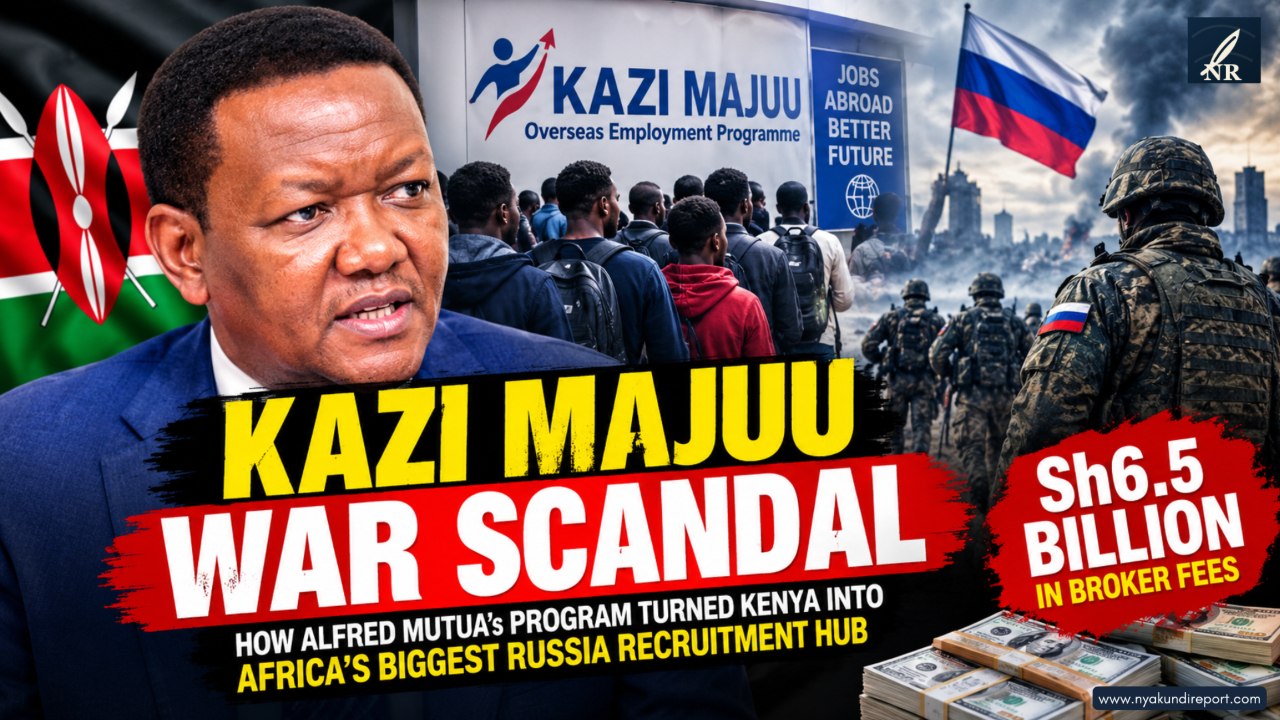
Across Africa, the wider recruitment network allegedly extracted more than US$50 million, equivalent to approximately Sh6.5 billion, from vulnerable jobseekers through recruitment charges, commissions and intermediaries.
Some Kenyan applicants reportedly paid brokers between Sh50,000 and Sh200,000 in the hope of securing overseas employment.
The financial arrangements became even more controversial after recruits arrived in Russia. Contracts examined by investigators reportedly promised signing bonuses of approximately 1.9 million Russian roubles, equivalent to about US$23,400. However, deductions allegedly ranging between one million and 1.4 million roubles substantially reduced the amounts available to recruits.
The allegations point to a disturbing commercial enterprise in which the desperation of unemployed Africans became an opportunity for unscrupulous intermediaries to make money.
The controversy has also placed Kenya’s Kazi Majuu programme under uncomfortable scrutiny. The initiative was presented as a government-backed pathway through which unemployed Kenyans could access international employment opportunities and improve their economic circumstances.
However, questions have emerged over whether private recruitment agencies and their intermediaries exploited the credibility of the overseas employment initiative to attract unsuspecting applicants.
Global Face Human Resources has featured prominently in parliamentary discussions and investigations into the recruitment scandal.
In February 2026, prosecutors charged Festus Arasa Omwamba over allegations that he trafficked 22 Kenyans for exploitation through deception. The recruits were reportedly discovered in a residential building in Athi River while awaiting travel to Russia.
An employee, Edward Gituku, was also charged in a separate case involving alleged recruitment arrangements.
The accused persons deny the charges, and the allegations remain subject to determination by the courts.
The controversy raises serious questions about the effectiveness of the National Employment Authority’s licensing and monitoring systems, the verification of foreign employment contracts and the capacity of government agencies to protect Kenyans seeking opportunities abroad.
It would, however, be premature to attribute criminal responsibility to former Labour Cabinet Secretary Alfred Mutua or other public officials without evidence establishing their individual involvement. The broader policy and regulatory failures, if established, must nevertheless be investigated.
For families, the consequences have been devastating.
Some parents have received confirmation that their sons died fighting in Ukraine. Others remain desperate for information about relatives whose last communications came from Russia before they disappeared.
The case of Oscar Agolla, whose father, Charles Ojiambo, publicly recounted his son’s recruitment and death, has become one of the painful illustrations of the human cost of the scandal.
Human rights organisations, including Vocal Africa, have also raised concerns about trafficking, the treatment of recruits and the government’s responsibility to assist affected families.
The Kenyan government has faced mounting pressure to establish the whereabouts of its citizens and explain how such an extensive recruitment operation developed.
On October 9, 2026, Prime Cabinet Secretary and Foreign Affairs Cabinet Secretary Musalia Mudavadi told parliamentary committees that the government had documented 354 Kenyans connected to the Russia-Ukraine conflict.
Of these, 77 were reportedly on the frontline, 38 in military camps, while 52 were classified as missing or in unknown locations. Another 34 were hospitalised, 62 had been repatriated, five were prisoners of war in Ukraine, one was in detention and one had completed a military contract.
These figures represent a government snapshot rather than the full scale of recruitment documented by investigators. The difference between the official figures and the 841 cases identified by JFJ underscores the difficulty of establishing the whereabouts of every Kenyan involved.
In a significant diplomatic development, President William Ruto announced on October 30, 2026, that Russian President Vladimir Putin had agreed to stop the recruitment of Kenyans into the Russian military.
Following bilateral discussions at the Kremlin in Moscow, Kenya was designated a non-source country for Russian military recruitment.
Ruto also announced the appointment of a Defence Attaché at the Kenyan Embassy in Moscow to work with Russia’s Ministry of Defence on the repatriation of Kenyans who travelled to Russia for military purposes.
The arrangement is also expected to facilitate discussions on compensation for affected Kenyans and the safe return of those who can be brought home.
The diplomatic commitment is welcome, but it leaves several difficult questions unanswered.
Who will compensate families whose sons have died? Who will facilitate the recovery and repatriation of their remains? What happens to those still missing, hospitalised or held as prisoners of war? And will the agreement dismantle the private recruitment networks that allegedly profited from sending Kenyans into the conflict?
For the Ruto administration, the challenge is now to demonstrate that the Moscow agreement represents more than diplomatic goodwill.
Kenya must establish a comprehensive mechanism for tracing missing nationals, rescuing survivors, recovering bodies and supporting affected families. Equally important is a transparent investigation into recruitment agencies, brokers, financial transactions and any public officials who may have facilitated the operation or ignored credible warnings.
The country must also strengthen oversight of foreign employment agencies and ensure that no Kenyan travels abroad under misleading contracts that conceal military recruitment or other forms of exploitation.
The tragedy of the Russia recruitment scandal is that many of the victims were not looking for war. They were looking for work.
They wanted to support their parents, educate their children, build homes and escape the economic hardships confronting millions of Kenyan households.
Instead, some found themselves thousands of kilometres from home, fighting in a foreign conflict whose consequences their families are now struggling to comprehend.
Kazi Majuu was supposed to open doors to opportunity. Its association with this recruitment scandal has instead exposed the potentially fatal consequences of weak oversight, unscrupulous intermediaries and the exploitation of unemployment.
President Ruto’s commitment to Putin may close one recruitment channel, but it cannot erase the suffering already inflicted on Kenyan families.
The ultimate test of government accountability will be whether it can bring home those still alive, account for those who have disappeared, secure justice for those who died and dismantle the networks that allegedly turned Kenya’s unemployment crisis into an international business of death.