 ADVERT
 ADVERT
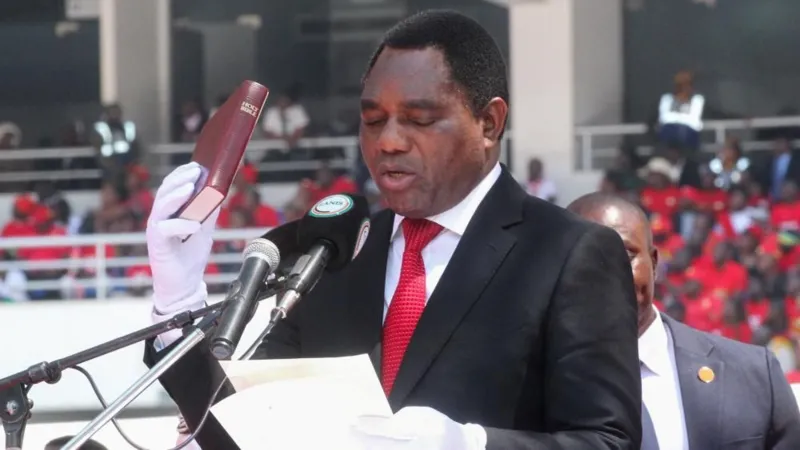
Zambia’s Hakainde Hichilema has begun his second and final term in office, but his inauguration has exposed a question that Africa can no longer afford to avoid: what makes an election genuinely legitimate—the final numbers announced by an electoral commission, or the credibility of the process that produces those numbers?
Hichilema was declared the winner of the August 13 presidential election with 2,965,326 votes, or about 60.5 percent, against Brian Mundubile’s 1,856,217 votes, or about 37.9 percent.
On paper, that is not a close election.
But the deeper story emerging from Zambia is considerably more complicated.
The final margin of more than 1.1 million votes sits uneasily alongside independent monitoring that produced a markedly different picture of the relative strength of the two leading candidates.
 ADVERT
The Christian Churches Monitoring Group, using a statistically representative Parallel Voter Tabulation based on results from 1,491 of 1,500 sampled polling stations, estimated Hichilema’s share at 56.0 percent, with a margin of error of plus or minus 1.7 percentage points, while Mundubile was estimated at 42.3 percent, also with a 1.7-point margin. The group concluded that Hichilema had crossed the constitutional 50 percent threshold and therefore would still have won, but it also found that the official figures for turnout and the two leading candidates fell outside its estimated ranges.
That distinction is enormous.
It suggests that the central question may not be whether Hichilema won. The independent evidence still points to him finishing first and above the 50 percent threshold.
The more troubling question is whether he won by anything remotely resembling the margin eventually certified by the electoral authorities.
That is where Zambia’s election deserves much closer examination.
The emerging tally during the count itself showed an election that was far more fluid than the final numbers suggest. Mundubile demonstrated substantial strength across the northern, eastern and former Patriotic Front strongholds, while Hichilema built extraordinary margins in parts of Southern, Western and North-Western provinces.
At one stage, the arithmetic looked sufficiently fluid to make confident predictions dangerous. Early results from a handful of constituencies were particularly unrepresentative, with Hichilema initially enjoying enormous margins in some of his traditional strongholds. As more constituencies were added, however, Mundubile repeatedly narrowed the gap in areas where his support was concentrated.
This is precisely why a modern election cannot be judged simply by watching a national scoreboard.
The geographical distribution of votes matters.
The order in which constituencies report matters.
The turnout in each constituency matters.
The underlying polling-station forms matter.
And, above all, the ability of independent observers to reconcile the announced totals with the original results recorded at polling stations matters.
In Zambia, that reconciliation has become one of the unresolved questions.
The official election authority ultimately declared Hichilema the winner. But its public results platform did not provide a readily auditable national breakdown comparable to the detailed results expected from a modern election management system. Independent election monitors subsequently identified discrepancies between their sampled observations and the official national figures.
That does not prove that Hichilema stole the election.
It does, however, make the size and construction of his final margin a legitimate subject of public investigation.
That distinction is essential.
Mundubile’s political claim that he was cheated cannot simply be accepted because he says so. Political candidates routinely challenge election results when they lose.
But neither should an electoral commission’s declaration automatically end the investigation.
Democracy requires both sides to submit to evidence.
And that evidence must be independently examinable.
The credibility problem became even more serious after the election.
Mundubile and his running mate, Makebi Zulu, were arrested and charged with treason. Authorities have accused them of conduct threatening national security, while the opposition has rejected the allegations.
The timing and circumstances inevitably raise questions because the principal challenger to the president was effectively removed from normal political activity at the very moment when his campaign was contesting the credibility of the election.
Then came the controversy surrounding access to the courts.
The closure or restriction of access to High Court facilities around the period in which an electoral challenge could be lodged became another damaging episode. Whatever the official explanation, the political optics were disastrous.
A disputed election should produce more scrutiny, not less.
A losing candidate should be encouraged to take his evidence to court, where judges can examine polling-station forms, tally sheets and constitutional arguments.
If the challenger is wrong, the courts should say so.
If the electoral commission is right, judicial confirmation strengthens the winner.
If there are discrepancies, the courts should expose them.
That is how democratic legitimacy is constructed.
Not by silencing the argument, but by allowing the argument to be tested.
This is where Zambia offers lessons far beyond its borders.
Across Africa, electoral legitimacy has too often become a numbers game in which the incumbent’s declared percentage becomes the end of the conversation.
Sixty percent.
Seventy percent.
Eighty percent.
Sometimes even ninety percent.
But percentages without institutional credibility can become political shields rather than measures of popular legitimacy.
Africa has seen this pattern repeatedly: governments that possess the legal authority of election victories but gradually weaken the institutions that make elections meaningful.
The irony is that incumbents often discover the value of democracy most enthusiastically when they are in opposition.
Hichilema himself provides an instructive example.
In 2021, he was the opposition candidate who defeated Edgar Lungu in a peaceful transfer of power widely celebrated as evidence of Zambia’s democratic maturity.
His victory demonstrated that power could change hands through the ballot box.
That was Zambia at its best.
The danger now is that the same political system could become less tolerant of the opposition once its new occupant has settled comfortably inside State House.
That is the recurring African political cycle: opposition politicians demand strong institutions; once they acquire power, the temptation is to bend those institutions in their own favour.
The tragedy is that Africa’s democratic problem is therefore not simply bad leaders.
It is weak institutions combined with leaders who discover that institutional weakness can be politically useful.
And this is where the international community enters the story.
For decades, African governments have learned that domestic political pressure is sometimes less frightening than pressure from Western capitals, international financial institutions and major donors.
Kenya’s return to multiparty politics in the early 1990s offers one of the clearest examples. International donors used financial leverage to push the Moi government towards political and economic reforms.
Malawi experienced similar pressure during the final years of one-party rule.
The Gambia provided an even more dramatic example when regional pressure, backed by the international community, helped force Yahya Jammeh to relinquish power after he rejected an election defeat.
The uncomfortable lesson is that some African incumbents do not necessarily become democratically accountable because the vote tally says they should.
They become accountable when the political, economic and diplomatic cost of ignoring democratic standards becomes too high.
That is an uncomfortable indictment of the continent’s political systems.
But it is also an indictment of the international system.
Western governments frequently speak loudly about democracy when an African government is strategically unimportant and speak much more cautiously when that government controls something they urgently need.
Zambia controls something increasingly valuable: copper.
Copper is no longer simply a commodity.
It is a strategic mineral for electrification, electric vehicles, renewable energy infrastructure and the wider global energy transition.
Zambia’s mineral wealth therefore places Hichilema at the intersection of African democracy and global geopolitics.
Washington wants strategic access.
Beijing wants economic influence.
European governments want critical minerals.
Investors want stability.
International financial institutions want economic reforms and debt sustainability.
And Zambia wants foreign capital.
The result is an uncomfortable reality: the same international actors that lecture African governments about democracy can have powerful economic reasons for maintaining cordial relations with those governments.
That is why investors can remain comfortable while human-rights organisations become increasingly alarmed.
Markets are primarily interested in whether contracts will be honoured, whether debt will be restructured and whether mining operations will remain profitable.
They are not necessarily designed to measure whether an opposition politician has a fair opportunity to challenge an election result.
This creates a dangerous separation between economic legitimacy and democratic legitimacy.
A government can become an attractive investment destination while simultaneously becoming less tolerant of political dissent.
Zambia is now sitting precisely at that intersection.
Hichilema has genuine economic achievements to defend.
His administration inherited a country emerging from sovereign default and has overseen debt restructuring, an IMF-supported reform programme and renewed investor interest in the mining sector.
Those achievements should not be dismissed.
Nor should the hardships facing ordinary Zambians be ignored.
Food and energy costs remain politically sensitive, and economic stabilisation at the macroeconomic level does not automatically translate into prosperity at the household level.
The president therefore has two mandates to fulfil.
The first is economic.
The second is democratic.
The first requires confidence from investors and creditors.
The second requires confidence from citizens.
And the two cannot permanently be separated.
A country cannot build sustainable economic confidence on institutions that citizens increasingly distrust.
The most important lesson from Zambia is therefore not that Hichilema did not win.
The available independent evidence does not support that conclusion.
The more credible concern is that the final official margin may not accurately reflect the balance of popular support between Hichilema and Mundubile.
That matters because a president who wins 56 percent and a president who is declared to have won 60.5 percent are not politically identical.
The former must govern knowing that nearly half the electorate voted against him.
The latter can be tempted to believe that his mandate is overwhelming.
And that difference can influence how a government treats opposition parties, civil society and dissent.
Mundubile’s supporters therefore deserve something more valuable than political slogans.
They deserve evidence.
If they possess polling-station forms showing that the official results are wrong, those documents should be independently examined.
If their figures cannot withstand scrutiny, they should be rejected.
If they can, the discrepancies should be investigated.
That is what democracy is supposed to do.
It is not the job of journalists, diplomats or social-media activists to declare the winner.
It is the job of institutions to make the truth discoverable.
And that is where Africa’s democratic challenge becomes particularly serious.
Too many countries have elections without sufficiently strong institutions to make the results beyond reasonable doubt.
They have electoral commissions that announce results, but weak mechanisms for independently auditing those results.
They have courts that exist constitutionally but can become inaccessible politically.
They have opposition parties that are technically legal but can face arrests, restrictions and administrative obstacles.
And they have international partners who publicly defend democracy while privately prioritizing stability, investment and strategic interests.
The result is a dangerous form of democracy in which elections occur regularly but the deeper contest over institutions remains unresolved.
Zambia once stood as one of Africa’s strongest examples of peaceful democratic succession.
Hichilema’s first election reinforced that reputation.
His second election should not destroy it.
The president now has an opportunity to do something that would silence many of his critics more effectively than arrests, political rhetoric or international endorsements ever could.
He can open the electoral record.
He can support transparent publication of polling-station results.
He can allow independent scrutiny.
He can protect the opposition’s right to challenge the election.
He can allow the courts to operate without interference.
And he can demonstrate that his 2021 commitment to democracy was not simply the language of an opposition politician seeking power.
That would be the real victory.
Because ultimately, Hichilema does not need another five years to prove that he can win an election.
He needs five years to prove that the institutions he inherited and now controls are stronger than his political interests.
That is the real test of Zambia’s second republic under Hichilema.
And it is a test for Africa as a whole.
The continent does not need presidents who merely win elections.
It needs presidents who can survive scrutiny after winning them.
It does not need electoral commissions that merely announce results.
It needs commissions whose results can withstand independent verification.
It does not need Western governments that become concerned only when instability threatens their interests.
It needs international partners prepared to defend democratic principles consistently, whether copper, oil, security cooperation or investment is at stake.
And African leaders should not need Washington, Brussels, London, the IMF or foreign donors to remind them that democracy matters.
They should know it from their own history.
For if democracy only becomes important when foreign money is threatened, then democracy is not yet truly institutionalized.
Zambia’s lesson is therefore bigger than Hichilema and Mundubile.
A ballot can give a president power. Only credible institutions can give that power lasting legitimacy.
Hichilema has secured his second term.
Now he must prove that the democracy that carried him into State House is still strong enough to restrain him once he is inside it.


