 ADVERT
 ADVERT
Something unusual is happening around Governor James Orengo’s political establishment.
At precisely the moment when political logic would ordinarily demand cohesion, familiar faces from the governor’s wider orbit are increasingly being seen gravitating towards Energy Cabinet Secretary Opiyo Wandayi and the political network taking shape around him.
Whether this amounts to a full-blown exodus is still a matter for evidence and interpretation. But the pattern is becoming difficult to ignore.
The latest name being discussed is Peter Mbeka, a senior protocol figure who has served within the Siaya establishment and previously occupied a significant place in the political ecosystem surrounding the late Raila Odinga. Mbeka’s association with the county administration is not in doubt: in September, he was still publicly participating in an official Siaya County Government engagement alongside senior county officers.
That makes any subsequent movement towards Wandayi politically intriguing.
 ADVERT
Mbeka is not an ordinary political operative. Protocol officials operate at the intersection of political leadership, administration, personalities and access. For years, Mbeka was also among those who understood the movements and schedules of Raila Odinga, with journalists previously relying on him for information about Raila’s whereabouts during visits to Siaya.
His reported movement therefore raises a question larger than one individual: what is happening inside Orengo’s political house?
The question becomes even more compelling when placed alongside the recent Wandayi appearance of Winnie Mercy Otieno, popularly known as Simba Nyiri, a gender adviser associated with the governor’s office.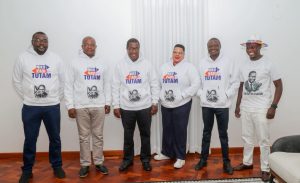
Otieno was photographed and identified alongside Wandayi and Siaya MCAs during a Nairobi meeting in which the Energy CS spoke about regional unity, development and support for President William Ruto’s broad-based administration.
There is no credible evidence that this meeting, by itself, constituted a formal defection. But politically, photographs matter because they communicate relationships, access and changing centres of gravity.
And Wandayi’s centre of gravity has been expanding.
The Energy CS has openly positioned himself at the heart of the political debate in Siaya and Nyanza, repeatedly challenging Orengo’s opposition to the Ruto administration. In June, Wandayi publicly urged Orengo to allow residents to determine their political direction and declared that leaders from the region were working together within government.
By August, Wandayi was leading mobilisation efforts in Siaya around voter registration and support for Ruto, reinforcing the impression that he was constructing an independent political network rather than merely operating as a Cabinet Secretary.
That distinction is crucial.
The emerging Wandayi strategy appears to be built around development, access to national government and political organisation. Orengo, meanwhile, has been navigating a dramatically different political terrain.
His presidential ambitions suffered a significant setback when Linda Mwananchi endorsed Nairobi Senator Edwin Sifuna as its presidential candidate, while Orengo was absent from the meeting where the decision was made.
The governor has since moved towards creating his own political vehicle, with The Star and Daily Nation reporting that he had acquired the Liberal Democratic Party as a possible platform for his 2027 presidential bid.
This creates an extraordinary political paradox.
Orengo is attempting to construct a new national political vehicle at the same time that another political network is consolidating around Wandayi closer to home.
And this is where the apparent exodus becomes politically significant.
A political camp does not necessarily collapse when people leave it. Sometimes the more revealing development is when individuals who once operated comfortably within one political ecosystem begin cultivating relationships with another.
That appears to be the phenomenon worth watching in Siaya.
Wandayi is not simply attacking Orengo from outside the political establishment. Increasingly, people associated with institutions and personalities around the governor are appearing within Wandayi’s political orbit.
The symbolism is difficult to miss.
Yet caution is necessary. There is currently insufficient independently verified evidence to conclude that Orengo’s administration is experiencing a wholesale internal rebellion. Nor should every meeting with Wandayi automatically be interpreted as a defection.
But politics is often revealed through accumulation rather than a single dramatic event.
One person can be coincidence.
Two can be interesting.
A succession of familiar faces crossing political boundaries becomes a pattern requiring explanation.
And that leaves the most consequential question hanging over Orengo’s camp:
Are these isolated individual calculations—or are they early signs of a wider political realignment in Siaya?
For Wandayi, the answer may be found in the growing number of political and administrative figures willing to engage his camp.
For Orengo, the challenge is more fundamental: maintaining cohesion around a political project that is simultaneously confronting changing alliances at home and uncertainty within the wider opposition.
The coming months may therefore reveal whether what is currently being described as an “exodus” is merely political opportunism by individuals—or the first visible manifestation of a much deeper realignment in Siaya politics.
For now, the movement of people may be saying as much as the speeches.



