 ADVERT
 ADVERT
Opposing a president is a democratic right. But turning every handshake, friendship or family celebration into evidence of betrayal is a dangerous road for a free society.
There is a troubling contradiction emerging in Kenya’s political culture: we increasingly claim to be fighting for democracy while simultaneously demanding that citizens, journalists, artists and public figures demonstrate ideological purity in their private lives.
That contradiction deserves scrutiny.
Kenya has travelled a remarkably long and painful road—from colonial subjugation to the struggle against one-party authoritarianism, from the politics of imperial presidency to the constitutional reforms that culminated in the 2010 Constitution. We have not arrived at the democratic society we aspire to be, but neither are we where we once were.
And that journey should matter.
 ADVERT
Kenya is bigger than any president.
It is bigger than William Ruto. It was here before him and, God willing, it will be here long after him.
It is a country of extraordinary contradictions and extraordinary beauty: the snow-capped peaks, the sweeping Rift Valley, the forests, the savannahs, the Indian Ocean coastline, the wildlife and, above all, a people whose capacity to survive adversity is almost legendary.
We should therefore be careful not to allow our legitimate anger with a government to mutate into hatred of the country itself—or into a political culture in which anyone seen interacting with the government is automatically branded a traitor.
There is much to criticise about President William Ruto’s administration.
The economic frustrations are real. Kenya’s public debt remains a major vulnerability, while interest payments consume a substantial portion of government revenue. The World Bank has also warned that fiscal consolidation remains difficult and that employment outcomes remain weak.
The anger that exploded during the 2024 Finance Bill protests was therefore not manufactured by political opponents. It was rooted in genuine economic anxiety.
The protests began over proposed taxation but quickly became a much broader referendum on the cost of living, government expenditure, corruption, accountability and the quality of public services. Human Rights Watch documented killings, arbitrary arrests, abductions and alleged enforced disappearances during the crackdown. The Kenya National Commission on Human Rights also recorded dozens of deaths and hundreds of injuries during the early phase of the demonstrations.
Those are not trivial matters.
A government cannot ask citizens to make economic sacrifices while appearing insensitive to the hardships those citizens endure. Nor can it expect public confidence when displays of privilege, political proximity and conspicuous wealth appear increasingly disconnected from the daily reality of ordinary Kenyans.
This is where the administration’s political problem becomes more complicated.
It is not simply about Ruto.
It is about the perception that political power provides an express lane to wealth and influence while the majority are being asked to tighten their belts.
The extravagant lifestyles displayed by some politically connected individuals—whether their wealth is legitimate, questionable or simply exaggerated on social media—have become symbols of a much deeper public frustration.
But even here, Kenyans must be careful.
Suspicion is not evidence.
A person’s proximity to State House, a government minister, a president’s family member or a politically connected businessman does not, by itself, establish corruption or wrongdoing.
And this brings us to the latest controversy surrounding journalist Larry Madowo.
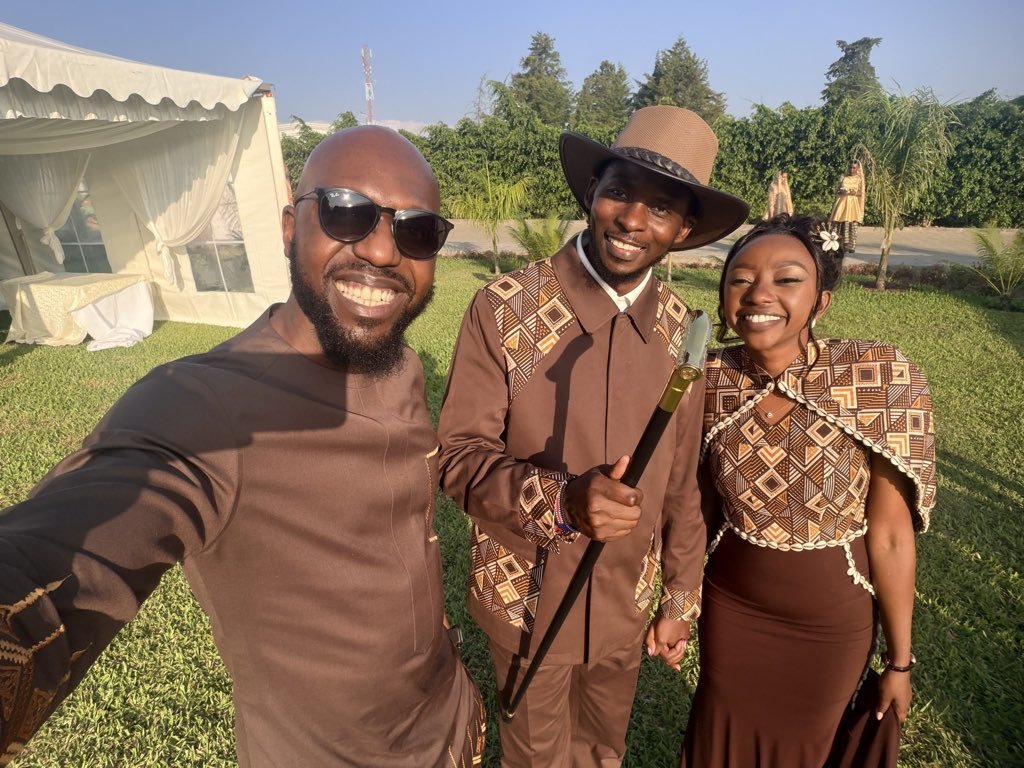
Madowo attended the traditional engagement ceremony of President Ruto’s daughter Charlene and Tanzanian entrepreneur Isaya Yunge in Kilgoris. Photographs of the journalist at the event immediately triggered a wave of criticism from sections of social media, with some people questioning how a journalist who has been outspoken on civic freedoms and government accountability could attend a family celebration associated with the President.
But why should attending a private family ceremony automatically invalidate a journalist’s professional record?
Why should a photograph at a social event become a political confession?
Why must every relationship with someone connected to power be interpreted as an endorsement of power?
That is an extraordinarily dangerous standard.
Journalists are human beings before they are journalists. They have families, friendships, schoolmates, professional networks and social relationships. They will inevitably encounter politicians, businesspeople, government officials and powerful families.
The journalist’s responsibility is not to avoid every person who holds power.
It is to remain capable of interrogating power.
There is a world of difference between attending somebody’s wedding, birthday, funeral, traditional engagement or family celebration and becoming their political propagandist.
The same principle applies to artists.
An artist who performs at a government function does not automatically become a government supporter. A journalist who interviews a president does not automatically become a presidential apologist. A lawyer who represents a government official does not necessarily endorse that official’s politics.
Democracy cannot operate on such simplistic mathematics.
Indeed, some of the loudest critics of governments have historically been capable of maintaining cordial personal relationships with the very people whose policies they opposed.
That is not hypocrisy.
Sometimes it is maturity.
The current reaction to Madowo illustrates a growing phenomenon in Kenya: political cancel culture.
Its logic is brutally simple.
If you oppose Ruto, you must not associate with Ruto.
If you attend an event involving his family, you are compromised.
If you perform at a State function, you have sold out.
If you interview a government official without confronting him aggressively enough, you are accused of being captured.
If you praise one government project, you must secretly support the entire administration.
If you criticize the opposition, you must have joined the government.
This is not democratic accountability.
It is tribalism of opinion.
And it is particularly dangerous because it creates political echo chambers in which people stop listening to anything that challenges their existing worldview.
We should be capable of holding two thoughts simultaneously:
Ruto’s government can be seriously criticized—and Larry Madowo can still attend Charlene Ruto’s engagement.
Both things can be true.
We can condemn police brutality and still acknowledge that the president has a right to have a family life.
We can oppose government policy and still congratulate a presidential daughter on her marriage.
We can demand accountability from State House without declaring every person who enters State House morally contaminated.
We can dislike Ruto’s politics without disliking Kenya.
That distinction is becoming increasingly important.
The President is not Kenya.
His family is not Kenya.
His supporters are not Kenya.
His critics are not Kenya.
Kenya belongs to all of us.
And that includes the people who voted for Ruto, those who voted against him, those who have changed their minds, those who remain undecided and those who simply want to get through the day without being dragged into another political shouting match.
There is also an uncomfortable irony here.
Many of those demanding ideological purity from journalists and public figures are themselves perfectly happy to engage politicians privately when it suits them. Politicians across the divide attend one another’s weddings, funerals, business functions and private celebrations. They shake hands today and trade accusations tomorrow.
Why should ordinary citizens be held to a higher standard of political hostility than politicians themselves?
Kenya’s democracy should be mature enough to accommodate disagreement without demanding hatred.
We should interrogate the government ruthlessly where necessary. We should expose corruption. We should challenge economic policies. We should defend the Constitution. We should demand justice for victims of state violence. We should scrutinize public expenditure. We should question the accumulation of unexplained wealth.
But we should also resist the temptation to manufacture villains out of people merely because they were photographed standing beside the wrong person.
That is not journalism.
It is not activism.
It is not patriotism.
And it certainly is not democracy.
President Ruto may ultimately be judged harshly or favourably by history. That judgement should be based on measurable outcomes: the state of the economy, jobs, public debt, corruption, healthcare, education, infrastructure, constitutional governance, human rights and the welfare of ordinary Kenyans.
It should not be based on who attended his daughter’s engagement ceremony.
Nor should the reputation of a journalist be determined by a photograph at a family event.
The fight for a better Kenya is too important to be reduced to social-media cancellation campaigns.
We should be angry when government fails.
We should be fearless when power abuses its authority.
But we should never become so consumed by our hatred of a politician that we lose sight of the country we claim to be fighting for.
Oppose Ruto if you must. Criticize him relentlessly if the evidence demands it. Vote him out if that is your democratic choice.
But love Kenya more than you hate her president.
That is the higher patriotic calling.
Lawrence Jeffrey
10th August, 2026
Siaya



