 ADVERT
 ADVERT
THE POLLSCAPE TRAP: Why Ruto Could Still Surprise His Nyanza Critics in 2027
The numbers are dramatic. Edwin Sifuna — 52 per cent. William Ruto — 37 per cent. Kalonzo Musyoka — 11 per cent.
The figures contained in a Pollscape-2026 graphic circulating online purport to represent the views of 3,298 respondents across Kisumu, Kisii, Nyamira, Siaya, Migori and Homa Bay. At first glance, the message appears unequivocal: Nyanza has already made up its mind, Sifuna is miles ahead and Ruto’s political prospects in the region are bleak.
But that conclusion may be premature.
The more important question is not whether the numbers are real. The arithmetic is straightforward: 1,716 votes for Sifuna, 1,220 for Ruto and 362 for Kalonzo add up to 3,298. The real question is: what exactly do those 3,298 votes represent?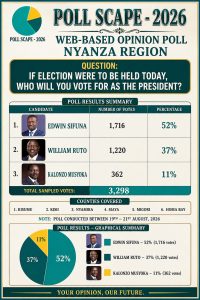
 ADVERT
That is where the Pollscape story becomes considerably more complicated.
A web-based poll can tell us what people who encountered the poll, chose to participate and successfully submitted their votes said. It does not automatically tell us what the entire Nyanza electorate thinks. And that distinction could prove enormously important as Kenya heads towards the 2027 General Election.
The greatest weakness of an open online poll is not necessarily manipulation. It is self-selection. People decide whether to participate. That means politically enthusiastic people may be more likely to vote than politically indifferent people. People who encounter the poll through a particular WhatsApp group, Facebook page, X account or political network may also be disproportionately represented.
A poll can therefore produce an extremely precise percentage from a sample that is fundamentally unrepresentative.
That is why serious polling requires more than simply accumulating responses. Researchers normally worry about sample selection, geographical distribution, demographics, weighting, screening, non-response and the precise population being measured.
So the Pollscape results should be treated as a political signal, not an electoral verdict.
That distinction is not intended to discredit Sifuna’s impressive showing. On the contrary, 1,716 people choosing him in an online exercise is politically interesting. It indicates substantial enthusiasm for his candidacy among the people reached by the poll.
But it does not prove that 52 per cent of all Nyanza voters would vote for him in a secret ballot tomorrow. There is a world of difference between the two.
The Pollscape graphic does not tell the public enough about how the 3,298 respondents were assembled. How many came from each county? How many were registered voters? How many were young people? How many were over 50? What proportion were urban and rural? Were duplicate votes prevented? How was the poll link distributed? Was the sample weighted? What was the margin of error? What was the response rate?
Without those answers, the 52 per cent figure cannot reasonably be presented as a scientific prediction of the 2027 Nyanza vote.
And there is another fundamental problem. Nyanza is not one voting constituency.
Kisumu is not Siaya. Siaya is not Homa Bay. Homa Bay is not Kisii. Kisii is not Migori. The political interests, personalities, local alliances and voting histories of those counties are different. Even within Siaya, political behaviour can vary significantly from one constituency or ward to another.
Reducing all of that complexity to a single regional percentage is convenient for headlines, but potentially misleading for serious political analysis.
This is where the Pollscape figures deserve a second look.
I am not predicting that William Ruto will win Siaya County. That would be a much bigger claim and one for which there is currently insufficient evidence.
My argument is more modest — and, I believe, more defensible: Ruto could substantially improve his vote tally in Siaya in 2027 compared with what his critics currently expect.
The reason is development.
For years, national politics in Siaya has been dominated by identity, history and opposition politics. But there is another reality developing on the ground: the national government is leaving a physical footprint in the county.
Consider the Ugunja-Sega-Ukwala Water Supply and Sanitation Project. The approximately Sh1 billion project was commissioned by President Ruto and is designed to supply reliable water to communities in Ugunja, Sega and Ukwala, with a capacity of millions of litres a day and a potential reach of tens of thousands of households.
For a political commentator, that may be a government programme.
For a household that has spent years searching for water, it is something entirely different.
It is a tap. It is time saved. It is water for children. It is water for a business. It is water for a school or health facility.
That is where politics becomes personal.
Then there is Sidindi.
The Sidindi Fresh Produce Market is another potentially important piece of the political puzzle. The modern-market concept goes beyond simply providing traders with stalls. It brings together trading space and supporting facilities intended to improve the commercial environment.
Again, whether the project ultimately delivers everything promised should be judged independently. But politically, there is a fundamental difference between a project that exists on a campaign manifesto and one that people can see being constructed or operating in their neighbourhood.
That distinction should not be underestimated.
In March 2026, Ruto launched the Siaya Community Digital Hub in Bondo. This may prove more politically significant than some traditional politicians realise.
Kenya’s political class often talks about young people as if their principal concern is ethnicity and political succession. Increasingly, however, young people are asking much more practical questions: Where is the job? Where is the internet? Where can I acquire digital skills? Where can I work online? Where can I start a business? Where can I access government services?
A digital hub does not solve Kenya’s unemployment problem. But it represents the kind of infrastructure that speaks directly to the aspirations of a younger electorate.
Then there’s the Nyota Program empowerment that drops money directly into the Mpesa accounts of a good number of youth.
The development list is much longer.
Ruto’s administration has also been associated with a growing portfolio of projects and proposals in Siaya involving roads, affordable housing, markets, electricity, health facilities, the blue economy and sports infrastructure.
Among the projects cited in the county are the Kodiaga-Rabango-Usenge road, Dhogoye Bridge works, planned tarmacking programmes, affordable housing units and hostels, the Ugunja modern market, the proposed Usenge Pier, fisheries infrastructure, electricity connections, health-facility upgrades and works around Jaramogi Oginga Odinga Stadium.
But this is where journalism must resist political propaganda from both sides.
A project announced is not necessarily a project completed. A groundbreaking ceremony is not a finished road. A budget allocation is not a functioning hospital. A promise is not delivery.
Some of these projects are completed, others are ongoing, while some remain at various stages of planning, procurement or implementation. They should therefore be judged individually rather than lumped together as a single “Ruto achievement.”
But the reverse is equally true.
An opposition analyst should not pretend that a government project has no political significance simply because the President remains unpopular.
It does.
This creates a fascinating political paradox. A voter can remain deeply dissatisfied with Ruto and still acknowledge that his government has brought a particular project to the county. A voter can dislike the President’s economic policies and still want the water project completed. A voter can remain loyal to the opposition while benefiting from a government market. A voter can admire an opposition leader while recognising that the government controls the resources necessary to implement major infrastructure projects.
This is precisely why voting behaviour cannot always be reduced to ideological loyalty.
And it is why the assumption that “Siaya is Luo and therefore automatically anti-Ruto” is too simplistic for serious 2027 analysis.
There is another uncomfortable truth that political commentators sometimes prefer to avoid.
Kenyan elections are not consistently won by whoever presents the best manifesto.
If they were, political campaigns would look very different.
Voters are influenced by identity, personality, history, party loyalty, local alliances, development, candidate networks, campaign machinery, ethnicity, economic interests and, yes, money.
Research into Kenyan elections has repeatedly demonstrated the significance of vote buying and material inducements.
That does not mean every Kenyan voter can be bought. Nor does it mean money guarantees victory.
It means that resources matter in an electoral contest.
And this is where the presidency carries an enormous structural advantage.
An opposition candidate can promise a road. An incumbent can point to one under construction.
An opposition candidate can promise a market. An incumbent can attend its groundbreaking.
An opposition candidate can promise water. An incumbent can say: “We have already commissioned the project.”
That does not mean the incumbent automatically wins. But it creates a powerful political advantage.
The incumbent possesses the machinery, visibility and resources of government. And Kenyan politics has traditionally rewarded candidates who can demonstrate access to resources.
This is why the simplistic argument that Kenyans vote purely according to “good policies” is difficult to sustain.
Sometimes voters vote for policies. Sometimes they vote for personalities. Sometimes they vote for communities. Sometimes they vote for change. Sometimes they vote for whoever they believe has the strongest capacity to deliver.
And sometimes they take the campaign money and still vote however they please.
The secret ballot makes that final calculation impossible to control.
This is why Sifuna’s 52 per cent should not frighten Ruto — yet.
Sifuna’s Pollscape performance should certainly concern the Ruto camp. A 15-point reported lead is politically significant. But it should not be mistaken for a 15-point lead over the entire Nyanza electorate.
That would require a scientifically representative survey demonstrating the same conclusion.
Until then, the Pollscape result is best understood as evidence of online political sentiment within the population reached by the poll.
And that sentiment could change dramatically before 2027.
The opposition still has to settle on its presidential candidate. It has to build a coalition. It has to decide how to distribute resources. It has to mobilise voters. It has to overcome internal competition. And it has to convince voters that its promises are more credible than what the incumbent government can demonstrate.
That is a much harder task than winning an online poll.
The most important point is that Ruto does not necessarily need Nyanza to become a pro-Ruto region.
He only needs to reduce the size of his defeat.
If an area where the incumbent previously suffered overwhelming losses shifts even moderately, the national arithmetic changes.
That is how elections are won.
Not necessarily through dramatic political conversions, but through marginal movements multiplied across millions of votes.
For Ruto, therefore, the realistic objective in Siaya may not be to transform the county into a UDA stronghold. It may simply be to persuade enough voters that voting against him is no longer automatic.
And development provides precisely the opening through which that argument can be made.
There is, however, a danger in making the opposite mistake.
It would be equally naïve to assume that roads, markets, water and digital hubs will automatically buy Ruto votes.
Kenyans have repeatedly demonstrated that they can accept government services and still vote against the government that delivered them.
Development is not a voting receipt.
The secret ballot remains the great equaliser.
A voter who receives water does not sign a contract to vote for Ruto. A trader occupying a government-built market does not surrender political choice. A young person trained at a digital hub does not become a government supporter by default.
The projects create an opportunity for Ruto.
They do not guarantee him the votes.
That is why the Pollscape graphic should be neither mocked nor worshipped.
It is a snapshot. It is a conversation starter. It may accurately capture a powerful mood among its respondents.
But it is not the election.
The election will be determined by millions of Kenyans who will vote according to calculations that no app can completely capture.
And in Siaya, one of those calculations may increasingly be: “Yes, I have always voted this way. But what has this government actually done for me?”
That is the question Ruto’s critics should not ignore.
The President has a difficult mountain to climb in Nyanza. His political baggage in the region is enormous, and opposition sentiment remains strong.
But he has something previous presidents did not necessarily possess in the same political environment: a growing catalogue of highly visible government projects that can be taken directly into the political conversation.
Whether those projects are enough to overcome decades of political loyalty remains to be seen.
But dismissing their impact before the votes are counted would be a mistake.
Pollscape may be right about its respondents. It may even be right about the mood of a section of Nyanza. But it cannot, by itself, tell us what Nyanza will do in 2027.
And those declaring Ruto politically finished in Siaya should remember one uncomfortable fact about Kenyan elections: the candidate with the best policy document does not always win. The candidate with the biggest purse does not always win either. But the politician who combines money, machinery, coalition-building, visible development and an effective ground operation can be extraordinarily difficult to defeat.
Ruto has the purse and the machinery.
His challenge is to convert them into trust and votes.
And Siaya may be one of the places where that conversion, however modest, could surprise his critics.



