 ADVERT
 ADVERT
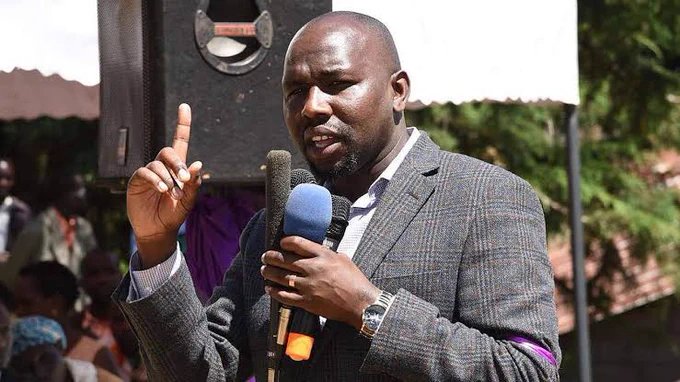
Interior Cabinet Secretary Kipchumba Murkomen has dramatically escalated Kenya’s political war over alleged goon networks, turning the spotlight on Siaya Governor James Orengo and warning that an International Criminal Court investigation into political violence could place the veteran politician in the dock.
“If we call the ICC, Orengo would be hanged even before the case is heard,” Murkomen declared on Friday, accusing Orengo of working with what he described as some of the “worst goons in the country.”
The extraordinary remarks came against the backdrop of the violent disruption of the Linda Mwananchi political tour in Homa Bay, an incident that has exposed the increasingly dangerous fault lines emerging as Kenya edges towards the 2027 General Election.
Murkomen accused Orengo and Embakasi East MP Babu Owino of mobilizing youths from Nairobi to Homa Bay, claiming that some were intercepted by the Directorate of Criminal Investigations while travelling towards the county. Others, he alleged, managed to enter Homa Bay after accompanying Orengo.
The Interior CS went further, accusing the political leaders of creating a crisis and then attempting to blame the security establishment for failing to contain it.
 ADVERT
His intervention has effectively transformed the Homa Bay violence from a local political confrontation into a national political-security battle, with the country’s security chief directly trading accusations with one of Nyanza’s most experienced political figures.
Orengo, a lawyer and veteran political activist who has spent decades at the centre of Kenya’s turbulent political history, has himself accused the police of failing to protect the Linda Mwananchi convoy. During the August 16 confrontation in Ndhiwa, he claimed security officers had surrendered their authority to goons and vowed that the political movement would not be intimidated.
The competing narratives could hardly be more different.
To Orengo and his allies, the Homa Bay violence represents evidence of a growing culture of political intolerance in which organized groups are being deployed to prevent rival political formations from holding rallies.
To Murkomen, the narrative has been turned upside down: he maintains that some opposition politicians are themselves responsible for mobilizing youths and then attempting to portray the government as the architect of the violence.
That contradiction is now at the heart of Kenya’s political debate.
And it raises a question that is considerably more important than the latest exchange of political insults: who actually organized the violence in Homa Bay?
There is already evidence that the confrontation involved armed youths. Police previously announced arrests and the recovery of weapons, including machetes and a knife, from suspects travelling towards areas where political meetings were expected. Journalists were also injured during the disturbances, while vehicles and other property were damaged.
But establishing the identity of people involved in street violence is only the beginning.
The real question is who recruited them, who transported them, who paid them and who gave them instructions.
That is where Murkomen’s allegations become particularly serious.
If the Interior Ministry has intelligence linking senior political figures to organized mobilisation of violent youths, Kenyans deserve to know what that evidence says. And if those allegations cannot withstand scrutiny, then the same ministry has an obligation to say so and protect those being accused from trial by political declaration.
The same standard should apply to allegations directed at the government.
Claims that the State sponsors or tolerates political goons are equally grave. They cannot be established merely through political speeches, social-media posts or competing press conferences.
They require evidence.
This is why the invocation of the ICC has added another explosive dimension to an already volatile political dispute.
Kenya’s relationship with the Hague is deeply rooted in the country’s painful history of post-election violence. The ICC proceedings following the 2007-08 crisis left an enduring political and psychological imprint on the country and established the international court as one of the most powerful symbols in Kenya’s political vocabulary.
But the ICC is not a political referee to be summoned whenever Kenyan politicians disagree.
Nor can an allegation that a politician works with goons automatically translate into an international criminal case.
The threshold for international criminal responsibility is far higher than political accusation.
That makes Murkomen’s choice of language particularly striking. Saying that Orengo would be “hanged even before the case is heard” is politically explosive because it appears to pronounce a verdict before any investigation, prosecution or trial.
For a Cabinet Secretary responsible for national security and public order, the language inevitably carries more weight than an ordinary campaign-rally insult.
Yet beneath the rhetoric lies a legitimate national concern.
Kenya cannot afford a return to the era when political competition was accompanied by organized gangs, hired youths and violence. The country’s political class should have learnt from 2007 that the price of weaponizing young people for political purposes can ultimately be paid by the entire nation.
The danger today is that the same cycle could return in a different form.
Young, unemployed and politically impressionable people are easy targets for mobilisation. Political financiers can provide money, transport and instructions, while the politicians who benefit from the violence can later distance themselves from the consequences.
That is why the Homa Bay confrontation should not simply disappear into the political news cycle.
It deserves a serious, independent investigation.
If Murkomen is right, the public should know who allegedly mobilized youths from Nairobi, Kisumu and Siaya, how they travelled, who financed them and what instructions they received.
If Orengo and Linda Mwananchi are right, the public deserves to know who organized the groups that attacked their convoy, why they were able to operate in the presence of security officers and whether anyone in authority deliberately failed to intervene.
Both versions cannot simultaneously be true.
But both can be investigated.
And that is precisely what Kenya needs.
The danger is that politicians will continue escalating their accusations while the young men at the centre of the violence become convenient foot soldiers and the masterminds remain unidentified.
Murkomen has thrown down the gauntlet to Orengo.
He has effectively said that if the ICC is brought into the political violence debate, the Siaya governor should not assume that the spotlight will fall exclusively on the government.
Orengo, in turn, has every reason to demand that the allegations against him be tested through evidence rather than political rhetoric.
That is where the matter should go.
Not to the microphone.
Not to social media.
Not to political vengeance.
But to the evidence room, the investigators and, where necessary, the courts.
Kenya has been down this road before.
The country’s political leaders should know better than to turn the spectre of violence and the ICC into campaign ammunition.
Because beneath Murkomen’s sensational “hanged” remark lies a much more sobering question for the country: who is really sponsoring the goons, and who will have the courage to expose them before Kenya’s 2027 political contest turns violent?



