 ADVERT
 ADVERT
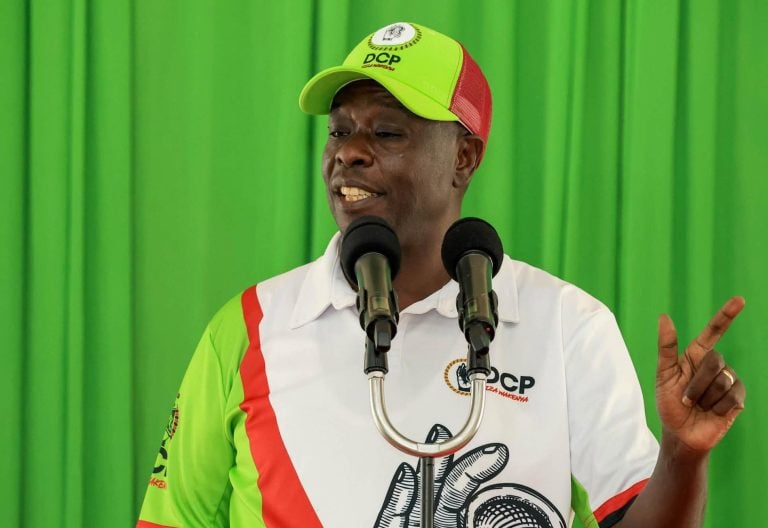
Former Deputy President Rigathi Gachagua has thrown Kenya’s opposition politics into fresh turmoil after unequivocally declaring that he will run for President in 2027, complicating the delicate race for the opposition ticket and jolting the political calculations of Wiper leader Kalonzo Musyoka and Nairobi Senator Edwin Sifuna.
Gachagua’s declaration came after the conclusion of his high-profile 55-day political conclave at his Wamunyoro home in Nyeri, an exercise that had been billed as an effort to consult Kenyans and help chart a strategy for uniting the opposition ahead of next year’s General Election.
But instead of emerging solely as a kingmaker, Gachagua has now positioned himself firmly among the politicians seeking to become Kenya’s fifth president.
The Democracy for Citizens Party leader made it clear that his political ambitions go beyond helping another opposition leader defeat President William Ruto.
“I will be running for President,” Gachagua declared, effectively ending months of speculation over whether he would seek the top seat or throw his weight behind another candidate.
 ADVERT
The declaration represents a significant shift in the opposition equation. Gachagua had repeatedly maintained that the opposition must eventually settle on a single presidential candidate capable of defeating Ruto, while leaving open the question of who that candidate should be.
His latest position makes the answer considerably more complicated.
The former deputy president has spent the past two months turning Wamunyoro into a political command centre, receiving delegations of politicians, professionals, religious leaders, grassroots representatives and ordinary Kenyans as he sought to gauge the national mood ahead of 2027.
The conclave, initially announced as a 45-day exercise, stretched to 55 days and became one of the most closely watched political mobilisation programmes ahead of the election.
Gachagua now says he is ready to take the political conversation beyond his traditional Mount Kenya base, with planned visits to Nyanza, Western and Coast regions. He has already announced plans to tour Siaya, Kisumu, Homa Bay and Migori as he seeks to build a broader national coalition.
That outreach could prove crucial.
For years, Gachagua’s political strength has been closely associated with the Mount Kenya region. His latest strategy, however, suggests an attempt to transform that regional influence into a national presidential movement.
His message to Nyanza is particularly significant given the region’s historical importance in presidential contests and the increasingly fluid alliances forming ahead of 2027.
Gachagua has also sought to neutralise attempts to portray his political project as hostile to the Luo community, insisting that his relationships with prominent Luo leaders stretch back decades.
His planned Nyanza tour therefore carries both political and symbolic significance as he attempts to demonstrate that his presidential ambitions extend beyond the mountain.
But the biggest political impact of his declaration could be felt within the opposition camp itself.
Kalonzo has long presented himself as a serious contender for the presidency and remains one of the most experienced politicians in the opposition. Sifuna, meanwhile, has emerged as an increasingly influential voice among younger opposition supporters, with calls growing for him to be considered for the top position.
The emergence of Gachagua as an outright presidential contender adds another formidable name to an already crowded field that includes former Interior Cabinet Secretary Fred Matiang’i and other opposition figures.
The challenge is obvious: the opposition has repeatedly insisted that it must avoid splitting its vote and eventually field one candidate against Ruto. Yet virtually every major faction has a politician with presidential ambitions.
Gachagua’s own message appears to acknowledge the dilemma.
He has maintained that if he is not selected as the opposition’s flagbearer, he will support whoever is chosen and remain committed to the broader mission of removing Ruto from office.
That pledge could become one of the most important tests of opposition unity in the months ahead.
For now, however, Gachagua is making it clear that he wants to be considered on merit rather than automatically relegated to the role of kingmaker.
Indeed, his political language has become increasingly assertive. Rather than describing himself as a broker between competing opposition camps, he has sought to present himself as a potential national leader with a political constituency capable of delivering millions of votes.
His DCP party has simultaneously been expanding its footprint in Mount Kenya, attracting elected leaders and political figures who previously operated within President Ruto’s Kenya Kwanza establishment.
That growing organisational base gives Gachagua something many presidential aspirants lack: a party structure already capable of mobilising voters in a politically decisive region.
The real battle now is whether he can convert that regional strength into a sufficiently broad national coalition.
That is where Kalonzo, Sifuna and Matiang’i become critical players.
Kalonzo brings decades of national political experience and a substantial Eastern Kenya base. Sifuna offers a younger generation of voters and a prominent presence in Nairobi and the wider opposition movement. Matiang’i carries a formidable reputation from his years in government and strong political networks, particularly in parts of the western and Nyanza regions.
Gachagua, meanwhile, brings the Mount Kenya vote, a rapidly expanding party network and a personal political narrative shaped by his dramatic fall from the Deputy Presidency.
The contest is therefore not simply about who can defeat Ruto. It is increasingly about who can persuade the opposition’s competing constituencies that he or she has the strongest claim to lead the country after the 2027 election.
For President Ruto, the developments offer both danger and opportunity.
A united opposition under one popular candidate could present his toughest electoral challenge yet. But a crowded opposition field, with several leaders unwilling to surrender their presidential ambitions, could fracture the anti-Ruto vote and make the incumbent’s path to a second term easier.
That is why Gachagua’s declaration is more than another campaign announcement.
It is a warning that the opposition’s much-discussed unity formula will face its hardest test yet.
The political question has moved from whether Gachagua intends to run to whether he can convince Kalonzo, Sifuna, Matiang’i and the other opposition principals that he is the man capable of carrying their coalition to State House.
With the 2027 presidential race rapidly taking shape, one thing is becoming increasingly clear: the battle against Ruto may be only half the opposition’s challenge.
The other half is deciding who among its own heavyweights gets to lead the charge.



