 ADVERT
 ADVERT
East Africa’s smallholder farmers and rural businesses are set to gain access to a major new source of climate adaptation finance following the launch of a US$200 million mechanism designed to help them withstand increasingly unpredictable weather and protect their livelihoods.
The International Fund for Agricultural Development (IFAD) and Equity Group have launched the Africa Rural Climate Adaptation Finance Mechanism (ARCAFIM), a 12-year blended-finance programme targeting farmers and rural enterprises in Kenya, Uganda, Tanzania and Rwanda.
The initiative seeks to reach approximately 260,000 smallholder producers and 500 rural micro, small and medium-sized enterprises, with women accounting for at least half of the intended beneficiaries and young people representing 30 per cent.
The programme comes at a time when climate change is putting unprecedented pressure on Africa’s food systems, with droughts, floods, erratic rainfall and rising temperatures increasingly threatening agricultural production, livestock and rural incomes.
Yet while billions of dollars are being committed globally to climate action, much of the financing has struggled to reach the farmers and rural businesses facing the consequences of climate change on the ground.
 ADVERT
ARCAFIM is designed to close that gap by combining concessional public and development finance with commercial capital and technical expertise, creating a financing model intended to make climate adaptation a sustainable business rather than a temporary development intervention.
The mechanism comprises US$180 million in lending capital and approximately US$20 million in technical assistance. Because the lending capital is expected to revolve through roughly four investment cycles, it could generate about US$266 million in loans to smallholder farmers and rural businesses across East Africa’s food systems.
A defining feature of the initiative is Equity Group’s decision to put its own balance sheet behind the programme. Of the US$180 million lending base, US$90 million will come from Equity Group, matching concessional capital on a one-for-one basis.
The financing structure also distributes credit risk across participating partners. International financing institutions will provide first-loss protection, while a mezzanine layer will be shared with the bank and Equity will carry the senior risk.
The arrangement is designed to encourage commercial financial institutions to lend to rural borrowers while reducing some of the risks that have traditionally made agricultural and climate-related lending difficult.
The programme will finance investments capable of helping farmers and agricultural businesses adapt to changing climatic conditions. These include irrigation and water harvesting, climate-resilient dairy and livestock production, post-harvest storage, renewable energy and climate-resilient agro-processing.
Technical assistance will form an integral part of the financing architecture. Participating microfinance institutions and SACCOs will receive support to develop the capacity to originate climate-adaptation loans, while farmers and rural enterprises will be equipped with knowledge to identify investments that can deliver meaningful protection against climate shocks.
The programme is expected to strengthen food security for approximately 1.2 million people and benefit an estimated 1.5 million people directly and indirectly.
IFAD Vice President Dr Gérardine Mukeshimana said the success of climate adaptation finance would ultimately be measured by its ability to translate global commitments into tangible investments in rural communities.
She said ARCAFIM was designed to make rural climate adaptation a recognisable, viable and sustainable business line for African financial institutions by equipping them with appropriate financial products, systems and knowledge.
The model, she said, would begin in East Africa but could eventually be adapted and replicated elsewhere on the continent.
Equity Group Managing Director and Chief Executive Officer Dr James Mwangi said the initiative represented a fundamental shift in how the financial sector should view Africa’s smallholder farmers.
He argued that farmers were entrepreneurs operating in some of the world’s most challenging risk environments, but had historically lacked financial systems capable of backing their businesses.
By committing its own capital alongside concessional financing, Equity is betting that climate resilience can become a viable commercial lending market rather than remain dependent on grants and development assistance.
Equity Bank Kenya Managing Director Moses Nyabanda said the bank would finance smallholder farmers and agricultural producers directly and through microfinance institutions, SACCOs and value-chain companies, while also extending credit to rural MSMEs.
The financing is expected to help farmers and agricultural businesses adapt, increase production, grow revenues and incomes and build resilience against climate-related shocks.
The Green Climate Fund, which has committed US$55 million to the programme, described ARCAFIM as an example of how catalytic climate finance can bring public and private capital together to expand investment in climate-resilient agriculture.
The programme is being convened with co-financiers including the Green Climate Fund, Finland’s Ministry for Foreign Affairs and the Nordic Development Fund, alongside co-financing from the Government of Denmark and the European Union.
Finland has emphasised the importance of using public-private partnerships to unlock capital for sustainable investments, arguing that strengthening agricultural resilience can simultaneously improve productivity and incomes while reducing risks associated with rural lending.
Nordic Development Fund Managing Director Satu Santala said the fund had supported ARCAFIM from its inception because of the importance of mechanisms capable of unlocking greater investment in climate adaptation.
The launch brought together representatives of IFAD and financing institutions, government officials from Kenya, Uganda, Tanzania and Rwanda, private-sector investors, development partners and climate-finance institutions.
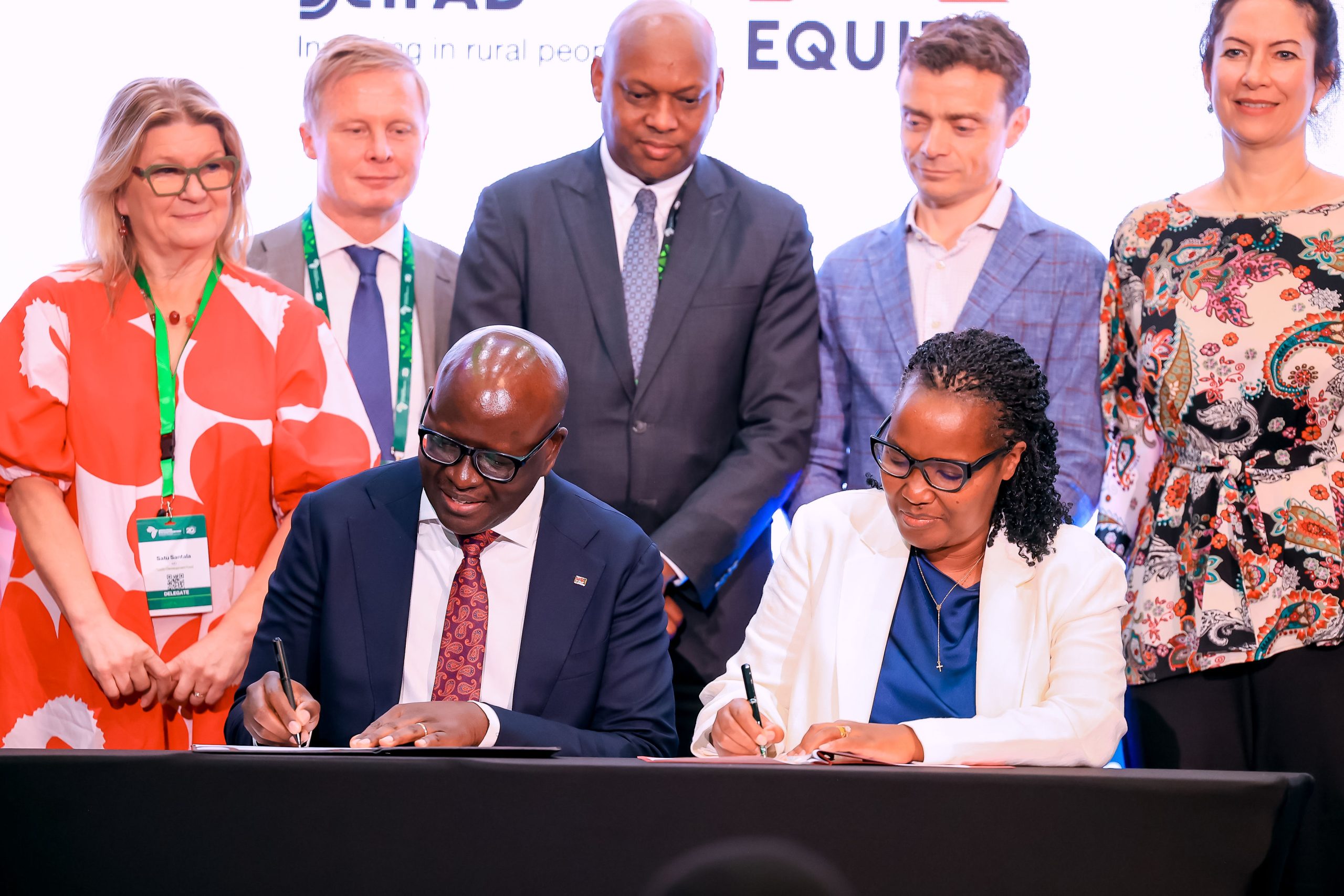
The agreements were signed by Dr Mukeshimana on behalf of IFAD and Moses Nyabanda for Equity Bank Kenya in a ceremony presided over by Hannington Namara, Managing Director of Equity Bank Rwanda.
For the architects of ARCAFIM, however, the biggest measure of success will not simply be the amount of money disbursed or the number of farmers reached.
Its real test will be whether climate adaptation lending survives after concessional capital has been deployed and becomes an ordinary, commercially sustainable business line for African financial institutions. 
That ambition gives the initiative significance beyond its immediate four-country footprint.
IFAD and Equity Group have identified Southern and West Africa as potential next regions for replication, raising the possibility that lessons from East Africa could help shape a new generation of climate-finance mechanisms across the continent.
If successful, ARCAFIM could demonstrate that climate resilience does not have to be treated solely as a development expense. With the right risk-sharing structures, technical support and commercial incentives, it can become an investable opportunity.
For millions of African farmers facing an increasingly uncertain climate, that could mark a crucial shift—from waiting for relief after a climate shock to accessing finance that enables them to prepare for it in advance.



