 ADVERT
 ADVERT
There is a difficult question Kenya must confront without fear, prejudice or political convenience: how did a once relatively modest Somali presence in Nairobi evolve into one of the country’s most powerful commercial, political and security networks—and what does that history tell us about the dangerous treatment of other immigrant communities today?
The question is legitimate.
But some of the popular history surrounding it is not.
The Somali story in Kenya did not begin in the late 1970s with a few hundred starving refugees arriving in Eastleigh. Somali communities have deep roots in what is now Kenya, particularly in the former Northern Frontier District, and there was already a Somali presence in Eastleigh during the colonial period and the early years of independence. Historical research shows that Somalis were involved in Nairobi’s trading networks long before the massive refugee movements of the 1990s.
The distinction is important because Kenya has long had two overlapping Somali stories: Kenyan Somalis who are citizens by birth and belong to communities indigenous to Kenya, and Somalis from Somalia who arrived principally through successive waves of migration, trade and displacement.
 ADVERT
Confusing the two has fuelled some of Kenya’s worst security and citizenship debates.
The Shifta War of the 1960s left a deep scar. The conflict pitted the Kenyan state against Somali separatists seeking to join the Northern Frontier District with Somalia. Its legacy was suspicion of Kenyan Somalis, many of whom were subsequently treated through the prism of security rather than citizenship.
Then came another turning point.
On August 1, 1982, Kenya was shaken by an attempted military coup. Major-General Mohamud Mohamed, a Kenyan Somali and senior military commander, played a central role in the operation that suppressed the rebellion. Historical accounts and academic research identify the coup as an important turning point in the relationship between the Moi administration and sections of the Somali community.
This is where the narrative becomes politically interesting.
The popular version is that President Daniel arap Moi subsequently transformed Somalis into the regime’s “blue-eyed boys”, filling the intelligence and security establishment with them. There is evidence of increased Somali representation and political incorporation, but sweeping claims that Somalis constituted half of the country’s intelligence personnel are difficult to substantiate and should not be presented as established fact.
Indeed, available public-sector representation data tell a more complicated story. A parliamentary report using 2019 census figures recorded Kenyan Somalis at 5.85 per cent of the population but only 2.74 per cent of the public service, classifying them as grossly under-represented.
That does not fit neatly into the mythology of a Somali takeover of the Kenyan security state.
But neither should it obscure the political significance of the relationship that developed after 1982.
Moi’s government increasingly relied on individuals and networks it considered dependable. Somali officers rose through the military and security structures, while political patronage helped reshape the fortunes of sections of the community.
At the same time, Somalia itself was collapsing.
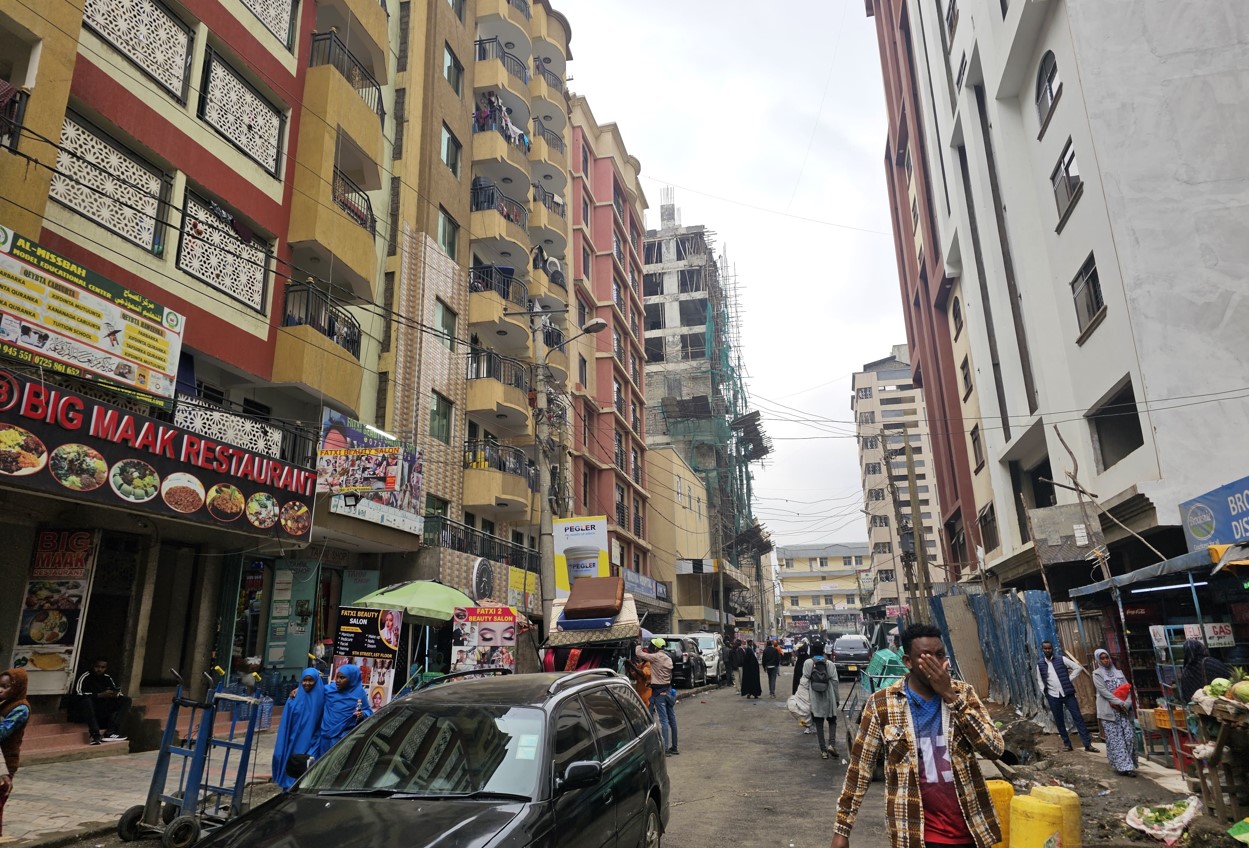
The late 1980s and early 1990s brought civil war, state collapse and mass displacement. Thousands of Somalis crossed into Kenya. Many eventually moved beyond refugee camps and into Nairobi, with Eastleigh becoming their commercial and social centre. Academic research describes this period as fundamental to the transformation of Eastleigh from a relatively quiet residential neighbourhood into a major regional commercial hub.
This was not simply a story of refugees receiving government favours.
It was a story of entrepreneurship.
Family networks, diaspora remittances, informal finance, cross-border trade and an extraordinary appetite for commerce combined to create an economic ecosystem that few other communities have replicated at the same scale.
Eastleigh became the most visible expression of that transformation.
Garissa Lodge and other early trading centres evolved into wholesale and retail enterprises. Buildings were converted from residential to commercial use. Shopping centres multiplied. Money from Kenya, Somalia and the wider diaspora flowed into property and trade.
Today Eastleigh is not merely a Somali neighbourhood. It is one of Nairobi’s most important commercial districts and serves customers from virtually every part of Kenya and the wider region. Local reporting has estimated that the district contributes a substantial share of Nairobi’s tax collection, although such figures should be independently verified before being treated as definitive.
This success should be celebrated rather than resented.
But it also creates legitimate questions.
How much capital circulates through the sector? How much is formally declared? How effective are tax, customs and anti-money-laundering controls? How much cross-border trade is properly documented? What is the nationality of the beneficial owners of major properties? How much of the economic activity belongs to Kenyan citizens and how much to foreign nationals?
These are questions for auditors, investigators, regulators and journalists—not mobs.
The same principle applies to the much-repeated allegation that Somali piracy financed Eastleigh’s property boom.
There were certainly contemporary reports alleging that ransom money found its way into Kenya and that Eastleigh’s property market benefited. NPR reported such claims in 2010, while The EastAfrican subsequently highlighted serious doubts about the scale of piracy money entering Nairobi’s property market. One analysis noted that total pirate ransoms at the time were insufficient to explain the scale of Nairobi’s property boom.
That distinction matters.
There may have been illicit money in Kenya. There may have been individual cases of money laundering. There may have been criminal networks.
But there is no journalistic justification for converting allegations about some individuals into an indictment of an entire ethnic community.
The same standard must now be applied to Kenya’s unfolding controversy over foreign traders.
President William Ruto’s administration has ordered measures aimed at regulating undocumented foreign traders and enforcing requirements governing small-scale commerce. The government says the policy is about documentation, local economic participation and protection of vulnerable Kenyan businesses—not ethnic discrimination. The Kenya News Agency reported on Tuesday that the government was clarifying the directive and emphasising that foreign residents would be protected while their documentation is regularised.
Yet the consequences have already become deeply troubling.
Burundians in Nairobi have reportedly sought assistance and travel documents amid fears generated by the crackdown. Burundi’s Foreign Minister Édouard Bizimana has accused Kenya of allowing xenophobic sentiment and demanded protection for Burundian nationals.
Reuters reported that hundreds of Burundians were seeking travel documents to leave Kenya despite the 90-day amnesty announced for undocumented East Africans, with some saying they no longer felt safe. The Kenyan government has insisted that xenophobic violence will not be tolerated.
That is where Kenya’s moral test begins.
If Kenya demands documentation from a Burundian trader, it must demand documentation—not blood.
If a Congolese businessman has no work permit, enforce the law.
If a Ugandan trader violates licensing requirements, enforce the law.
If a Kenyan businessperson employs undocumented foreigners, prosecute the offence.
If a Somali businessman evades tax, investigate him.
If a Kenyan businessman does exactly the same thing, investigate him too.
But when enforcement becomes collective punishment based on nationality, religion, language, dress or appearance, the republic crosses a very dangerous line.
Kenya’s Constitution is unequivocal. Article 27 guarantees every person equality before the law and equal protection, while prohibiting discrimination on grounds including ethnic or social origin, religion, culture, language and birth. Article 28 protects human dignity, while Article 29 protects every person against violence and cruel, inhuman or degrading treatment.
There is therefore nothing contradictory about demanding that Kenya’s immigration and business laws be enforced while simultaneously demanding that foreigners be protected from mobs.
The two principles reinforce each other.
And this is where the Eastleigh question becomes uncomfortable.
If Somali Kenyans—many of whose families have lived within Kenya’s borders for generations—can rise from a historically marginalised community into prominent positions in commerce, the military, intelligence, politics and professional life, then Kenya should regard that as evidence of what citizenship can accomplish.
It should not become a reason to manufacture ethnic suspicion.
Nor should Somali success be used to deny legitimate questions about criminality, illicit finance, immigration or security.
A prosperous community is not automatically innocent.
Neither is a struggling immigrant community automatically guilty.
The appropriate response is investigation.
If there are claims that criminal networks operate across the Kenya-Somalia border, investigate them.
If intelligence agencies have information about arms trafficking, prosecute those responsible.
If foreign nationals operate businesses without permits, regularise or remove them according to law.
If Kenyan citizens use ethnic networks to facilitate crime, arrest them.
If money laundering occurs through hawala, banks, real estate or businesses, follow the money.
And if police officers, politicians or officials protect criminals because of political connections, expose them.
But do not turn the investigation into a hunt for an ethnicity.
The danger is particularly acute because Kenya’s history demonstrates how easily security concerns can become ethnic suspicion.
The country once viewed Kenyan Somalis largely through the prism of the Shifta War. Later, terrorism placed Somali communities under renewed suspicion. Security operations sometimes blurred the distinction between Kenyan citizens, refugees, migrants and suspected criminals.
That is precisely the mistake Kenya must not repeat.
The question posed by the killing of Burundians is therefore bigger than Burundi.
And the question posed by attacks on Christians in Eastleigh is bigger than Christianity.
If a Burundian can be killed because he is Burundian today, a Somali can be targeted tomorrow because he looks Somali. A Christian can be attacked because of his faith today; a Muslim can become the target tomorrow.
A republic cannot survive such arithmetic.
Nor should Kenya pretend that economic competition does not exist. Small Kenyan traders have genuine grievances. They face taxation, inflation, expensive credit, unemployment and competition from businesses owned by foreigners. Their frustrations deserve policy responses.
But the answer cannot be vigilantism.
The State must decide what economic activities are reserved for citizens, what foreigners may legally undertake, what permits they require and how those rules are enforced. Parliament must legislate clearly. Regulators must act transparently. Immigration authorities must maintain credible records. Revenue authorities must follow the money.
And the police must protect everybody.
That includes the Somali shopkeeper.
The Burundian trader.
The Congolese entrepreneur.
The Ugandan worker.
The Kenyan hawker.
The Christian worshipper.
The Muslim family.
And every other person who is lawfully present in Kenya.
Kenya’s Somali community has travelled an extraordinary distance—from a community shaped by marginalisation, insecurity and displacement to a formidable economic and professional force.
But the community’s remarkable rise should not be romanticised either.
Its successes deserve examination.
Its wealth deserves taxation where applicable.
Its businesses deserve regulation.
Its political influence deserves scrutiny.
Its security connections deserve transparency.
And where individuals commit crimes, they should face the law.
The same must be true of every other Kenyan and every foreign national.
That is the meaning of equality before the law.
The real scandal would not be that Somalis have become powerful.
The real scandal would be if Kenya allowed power, wealth, ethnicity or political connections to determine who receives justice—and who receives protection from it.
Eastleigh’s story should therefore not be written as a story of Somali conquest.
It should be understood as one chapter in Kenya’s complicated history of migration, citizenship, commerce, insecurity, political patronage and remarkable entrepreneurial resilience.
And the lesson from the present crisis is brutally simple:
Kenya can regulate foreigners without hating them. It can defend Kenyan businesses without persecuting immigrants. It can investigate Somali networks without demonising Somalis. It can fight crime without criminalising communities.
A country that cannot make those distinctions is not strengthening national security.
It is weakening the very idea of the republic.
Lawrence Jeffrey
8th September, 2026
Editorial



