 ADVERT
 ADVERT
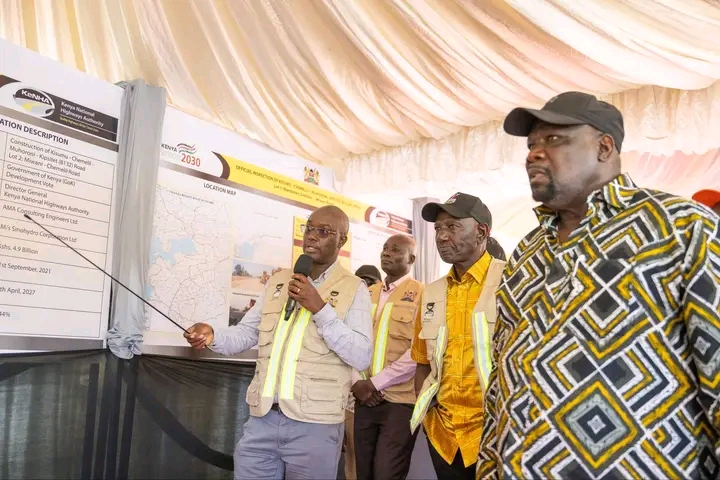
The inspection by President William Ruto of the ongoing works on the Chemelil–Muhoroni Junction Road offers a timely reminder of a simple but often underestimated reality: roads are not merely stretches of tarmac; they are the arteries through which economies, communities and opportunities move.
The road, forming part of the wider Kisumu–Chemelil–Muhoroni–Kipsitet road upgrade, carries significance far beyond the immediate construction works. Its completion has the potential to reshape movement between Kisumu and Kericho counties, strengthen agricultural value chains, expand market access and improve the everyday connection between people and essential services.
For a region whose economic fortunes are closely tied to agriculture, commerce and increasingly diversified enterprise, dependable transport infrastructure is not a luxury. It is an economic necessity.
Connecting producers to markets
Kisumu is an important commercial hub, while Kericho and the surrounding areas have a powerful agricultural base. Between these two economic ecosystems lies a network of farmers, traders, processors, workers, consumers and businesses whose success depends, in part, on how efficiently they can move.
 ADVERT
That is why the Chemelil–Muhoroni corridor matters.
A good road reduces the friction between production and consumption. It can lower transport costs, improve reliability and reduce the time required to move agricultural produce from farms to markets and processing centres.
For smallholder farmers, this can make a meaningful difference.
Agricultural production does not end at the farm gate. Farmers need roads to get inputs to their farms and produce to buyers. Processors need reliable access to raw materials. Traders need predictable transport schedules. Consumers need goods to reach markets efficiently.
When roads fail, these relationships become expensive and unpredictable. When roads work, economic activity becomes more efficient.
Infrastructure that can unlock investment
The economic value of the road will ultimately be measured not only by the vehicles that travel on it but also by the economic activity that develops around it.
Reliable connectivity can make communities more attractive to investors and entrepreneurs. Businesses are more likely to establish or expand operations where raw materials, employees, customers and finished products can be moved efficiently.
This is particularly important for agricultural value addition.
Kenya cannot sustainably transform its agricultural economy by concentrating solely on production. Farmers need access to storage, processing, packaging and larger markets. Those facilities, in turn, require dependable infrastructure.
A better road between Kisumu and Kericho can therefore become part of a much larger economic chain—linking rural production to processing, manufacturing, wholesale and retail markets.
A road is also a social investment
The significance of the project extends beyond commerce.
Roads determine how easily people access schools, hospitals, workplaces, markets, government offices and other essential services. They influence how families interact and how communities participate in the wider economy.
For patients requiring specialised medical attention, reliable transport can mean the difference between a manageable journey and a potentially dangerous delay.
For students and teachers, better connectivity can improve access to learning institutions.
For workers, it can expand the geographical area within which they can seek employment.
For families and communities, it makes social interaction easier.
In this sense, a road is simultaneously an economic, social and human-development investment.
The bigger case for balanced regional development
One of the most important questions surrounding Kenya’s infrastructure agenda is whether development is sufficiently distributed across regions and economic corridors.
Development cannot be sustained if productive communities remain physically disconnected from major markets.
The Kisumu–Chemelil–Muhoroni–Kipsitet corridor cuts through areas with substantial agricultural, commercial and human potential. Improving its connectivity is therefore consistent with the broader objective of integrating productive regions into the national economy.
The real test, however, is whether such infrastructure translates into tangible improvements in household incomes, business activity and access to services.
A completed road should not become merely another government statistic. It should become an economic platform.
Construction is only the beginning
President Ruto’s inspection of the project is important because infrastructure development does not end with the awarding of a contract.
The government must maintain rigorous standards of supervision, quality control, accountability and timely delivery. Public infrastructure is funded by taxpayers and should therefore be built to provide value for money over many years.
Communities along the corridor also deserve meaningful engagement throughout implementation.
Residents understand local transport challenges, environmental concerns and economic realities that may not always be obvious from project plans drawn elsewhere. Public participation should therefore be treated not as a procedural obligation but as an important component of effective infrastructure development.
The maintenance question
There is another lesson Kenya must learn from its infrastructure experience: building a road is only half the job. Keeping it functional is the other half.
A newly completed road can deteriorate rapidly without proper drainage, routine maintenance and timely rehabilitation.
Government agencies must therefore begin thinking about maintenance before construction is completed. A maintenance culture protects public investment and is ultimately cheaper than allowing infrastructure to deteriorate until expensive reconstruction becomes necessary.
Communities, too, have a responsibility to protect public infrastructure and report emerging problems before they become major defects.
Beyond Kisumu and Kericho
The importance of the road should also be understood within the wider national transport network.
Roads do not exist independently. Their economic value increases when they connect efficiently with other roads, markets and transport systems.
Improved connectivity between Kisumu and Kericho can strengthen movement across western Kenya while supporting wider domestic trade. Agricultural produce, manufactured goods, construction materials and consumer products can move more efficiently between production centres and markets.
That is how infrastructure gradually creates an integrated economy.
The objective should therefore not simply be to build individual roads, but to develop interconnected economic corridors capable of supporting trade, investment and regional mobility.
Infrastructure must connect with opportunity
The strongest infrastructure strategy is one in which roads complement other investments in electricity, water, healthcare, education, housing, agriculture and enterprise.
A road leading to an agricultural production area becomes more valuable when farmers have electricity for processing.
A road serving a growing population becomes more meaningful when that population has access to healthcare and education.
A road connecting businesses to markets becomes more transformative when entrepreneurs can access finance, technology and skilled labour.
Infrastructure works best when it is conceived as an ecosystem rather than as isolated projects.
The real measure of success
The Chemelil–Muhoroni Junction Road should therefore be judged by what happens after the ribbon-cutting ceremony.
Do farmers reach markets more cheaply?
Do businesses expand?
Does agricultural value addition increase?
Do young people find more economic opportunities?
Can patients reach hospitals faster?
Can traders move between Kisumu and Kericho with greater predictability?
Do communities along the corridor experience measurable improvements in their livelihoods?
Those are the questions that will ultimately determine whether the investment has delivered its promised dividend.
President Ruto’s inspection of the ongoing works provides an opportunity to reinforce that larger vision. The road is important, but its greatest value will come from the economic and social opportunities that reliable connectivity unlocks.
Kenya’s development story is, in many ways, a story of connection.
People must be connected to jobs. Farmers to markets. Businesses to customers. Students to schools. Patients to hospitals. Producers to processors and counties to one another.
That is why roads remain the spine of regional prosperity.
The successful completion, quality construction and long-term maintenance of the Chemelil–Muhoroni–Kipsitet corridor can help strengthen the economic relationship between Kisumu and Kericho while opening new possibilities for communities along the route.
The asphalt itself is not the destination.
The destination is a more connected, productive and prosperous region—and a Kenya in which infrastructure turns geographical potential into economic opportunity.


