 ADVERT
 ADVERT
Linda Mwananchi’s emerging consensus could redraw the 2027 opposition map — leaving Babu Owino to make a Nairobi bid and Orengo facing a difficult choice in Siaya
Kenya’s opposition politics may be quietly approaching its most consequential moment yet ahead of the 2027 General Election.
What began as a loose political rebellion has increasingly acquired the architecture of a national presidential project, with the Linda Mwananchi movement now openly positioning Nairobi Senator Edwin Sifuna as the man it wants to carry its flag into the battle against President William Ruto.
The latest signals from within the movement suggest that the debate is no longer primarily about whether Sifuna should run. It is increasingly about how his candidacy can be fitted into the wider opposition coalition without provoking a political rupture.
Suba South MP Caroli Omondi, the movement’s spokesperson, has indicated that Linda Mwananchi intends to first nominate Sifuna as its presidential candidate before opening negotiations with other opposition formations on a possible joint ticket.
 ADVERT
That is a significant change in the political equation.
It transforms Sifuna from an ambitious opposition politician into a negotiating asset around whom a larger coalition could potentially be constructed.
And therein lies the real story.
The Sifuna wave is becoming difficult to ignore
Sifuna’s political trajectory over the past several months has been remarkably swift.
He has moved from being one of the most prominent voices in ODM to becoming the face of Linda Mwananchi and, increasingly, one of the central figures in discussions about the opposition’s presidential succession.
His Nairobi rallies, grassroots mobilisation and appeal to younger voters have given him a political constituency that cannot simply be wished away during negotiations.
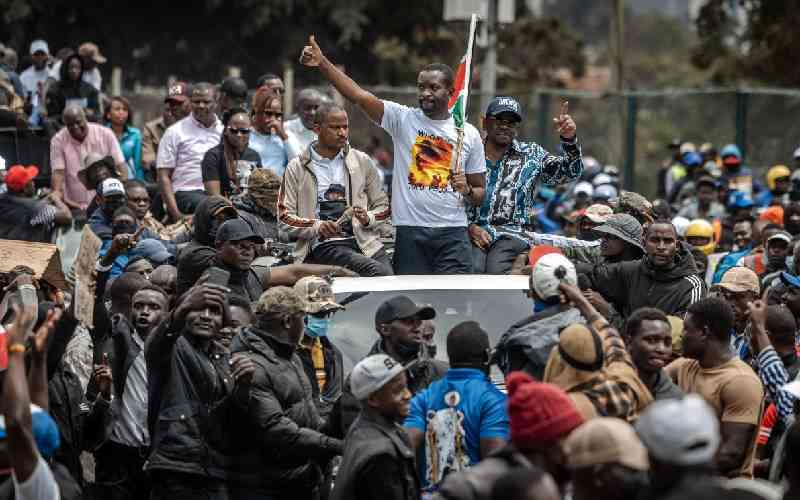
The Sunday Jacaranda Grounds rally in Nairobi provided another demonstration of that momentum, with thousands turning out for the Linda Mwananchi procession and rally.
More importantly, Sifuna has repeatedly insisted that the opposition should ultimately field one presidential candidate against Ruto.
That message now appears to be coming full circle.
If Linda Mwananchi settles on Sifuna, the movement will enter the broader opposition negotiations not as a group merely seeking accommodation, but as a political formation with its own presidential proposition.
The question will then become whether the established opposition heavyweights can persuade Sifuna to step aside — or whether they will have to negotiate around him.
The Babu Owino equation
One of the less discussed consequences of the Sifuna consolidation concerns Embakasi East MP Babu Owino.
For months, Babu has occupied an interesting position within the emerging Linda Mwananchi hierarchy: a youthful, combative and highly visible politician with a formidable Nairobi constituency and national ambitions.
But if Sifuna becomes the movement’s presidential candidate, the political logic begins to point Babu towards a different battlefield.
Nairobi.
A Sifuna presidential campaign would need a powerful urban political machine beneath it. Babu, with his established base in Nairobi and his highly recognisable political brand, could become one of the movement’s most important city-level assets.
This creates a potentially attractive division of political labour: Sifuna takes the national fight while Babu concentrates on capturing City Hall.
That would give Linda Mwananchi a presidential project and a serious Nairobi gubernatorial project at the same time.
It would also prevent two of the movement’s most recognisable youthful politicians from competing directly for the same political space.
And then there is Orengo
The most intriguing casualty of the emerging arrangement could, paradoxically, be Siaya Governor James Aggrey Orengo.
Orengo entered the presidential conversation with perhaps the strongest institutional and historical credentials among the Linda Mwananchi principals.
But presidential politics is ultimately a numbers game.
If Sifuna succeeds in consolidating the movement behind his candidacy, Orengo will face a strategic calculation that is far more difficult than simply deciding whether he wants to run for President.
He will have to decide where his political capital is most effectively deployed.
And this is where Siaya becomes critical.
A Sifuna-led national campaign could leave Orengo with a stark political choice: continue fighting for an increasingly crowded presidential space, or return to Siaya and defend the governorship.
The latter may eventually become not merely the safer option but the politically rational one.
Indeed, if the opposition’s internal arithmetic increasingly coalesces around Sifuna, Orengo could find himself with little practical choice but to go back home and defend his gubernatorial seat.
That would not necessarily represent political defeat.
Far from it.
For Orengo, retaining Siaya could provide something arguably more valuable than an unsuccessful presidential campaign — a secure institutional base from which to remain relevant in national politics.
Siaya becomes the next chessboard
This is where the emerging national realignment becomes particularly interesting for Siaya.
For months, uncertainty over Orengo’s presidential intentions has complicated the county’s 2027 gubernatorial contest.
Potential contenders have had to calculate whether it makes sense to invest heavily in a race whose incumbent could either seek another term as governor or leave the county to pursue the presidency.
A clear presidential settlement could finally remove that uncertainty.
If Orengo returns to defend his seat, the Siaya gubernatorial race immediately becomes a different contest.
The governor would have the advantages of incumbency, visibility and an established political network — but he would also have to defend his record before voters.
And that is precisely where the contest could become more interesting.
The argument would no longer be about presidential possibilities in Nairobi or national opposition calculations.
It would be about roads, water, health, agriculture, jobs, local institutions, county finances and the tangible record of the administration.
In other words, Siaya voters would get an opportunity to judge Orengo not by his ability to challenge the national government, but by his performance as governor.
Opposition unity is still unfinished business
None of this means the opposition’s presidential equation has been settled.
The consultations remain fluid, and Sifuna still has to negotiate with established figures whose political ambitions and constituencies cannot simply be swept aside.
Kalonzo Musyoka, Fred Matiang’i and other opposition actors remain part of the wider equation.
Even within Linda Mwananchi, Orengo’s presidential ambition has already demonstrated that consensus cannot be assumed.
Orengo himself has said he is prepared to sit down with Sifuna to find a formula that produces one candidate.
That may ultimately be the defining test.
The opposition does not merely need a popular candidate. It needs a political settlement capable of persuading competing principals to subordinate individual ambitions to a common strategy.
And that is considerably harder than filling a rally.
The bigger 2027 picture
The emerging Sifuna arrangement nevertheless offers an intriguing possibility.
Sifuna could become the national face of the opposition.
Babu Owino could concentrate on Nairobi.
Orengo could return to Siaya.
Other principals could negotiate positions within a broader coalition.
If that formula holds, Linda Mwananchi would cease to look like merely a youthful protest movement and begin to resemble the nucleus of a serious electoral machine.
But there is an important caveat.
Political momentum is not the same thing as electoral victory.
Crowds must eventually become votes. Enthusiasm must become organisation. Online visibility must translate into polling-station machinery. And a charismatic national campaign must eventually answer the hard questions of governing a complex country.
For now, however, the direction of travel is becoming clearer.
The opposition’s crowded presidential field is slowly narrowing.
And as the political pieces move into place, Edwin Sifuna is increasingly looking less like a candidate waiting for an opportunity and more like a candidate around whom the opportunity is being organised.
The consequences could reach far beyond State House.
They could determine who governs Nairobi — and who governs Siaya.



