 ADVERT
On December 13, 2025, former Lugari MP and veteran Kenyan politician Cyrus Jirongo died in a head-on collision on the Nairobi-Nakuru Highway at around 3 a.m. His Mercedes-Benz collided with a passenger bus, resulting in fatal injuries confirmed by autopsy as severe blunt force trauma to the chest and abdomen.
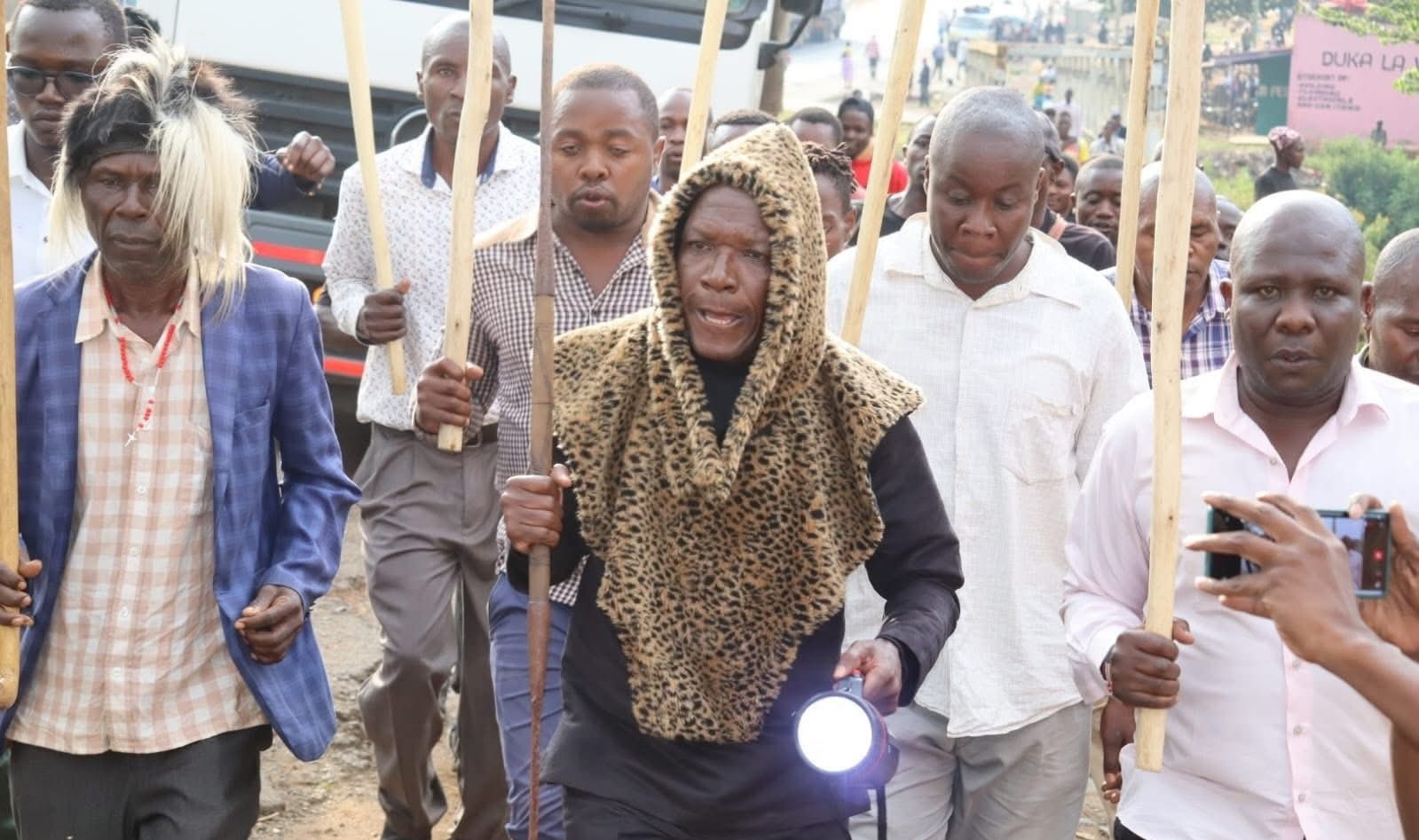
Yet in the weeks that followed, Jirongo’s death became shrouded in controversy—not just political, but cultural. At his burial in Lumakanda, Kakamega County, on December 30, 2025, a traditional Tiriki ritual took center stage: the placement of a lit torch in his grave. According to some Luhya elders and community members, this rite is invoked when murder is suspected, empowering the deceased’s spirit to “hunt” those responsible.
This ancient belief collided with modern investigations, fueling sensational headlines linking National Assembly Speaker Moses Wetang’ula to supernatural “haunting” as he recorded a statement with the Directorate of Criminal Investigations (DCI).
The DCI’s investigation, concluded in early January 2026, found no evidence of foul play. Director Mohammed Amin stated that findings “point to a crash involving a public service vehicle (PSV), and not a criminal act.” Over 28 statements were recorded, including from bus passengers and individuals Jirongo met hours earlier. The file was forwarded to the Director of Public Prosecutions with a recommendation to close the case as a road traffic incident.
Jirongo, 64, had spent the evening of December 12 at a Karen restaurant meeting friends, including Wetang’ula. He left alone, driving toward western Kenya, when the fatal collision occurred near Naivasha.
The Tiriki, a sub-group of the Luhya people primarily in Vihiga and Kakamega counties, have distinct burial customs. Among them is a ritual for deaths suspected to be unnatural or murderous: burying the deceased with a lit flashlight (modern torch).
Sources familiar with the tradition explain that the torch is believed to guide or empower the spirit. When the battery eventually dies, misfortune—illness, accidents, or death—is said to befall the guilty parties, forcing confession or retribution.
At Jirongo’s funeral, politicians like Senator Boni Khalwale prominently carried a torch, and elders reportedly performed the rite amid calls for deeper probes. Some speakers questioned the accident narrative, noting the body’s condition or lack of public witness accounts.
Anthropologically, such rituals are common in many African communities, serving as mechanisms for justice in eras before formal investigations. They reflect deep-seated beliefs in ancestral spirits and communal accountability. However, there is no documented evidence of the torch ritual empirically revealing killers; outcomes are often attributed to coincidence, psychological pressure, or social ostracism.
Moses Wetang’ula, a fellow Luhya leader from Bungoma, was one of the last people to see Jirongo alive. He confirmed meeting him casually that evening and later recorded a routine statement with DCI homicide detectives.
Sensational media and social media amplified rumors, with headlines claiming Wetang’ula was “haunted” by the torch. Some posts speculated he opposed the ritual out of guilt. These claims appear rooted in political rivalries within the Luhya community and broader Kenya Kwanza alliance tensions, rather than evidence.
Wetang’ula has not publicly commented on supernatural fears, and reports of his “difficulties” seem limited to standard investigative cooperation and political scrutiny.
Is there any basis for the torch to literally haunt Jirongo’s alleged killers? From a rational standpoint: no. Supernatural claims lack verifiable evidence and fall outside scientific inquiry. Any subsequent misfortunes to individuals linked to the case would likely be coincidental or influenced by heightened public attention and stress.
Yet culturally, the ritual’s power lies in belief. Fear of ancestral wrath can induce guilt, confessions, or behavioral changes—effectively achieving communal justice through psychology rather than metaphysics.
In Jirongo’s case, with DCI conclusively ruling accident, the torch serves more as a symbol of unresolved community grief and distrust in institutions than an active supernatural force.
As Kenya modernizes, such traditions highlight the tension between cultural heritage and evidence-based justice. Jirongo’s torch may burn out in the grave, but the questions it illuminated—about road safety, political intrigue, and belief—linger in the public mind.


