 ADVERT
 ADVERT
There comes a point when a road project ceases to be a development promise and becomes a test of whether government understands the economy it is supposed to serve.
The Kisumu–Busia highway has reached that point.
For years, governments have spoken about upgrading the corridor. Feasibility studies have been commissioned. Sections have been opened up for rehabilitation. Road reserves have been cleared. Plans have been announced. Politicians have made pledges. Yet the fundamental problem remains: a strategically vital international transport corridor is still expected to carry twenty-first-century volumes of traffic on infrastructure that is struggling to cope with today’s demands.
That is no longer acceptable.
The case for upgrading the Kisumu–Busia corridor is not a regional political demand dressed up as infrastructure policy. It is an economic imperative.
 ADVERT
The Kisumu–Kisian–Busia route forms part of the Northern Corridor and the wider East African transport network connecting Kenya to Uganda and, through Uganda, to markets in Rwanda, Burundi, eastern Democratic Republic of Congo and beyond. The African Development Bank’s project documentation identifies the 104-kilometre Kisian–Busia section as requiring rehabilitation and capacity enhancement, including conversion from the existing two-lane carriageway to a dual carriageway.
The East African Community has gone further. Its multinational expressway project envisages a 256-kilometre Kenya-Uganda corridor linking Kisumu through Busia and Kakira towards Malaba, with a section of the existing road earmarked for dualisation. Feasibility work was formally advanced with AfDB support.
In other words, the strategic importance of the corridor is not in dispute.
What is in dispute is Kenya’s sense of urgency.
A highway carrying the weight of regional trade
Busia is not an ordinary border town. It is one of the country’s principal gateways into East Africa.
The Busia One Stop Border Post generated KSh6.83 billion in the 2024/25 financial year, exceeding its KSh5.33 billion target. Parliament has separately recorded persistent congestion, delays and infrastructure constraints at the border.
Kenya and Uganda themselves acknowledged the problem in 2025, agreeing to address congestion at Busia and Malaba and to improve critical infrastructure as part of efforts to remove tariff and non-tariff barriers to trade.
And as recently as July 2026, the EAC Secretary General visited the Busia-Busia One Stop Border Post and called for decisive action against bottlenecks that delay goods, raise business costs and undermine regional competitiveness.
That should be a warning bell in Nairobi.
There is little economic sense in digitising customs, improving border procedures and negotiating away trade barriers while leaving the physical artery feeding the border congested, narrow and vulnerable to disruption.
A modern border requires a modern road.
The problem is not lack of plans. It is execution.
Kenya has been here before.
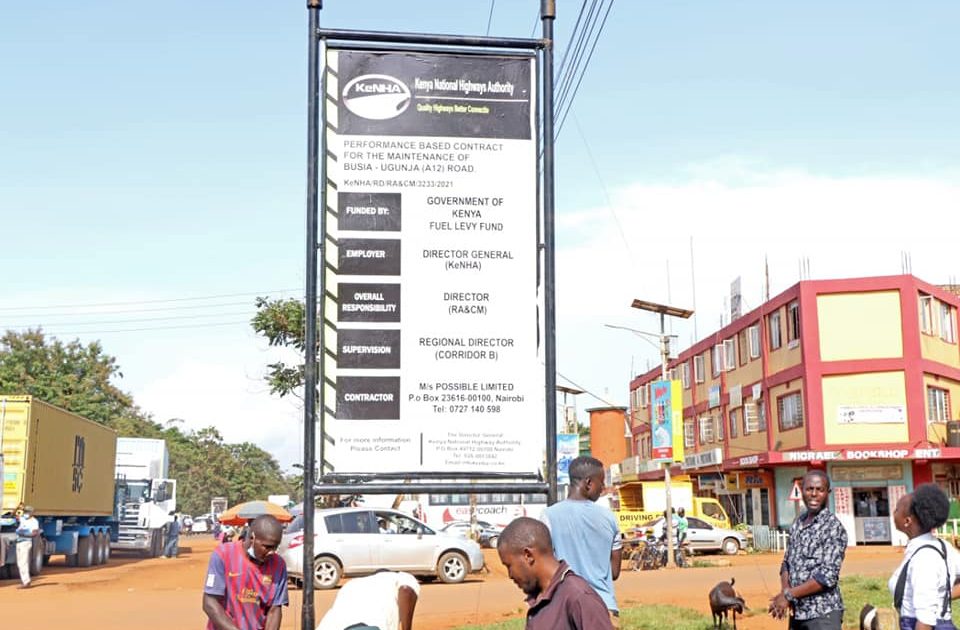
In 2021, KeNHA commenced works on a 40-kilometre section between Amukura House and Ugunja, with the stated scope including expansion and recarpeting.
Yet the broader strategic question has remained unresolved: when will Kenya stop treating this corridor as a collection of maintenance contracts and start treating it as a single economic infrastructure system?
That distinction matters.
Pothole patching cannot solve a capacity problem.
Periodic resurfacing cannot solve the danger created when heavy trucks, buses, matatus, motorcycles and private vehicles are forced to share a narrow carriageway with inadequate separation.
And road reserve demolitions without timely construction create an especially bitter spectacle: citizens lose property and livelihoods in anticipation of infrastructure that then takes years to materialise.
Government must therefore be honest about what has happened.
If structures were removed to facilitate an upgrade, the public deserves to know why the promised works have not followed at the speed originally envisaged. If designs have changed, publish them. If financing has been the obstacle, explain the financing gap. If procurement has stalled, identify the bottleneck.
What cannot continue is the culture of perpetual planning.
The human cost is already visible
The argument for the highway cannot be reduced to trade statistics.
People are dying on it.
There have been repeated serious crashes involving heavy trucks, buses and smaller vehicles. In March 2025, an oil tanker and a saloon car collided at Kisian, killing one person and injuring several others.
In August 2025, another crash on the Kisumu–Busia highway involving a bus, a fuel tanker and a flat-bed trailer left one person dead and several others seriously injured.
In August 2023, a three-vehicle collision near Ojola killed people and injured 13 others, with police and road users pointing to overtaking and the narrowness of the road among the dangers.
These are not merely unfortunate statistics. They are reminders that infrastructure design is ultimately about human life.
We should therefore be cautious about repeating unverified claims that the road records exactly 45 accidents every month, or that vehicle operating costs are precisely 30–60 per cent higher than comparable highways. Those figures require a published traffic or economic study before being presented as established fact.
But we do not need questionable statistics to establish the underlying problem.
The documented accidents, congestion, truck queues, deteriorating road conditions and repeated parliamentary demands already make the case compelling.
Western Kenya should not have to plead for economic infrastructure
There is also a larger development question.
For decades, Kenya has concentrated major transport infrastructure around established economic centres while western Kenya has continued to carry enormous agricultural and commercial potential without equivalent highway capacity.
That is increasingly difficult to justify.
The Kisumu–Busia corridor cuts through an economically productive part of the country. It serves farmers, traders, manufacturers, transporters, students, workers and millions of ordinary residents. It connects Kisumu’s commercial and logistics economy with Siaya and Busia and ultimately with Uganda and the wider Great Lakes region.
Busia County’s own Integrated Strategic Urban Development Plan recognises the road’s importance to transport, logistics, warehousing, clearance, cross-border trade and commercial development, and proposes upgrading the B1 road into a multimodal dual carriageway.
This is precisely how infrastructure should be understood: not merely as asphalt, but as an economic platform.
A better highway would make it easier to move fish from Lake Victoria, agricultural produce from western Kenya and manufactured goods from industrial centres. It would make towns along the route more attractive to investors. It would support logistics, hospitality, retail, warehousing and tourism.
Most importantly, it would reduce the economic penalty imposed on businesses simply because they operate far from Nairobi.
The Treasury has already shown that the bigger conversation is possible
The national government’s own planning documents point towards a much more ambitious future.
In April 2026, reporting based on the Kenya Investment Projects Catalogue indicated that the Mau Summit–Kisumu–Malaba highway was being considered as a 243-kilometre, four-lane, access-controlled dual carriageway under a PPP structure, with an estimated project cost of about KSh130 billion.
That development is significant.
It means the question is no longer whether Kenya can imagine a modern transport corridor connecting the Rift Valley, Kisumu and the Uganda border.
The question is whether the government can move from catalogues, feasibility studies and financing concepts to construction.
And that is where accountability must become much sharper.
No more open-ended promises
The government should now establish a firm implementation timetable.
Within six months, the responsible agencies should publish the definitive design, project scope, environmental and social safeguards, financing structure, land requirements and procurement timetable.
Within 12 months, financing should be secured, procurement concluded and contractors mobilised where the project structure permits.
Within 18 months, visible full-scale construction should be underway on the priority sections, with a publicly accessible progress dashboard showing expenditure, milestones, contractors, delays and reasons for any slippage.
This should not be another project whose progress is measured by press conferences.
KeNHA, the National Treasury, the State Department for Roads and the EAC Secretariat must be able to tell citizens exactly who is responsible for what.
And Parliament must do more than ask questions.
It must follow the money.
It must interrogate contracts.
It must demand timelines.
It must summon agencies when milestones are missed.
The same applies to elected leaders in Kisumu, Siaya and Busia. The corridor should not become a seasonal political slogan revived whenever elections approach. Its importance is too great to be reduced to campaign rhetoric.
The cost of doing nothing will only rise
There is a simple economic principle at work here: traffic grows faster than infrastructure when governments postpone capacity expansion.
A road that is barely coping today will not cope tomorrow if freight, passenger traffic and regional commerce continue expanding.
The danger is that Kenya will eventually spend far more correcting a crisis than it would have spent preventing one.
The government should therefore resist the temptation to define success as another layer of asphalt.
What is required is a properly engineered corridor: adequate carriageway capacity, safe junctions, shoulders, drainage, pedestrian facilities, controlled access where appropriate, truck management facilities, intelligent traffic systems and proper maintenance arrangements.
The objective should be to create a highway capable of carrying the region’s future economy—not merely repairing the road on which the current economy is already struggling.
This is bigger than Kisumu, Siaya or Busia
The most important point is this: the Kisumu–Busia highway is not a western Kenya road.
It is a Kenyan road serving an East African economy.
Every truck delayed on the corridor represents capital tied up in transit. Every accident represents a human and economic cost. Every pothole damages vehicles and increases logistics costs. Every hour lost in congestion reduces the competitiveness of Kenyan goods.
And every year the project is postponed is another year in which Kenya’s competitors can offer more efficient routes to regional markets.
The EAC has set itself an ambitious goal of increasing intra-regional trade. Its own leadership has now acknowledged that administrative and infrastructure bottlenecks are undermining that ambition.
Kenya cannot credibly champion regional integration while allowing one of its principal gateways to remain capacity-constrained.
The choice is therefore no longer between building the road and doing nothing.
The choice is between investing deliberately now or paying a much higher economic and human price later.
The Kisumu–Busia highway has been planned enough, discussed enough and promised enough.
Kenya needs a decision, a financing commitment, a contractor, a timetable and measurable delivery.
No more endless reviews.
No more vague assurances.
No more ceremonial ground-breaking without construction.
Build the corridor. Protect the lives that use it. Open the markets that depend on it. And give Western Kenya—and East Africa—the infrastructure its economy has already earned.
Lawrence Jeffrey
12th August, 2026
Siaya



