 ADVERT
 ADVERT
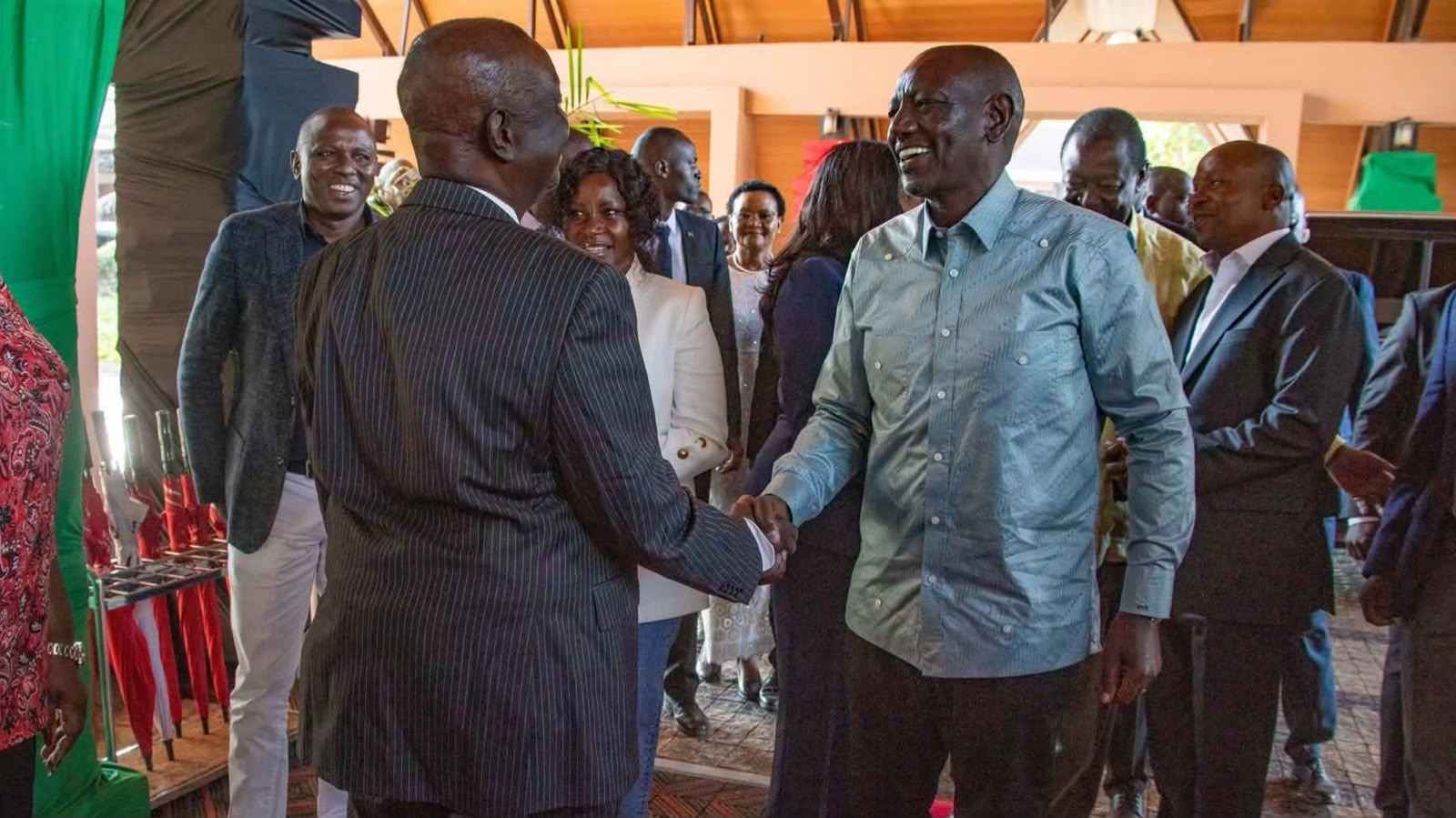
President William Ruto has formally thrown open a new chapter in Kenya’s 2027 political contest, announcing that Kenya Kwanza and the Orange Democratic Movement (ODM) will enter the General Election as coalition partners.
The announcement, made in Naivasha on Monday, August 10, transforms what began as a broad-based arrangement inside government into an explicitly electoral alliance — potentially redrawing the political map a year before Kenyans return to the ballot.
Ruto said the decision followed consultations within the two political formations and would culminate in a joint manifesto and a formal coalition framework for the 2027 election.
“Kenya Kwanza and the Orange Democratic Movement have today formally resolved to develop a joint manifesto for the next election and constitute a coalition to contest the 2027 General Election together,” Ruto said.
The President described the move as the formalisation of a political partnership that had already taken shape through the broad-based government.
 ADVERT
“What began as cooperation in government will become a common political platform upon which we shall seek the mandate of the Kenyan people in August next year,” he said.
The development is arguably the biggest political realignment of the 2027 cycle so far.
It brings together Ruto’s Kenya Kwanza establishment and a party that for two decades was synonymous with opposition politics and the political career of the late Raila Odinga.
The two sides had already been working together in government following the March 2025 Kenya Kwanza-ODM framework agreement. At the time, Ruto and Raila insisted that their arrangement was intended to promote national unity, address socio-economic challenges and implement agreed reforms rather than constitute an electoral alliance.
That political understanding has now crossed the electoral Rubicon.
TWO TEAMS TO BUILD THE 2027 COALITION
Ruto announced that the coalition process will be driven by two separate joint teams.
The first will develop the common manifesto, while another will work on the coalition framework, including its governance structures and leadership arrangements.
The manifesto team will comprise five representatives from each side, with the respective party executive directors serving in ex-officio capacities.
Its mandate goes beyond writing a conventional campaign document. The team is expected to identify areas where Kenya Kwanza and ODM agree, harmonise contentious policy positions and incorporate ideas emerging from the national conversation on Kenya Beyond Vision 2030 and the proposed National Development Charter.
The second committee will have an even more politically sensitive assignment: working out the architecture of the coalition and recommending how leadership and governance responsibilities will be organised.
That is where the real political negotiations are likely to begin.
Because while manifestos can be written by committees, presidential tickets, running mates, parliamentary nominations, county power bases and the distribution of political influence will ultimately have to be negotiated by politicians.
OBURU: ODM WILL NOT BE SWALLOWED
ODM leader Oburu Oginga moved quickly to dispel suggestions that the coalition represents the absorption of ODM into Ruto’s political machine.
Oburu insisted that ODM entered the broad-based government from a position of strength and would retain its identity.
“ODM is not a weak party,” he said, arguing that the party has a formidable grassroots structure and remains capable of mobilising voters across the country.
He further rejected fears that ODM would simply disappear inside Kenya Kwanza.
“ODM is not going to be swallowed,” Oburu declared.
The statement is politically significant.
For ODM, the coalition is not merely about helping Ruto secure another presidential term. The party will want its influence reflected in the coalition’s policy agenda, candidate selection, governance arrangements and distribution of political power.
Oburu has also previously indicated that ODM would support Ruto’s re-election bid and would not field its own presidential candidate in 2027. In July, he said negotiations for a pre-election agreement had been completed.
The Naivasha announcement therefore gives political form to an arrangement that has been steadily taking shape for months.
RUTO’S ‘MUST WIN’ MESSAGE
The President was equally unequivocal about the electoral objective.
Addressing leaders from the broad-based camp, Ruto said the alliance must win the 2027 election.
He framed victory not as a personal political ambition but as a national imperative, warning that an opposition victory would place Kenya on a dangerous path.
But that argument will inevitably become one of the central battlegrounds of the coming campaign.
Opposition leaders are likely to portray the coalition as an establishment pact designed to preserve power, while Ruto and his allies will present it as a broad national coalition capable of transcending the traditional government-versus-opposition divide.
The competing narratives will be crucial.
For voters, however, the more important question may eventually be less about the size of the coalition and more about what it intends to do with power.
FROM RAILA-RUTO HANDSHAKE TO RUTO-OBURU COALITION
The political symbolism cannot be ignored.
The original Kenya Kwanza-ODM rapprochement was negotiated between Ruto and Raila Odinga after years in which the two stood on opposite sides of Kenya’s political divide.
Raila’s death fundamentally altered ODM’s internal and national political dynamics, with his brother Oburu eventually assuming the party leadership amid intense debate over ODM’s future.
The party subsequently embarked on a process of repositioning itself for the 2027 elections, with its leadership openly considering coalition options.
The Naivasha declaration therefore represents more than an electoral pact.
It is the institutionalisation of a political realignment that would have been almost unimaginable during the fiercest phases of the Ruto-Raila rivalry.
THE BIG QUESTION: WHO GETS WHAT?
Behind the celebratory language about unity, development and national transformation lies an unavoidable question:
What does each side get from the deal?
Ruto gets what every incumbent president seeks — a broader electoral coalition and access to ODM’s political networks, particularly in regions where Kenya Kwanza has historically struggled to establish overwhelming dominance.
ODM, meanwhile, gets a direct seat at the table of power and an opportunity to influence the national government rather than remain permanently confined to opposition politics.
But coalitions are ultimately tested by interests.
Who will be Ruto’s running mate?
How will ODM candidates and Kenya Kwanza candidates share parliamentary and gubernatorial contests?
Which party will control which constituencies?
How will campaign financing be managed?
What happens in areas where ODM and UDA candidates want the same seat?
And, perhaps most importantly, how will the two sides manage the inevitable battle over succession after 2027?
These questions are not yet answered.
The second coalition committee is expected to tackle precisely these sensitive issues.
A FORMIDABLE ALLIANCE — BUT NOT AN AUTOMATIC VICTORY
The mathematics of political coalitions can be seductive.
Put two large parties together and it is tempting to assume that their combined vote automatically guarantees victory.
Kenyan elections, however, have repeatedly demonstrated that political arithmetic is rarely that simple.
Voters do not necessarily transfer their allegiance simply because party leaders sign agreements.
Local rivalries, candidate popularity, ethnic calculations, economic grievances, turnout, youth sentiment, regional interests and the credibility of the presidential ticket can all reshape an election.
The coalition will therefore have to convert elite-level agreement into grassroots enthusiasm.
That may prove to be its greatest challenge.
ODM has already insisted that it is joining from a position of strength. Kenya Kwanza, for its part, believes the partnership provides the numbers and national reach necessary to secure another term for Ruto.
The coming months will test both assumptions.
THE OPPOSITION NOW FACES A NEW REALITY
The announcement also places enormous pressure on the opposition.
A fragmented opposition confronting a united governing coalition would face a significantly more difficult electoral environment.
The opposition must now determine whether it can produce its own broad alliance, settle on a credible presidential candidate and offer voters a coherent alternative rather than merely an anti-Ruto platform.
The emergence of the Kenya Kwanza-ODM coalition could therefore accelerate the search for a counter-alliance involving figures such as Kalonzo Musyoka and other opposition leaders.
The battle for 2027 is no longer theoretical.
The political chessboard is being assembled.
THE REAL CAMPAIGN HAS BEGUN
With the election approximately one year away, Ruto’s announcement marks the transition from political speculation to formal electoral preparation.
The joint manifesto committees will now have to translate the broad-based government’s record and the two parties’ competing political traditions into one programme.
That will not be easy.
ODM carries a long history of opposition politics, reform advocacy and calls for greater political inclusion. Kenya Kwanza carries the record — and burden — of being the incumbent administration.
The coalition must convince Kenyans that these apparently different political traditions can produce a coherent government programme.
More importantly, it must convince voters that the alliance is about more than winning an election.
For Ruto, the 2027 contest is now a bid for a second term built around the broadest political coalition of his presidency.
For ODM, it is a defining moment that could either establish the party as a permanent participant in national power or expose the risks of becoming junior partner in a presidential re-election project.
And for Kenya, the emergence of the Kenya Kwanza-ODM coalition means one thing above all:
The 2027 presidential race has entered a new and far more consequential phase.
The handshake has become a coalition.
Now Kenyans will be watching to see whether the alliance can turn political arithmetic into electoral chemistry.



