 ADVERT
 ADVERT
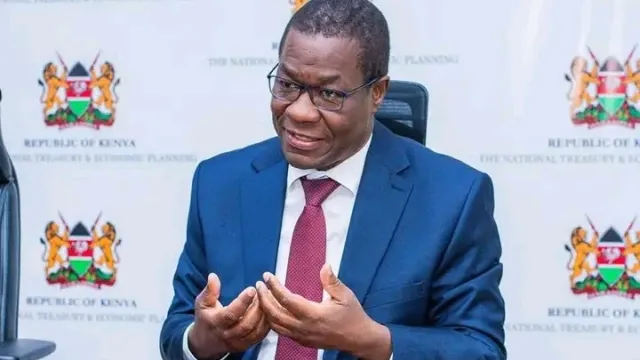
The Energy CS is no longer appearing merely as the man in charge of electricity, fuel and power policy. The intensity of national scrutiny around him suggests that his political profile has entered a different league.
For years, Opiyo Wandayi has occupied an interesting space in Kenyan politics: nationally known, politically experienced and increasingly visible, yet often discussed primarily through the narrow prism of his Cabinet portfolio.
That appears to be changing.
The latest controversy involving artificial intelligence, political messaging and social-media activity has placed the Energy and Petroleum Cabinet Secretary in an altogether different national conversation. More significantly, The Standard has devoted substantial national-level attention to Wandayi not simply as the Cabinet Secretary responsible for energy, but as a political subject in his own right.
That development is noteworthy.
 ADVERT
The newspaper’s coverage of the Anthropic investigation into the misuse of AI to generate political content praising Wandayi and attacking opposition figures has effectively pulled his name into one of the most consequential emerging debates in Kenyan politics: the industrialisation of political propaganda through artificial intelligence.
Anthropic’s report documented an operation in which Claude was used to generate batches of political posts designed to resemble spontaneous grassroots commentary. Some of the content praised Wandayi, while other material attacked or undermined opposition personalities.
Crucially, Anthropic did not establish that Wandayi, his ministry or the Kenyan Government commissioned the operation. That distinction remains essential.
Yet there is another story here—one that concerns the evolution of Wandayi’s political stature.
From Cabinet Secretary to Political Subject
A Cabinet Secretary ordinarily enters the national news cycle because of his or her portfolio: a new policy, a government programme, a crisis, a parliamentary appearance or an official announcement.
Wandayi increasingly appears to be attracting attention beyond those conventional boundaries.
The question is no longer merely what the Energy Ministry is doing. It is increasingly about Wandayi himself—his public profile, his political messaging, his relationship with the administration and the significance attached to his growing visibility.
That is a different category of political relevance.
The Standard’s decision to give the AI controversy substantial national treatment does not, by itself, establish that the newspaper is endorsing Wandayi, promoting him or predicting a particular political future for him.
But media attention is not politically meaningless.
When one of Kenya’s established mainstream news organisations repeatedly places a Cabinet Secretary at the centre of a national political narrative, it contributes to the process through which that politician becomes part of the country’s broader political conversation.
In other words, Wandayi has become a subject of political scrutiny rather than merely an administrator of a government docket. 
The Curious Politics of Artificial Attention
There is a delicious irony in the controversy.
The alleged objective of the AI operation was apparently to manufacture the appearance of organic public support.
Instead, the episode generated something considerably more tangible: real national media attention.
That raises an important question.
If artificial intelligence is being deployed to manufacture political narratives, and those narratives are subsequently investigated by international technology companies and reported by mainstream media, can an attempted propaganda operation inadvertently elevate the very politician it was supposedly promoting?
That question cannot be answered conclusively from the Anthropic report.
But it is an important question for Kenyan journalism.
The country is entering an era in which the distinction between political communication, public relations, social-media activism and manufactured influence is becoming increasingly difficult to police.
The Wandayi controversy is therefore bigger than Wandayi.
It is about the changing architecture of political power.
Why Wandayi’s Name Matters
Wandayi did not emerge from nowhere.
Before entering Cabinet, he had already built a substantial political career, including his tenure as Ugunja MP and his leadership role in Parliament. His appointment to the Energy and Petroleum docket subsequently placed him at the centre of one of the most economically and politically sensitive sectors in the country.
Energy politics is not peripheral politics.
Electricity prices affect households. Fuel prices affect transport. Energy costs affect manufacturing, agriculture, small businesses and virtually every component of the economy.
Consequently, the Cabinet Secretary occupying that office inevitably acquires national visibility.
But political visibility and political succession are not the same thing.
It would therefore be premature to interpret The Standard’s coverage as evidence that Wandayi has been selected, anointed or positioned for a particular role in a future coalition government.
There is no such conclusion in the evidence.
What can reasonably be observed is that the threshold of scrutiny surrounding Wandayi appears to have changed.
He is increasingly being discussed in the vocabulary of national politics rather than solely in the language of energy policy.
The Media Is Part of the Political Ecosystem
There is another dimension that deserves attention.
Mainstream media organisations do not merely report political relevance; they also help determine which political figures receive sustained national attention.
A politician can have enormous influence within a constituency and remain largely invisible nationally. Another can become a recurring national news subject through a combination of office, controversy, policy decisions and political networks.
That does not make media coverage proof of political destiny.
It does, however, make media attention an important indicator of political visibility.
And this is precisely why the Wandayi story deserves to be watched without either exaggerating it or dismissing it.
The interesting development is not that an AI system supposedly “made” Wandayi popular.
It is that the controversy has given the national media establishment another reason to examine Wandayi as a political figure.
That is a much more consequential development.
The Bigger 2027 Question
As Kenya approaches the 2027 political cycle, Cabinet Secretaries will inevitably be scrutinised not only for what they deliver in government but also for their political networks, public communication, regional constituencies and relationships within emerging coalition formations.
Wandayi’s name is now increasingly appearing within that broader national conversation.
Whether that develops into something more substantial is a matter that only political events—not headlines—will determine.
For now, the prudent conclusion is simpler.
The Standard has helped move Opiyo Wandayi from the confines of the Energy and Petroleum docket into the national political spotlight.
That does not make him the inevitable occupant of any future office.
It does, however, make him a political figure whose trajectory deserves closer national observation.
And perhaps that is the most revealing aspect of the entire AI controversy.
The artificial campaign may have been manufactured.
The national conversation it triggered is real.



