 ADVERT
 ADVERT
The battle between the Siaya County Assembly and Governor James Aggrey Orengo has entered a potentially decisive new phase, with the House digging in against the renomination of George Odhiambo Nyingiro as County Executive Committee Member for Finance and Economic Planning and instead pushing for Erick Abungu Odawa to take charge of the docket in an acting capacity.
What began as a seemingly routine disagreement over one county executive appointment is increasingly looking like something bigger: a test of whether the Siaya County Assembly is finally prepared to exercise its constitutional mandate without fear, favour or political convenience.
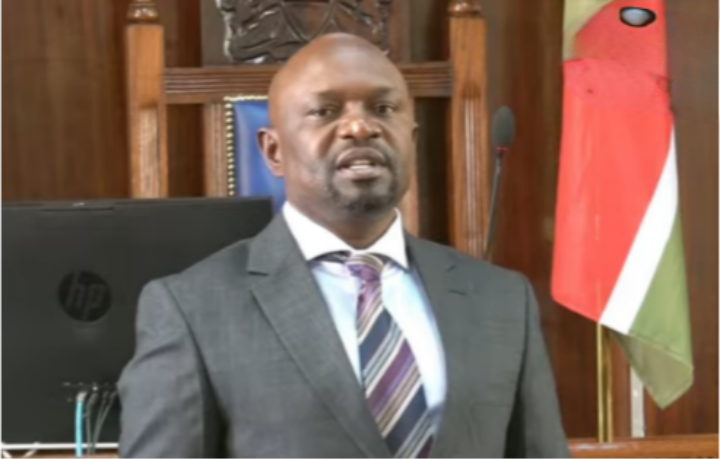
Addressing the House, Speaker George Okode reportedly made it clear that the Assembly had not changed its position on Nyingiro. He reiterated an earlier warning that Members would continue occupying Nyingiro’s office every Wednesday until he relinquished the position, an extraordinary confrontation that underscores just how deep the disagreement over the Finance docket has become.
The Speaker also sought to draw a distinction between the Assembly’s actions and a blanket war against Governor Orengo. According to Okode, the Governor made two nominations requiring the House’s consideration — Grace Agola for the position of acting County Secretary, which the Assembly approved, and Nyingiro for Finance, which it rejected.
That distinction is politically important.
 ADVERT
If the Assembly were simply determined to frustrate everything coming from the Governor’s office, it could have rejected both nominations. Instead, it approved one and rejected the other.
The message, therefore, appears increasingly to be that the House wants its decisions judged nomination by nomination rather than interpreted as an institutional declaration of war against Orengo.
And that may be the most significant development in Siaya’s current political drama.
The Assembly had already rejected Nyingiro’s nomination for the substantive Finance and Economic Planning position on April 29, 2026. Its official records show that Nyingiro was among the nominees vetted by the Committee on Appointments chaired by Speaker Okode, alongside seven other nominees. The House subsequently approved several of Governor Orengo’s nominees but rejected Nyingiro and Grace Agola.
The Finance controversy did not end there.
In May, the Assembly passed a motion questioning the legality of Nyingiro’s continued performance of functions in the Finance docket after his earlier contract had expired. The House argued that he lacked lawful authority to continue performing the functions of the position after the expiry of his tenure.
That history explains why the latest confrontation cannot simply be dismissed as a sudden political quarrel.
There is institutional memory behind it.
The Assembly has been steadily building a case around the Finance docket, and the latest refusal to accommodate Nyingiro suggests that Members believe the matter is no longer merely about the suitability of one individual. It is about who exercises authority over one of the most sensitive departments in the county government — and under what conditions.
Finance is not an ordinary county department. It sits at the heart of budgeting, revenue collection, expenditure control, procurement flows and the release of funds to departments and projects. Whoever controls the docket occupies one of the most consequential administrative positions in the county.
That makes the Nyingiro question politically explosive.
It also makes the Assembly’s demand for an alternative, with Odawa being recommended as acting CECM Finance, particularly significant.
Odawa is not an outsider to the political and administrative architecture of Siaya. He was among the nominees submitted by Governor Orengo earlier this year, although his substantive nomination was for Public Works, Roads, Energy and Transport. The Assembly’s own vetting records identify him as Erick Abungu Odawa.
The proposed deployment of Odawa to Finance therefore potentially represents more than a stop-gap administrative arrangement. It could give the county government an opportunity to stabilise the docket while allowing the political temperature surrounding Nyingiro to cool.
But the larger story is not Odawa versus Nyingiro.
It is the emergence of an Assembly that appears increasingly unwilling to operate as a rubber stamp.
For years, county assemblies across Kenya have faced the perennial accusation that oversight becomes aggressive only when political relationships collapse, while legislative independence mysteriously disappears when governors and MCAs are on friendly terms.
Siaya may now be testing a different model.
The House appears to be saying that friendship with the executive cannot substitute for oversight, and disagreement with the Governor does not automatically mean opposition to every government initiative.
That is a subtle but important distinction.
The Constitution gives county assemblies legislative and oversight responsibilities, while the Assembly’s approval of CEC nominees is part of the institutional checks and balances governing county executives. The Siaya Assembly itself explicitly states that its approval hearings are conducted under Article 179(2)(b) of the Constitution, Section 35 of the County Governments Act and its Standing Orders.
If the House is now serious about enforcing those powers, the political implications could be considerable.
For Governor Orengo, the immediate challenge is obvious. A governor can nominate, but the Assembly can scrutinise and reject. The executive can command the machinery of government, but it cannot constitutionally expect automatic approval from the legislature.
For Speaker Okode, however, the stakes are equally high.
Once an Assembly asserts its independence, it must be prepared to apply the same standards consistently. Oversight cannot become selective. Accountability cannot depend on which side of the political divide an individual occupies.
That is the real test facing the Siaya Assembly.
The House must demonstrate that its resistance to Nyingiro is about competence, legality, accountability and the public interest — not personalities or factional politics.
Equally, the Governor’s administration must demonstrate that its insistence on Nyingiro is based on merit, institutional continuity and confidence in his ability to manage the county’s finances — not political loyalty.
This is where the Nyingiro saga becomes much bigger than one man.
It is about the county purse.
It is about who has the authority to make decisions over public resources.
It is about whether the Assembly can summon the executive and expect answers.
And it is about whether a governor can nominate an official whom the legislature has already rejected and expect the legislature to simply surrender.
The emerging posture of the Siaya Assembly is therefore worth watching closely.
The House may have discovered something that many county assemblies forget: oversight is not a favour to the governor, and it is not an act of rebellion against the executive.
It is the job.
The latest confrontation may indeed contain an element of political warfare between Orengo and an increasingly assertive Assembly. Politics is never completely absent from such battles.
But reducing everything to political warfare would miss the bigger transformation taking place inside the House.
For perhaps the first time in the Orengo administration, the Assembly appears determined to demonstrate that it can say no — and mean it.
And if Speaker George Okode and his Members can sustain that independence while applying the same standards to every department, every nominee and every executive decision, the Nyingiro affair could ultimately become less about the fate of one CECM and more about the birth of a genuinely assertive Siaya County Assembly.
The question now is no longer simply whether George Nyingiro will remain in Finance.
The bigger question is whether the Siaya County Assembly has finally found its voice — and whether Governor Orengo is prepared to listen.



