 ADVERT

 ADVERT
Kenya’s drive to achieve universal electricity access is increasingly becoming more than an energy policy—it is emerging as a powerful instrument for economic inclusion, regional cooperation and national unity.
That message was brought into sharp focus when Cabinet Secretary for Energy and Petroleum Opiyo Wandayi visited Matayos Constituency in Busia County to advance the Government’s Last Mile Connectivity Programme, in a show of leadership that brought together national, county and regional political actors.
The visit, hosted by Busia Governor Paul Otuoma, Matayos MP Geoffrey Odanga and Busia Woman Representative Catherine Omanyo, alongside Kakamega Deputy Governor Ayub Savula, underscored a simple but important reality: electricity infrastructure knows no political or administrative boundaries.
Where power lines go, opportunity follows.
During the visit, CS Wandayi flagged off construction materials and conducted a symbolic groundbreaking for the Kenya Power Esikulu Village Last Mile Connectivity Project in Bukhayo West Ward. He also launched the REREC Madua Village and Pramukh Last Mile Connectivity Project in Burumba Ward, undertaken in partnership with the County Government of Busia.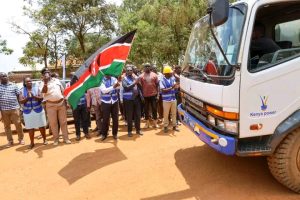
 ADVERT
For communities that have waited for years for reliable electricity, these were more than ceremonial events. They represented the movement of projects from plans and promises to physical implementation.
The significance goes beyond the individual villages.
The Last Mile Connectivity Programme addresses one of the most persistent barriers to rural electrification—the cost and logistical challenge of extending electricity infrastructure to households located far from existing distribution networks. By targeting underserved communities, the programme seeks to ensure that rural families are not permanently locked out of the economic and social opportunities created by electricity.
That is where the broader national policy of equitable resource distribution becomes particularly important.
President William Ruto’s administration has repeatedly framed development around the principle that government investment must reach communities across the country rather than remain concentrated in traditionally better-served areas. In the energy sector, last-mile electrification provides one of the most visible ways of translating that philosophy into tangible development.
Electricity is no longer a luxury.
It is a foundation for modern education, healthcare, agriculture, manufacturing, commerce and digital connectivity. A household connected to the national grid is potentially a household with more opportunities to study after dark, operate a small enterprise, access digital information and use modern appliances and equipment.
For a tailor, electricity can mean an electric sewing machine and longer working hours. For a farmer, it can mean refrigeration and better post-harvest management. For a small shop, it can mean cold storage, lighting and extended operating hours. For a student, it can mean access to digital learning resources long after the sun has set.
These individual improvements may appear modest, but multiplied across thousands of households, they can fundamentally change the economic profile of an entire constituency.
This is why the involvement of leaders from Busia and neighbouring Kakamega carries significance beyond political symbolism.
Development is most effective when leaders cooperate around shared infrastructure rather than allowing administrative boundaries to determine who benefits from national investment. Electricity generated, transmitted or distributed in one area can stimulate economic activity far beyond the immediate project site.
The western Kenya region, like other parts of the country, needs precisely this kind of collaborative approach.
The presence of national and county leaders at the Matayos projects sent a strong message that rural electrification is a shared responsibility. It also reinforces the expectation that national and county governments must continue working together to identify underserved communities, mobilise resources and ensure that infrastructure is completed and maintained.
But the real measure of success will not be the number of groundbreaking ceremonies.
It will be the number of homes actually connected, businesses powered, schools transformed, health facilities strengthened and livelihoods improved.
That distinction matters because infrastructure development ultimately succeeds through implementation.
Communities that have witnessed stalled or abandoned projects naturally become sceptical of government announcements. Visible progress, therefore, has a value beyond the physical infrastructure itself. It restores confidence in public institutions and strengthens the relationship between citizens and the state.
When residents see electricity poles installed, lines connected and homes switched on, government becomes tangible.
That tangible presence can strengthen civic participation as well. Electrified communities can remain connected to information through television, radio and digital platforms. Community meetings can take place after working hours. Local entrepreneurs can access digital services. Young people can participate more effectively in the digital economy.
Energy access consequently becomes both an economic and civic enabler.
The economic argument is equally compelling.
Reliable electricity lowers the cost of doing business, enables enterprises to adopt productive technologies and creates an environment in which new investments can emerge. Small businesses can expand their operating hours, workshops can acquire electric equipment and agricultural enterprises can explore value addition.
For western Kenya, where agriculture remains central to household incomes, access to reliable electricity can also support agro-processing and cold-chain development, helping communities move beyond the production of raw commodities towards higher-value enterprises.
This is the real meaning of economic empowerment.
It is not simply about providing people with assistance. It is about building infrastructure that gives citizens the tools to create wealth, generate employment and improve their livelihoods through their own enterprise.
Equity, however, is not only an economic calculation. It is also a question of national justice.
A child born in a remote village should not have fewer opportunities simply because of where that child lives. A rural entrepreneur should not be permanently disadvantaged because electricity infrastructure stopped several kilometres away. A health centre should not struggle to provide basic services because it lacks dependable power.
Universal electricity access therefore represents a commitment to equal citizenship.
The national grid becomes, in effect, a physical expression of national unity.
It connects households to businesses, schools to digital resources, farmers to markets and communities to the wider economy. Every new connection strengthens the network of opportunity and brings another community closer to full participation in Kenya’s economic transformation.
The Matayos projects therefore deserve to be viewed within this bigger picture.
They are not isolated infrastructure interventions. They are part of a wider effort to close Kenya’s electricity access gap, promote equitable development and ensure that rural communities participate in the opportunities created by modern energy.
The involvement of Governor Otuoma, MP Geoffrey Odanga, Woman Representative Catherine Omanyo, Deputy Governor Savula and CS Wandayi demonstrated what can happen when different levels of leadership rally around a common development objective.
The next challenge is to sustain that momentum.
Electricity connections must be accompanied by reliable maintenance, adequate distribution capacity and affordable services. As demand grows, the grid must also expand to accommodate new homes, businesses and industries.
But the direction is unmistakable.
Kenya’s energy transformation will be judged not merely by how much electricity the country generates, but by how equitably that electricity reaches its people.
From Matayos to the wider western Kenya region, the message is becoming clearer: development cannot be truly national if entire communities remain disconnected from the infrastructure that powers modern life.
Powering the villages is therefore about more than switching on lights.
It is about switching on businesses, classrooms, clinics, farms and dreams.
It is about using infrastructure to narrow regional inequalities and strengthen the bonds that hold the country together.
And ultimately, it is about building a Kenya in which geography no longer determines who gets to participate in economic opportunity.
Powering the New Kenya begins with ensuring that every Kenyan has a fair chance to plug into its future.


