 ADVERT
 ADVERT
President William Ruto’s visit to Siaya on Tuesday, September 15, 2026, is officially packaged as another leg of a development tour. But beneath the roads, bridges, stadiums and public projects lies a much more consequential political experiment: can the President move from negotiating with Siaya’s political elite to speaking directly to the people who move its economy every day?
The answer may begin with the boda boda rider.
Ruto’s four-county Nyanza tour has combined project launches and inspections with increasingly unmistakable political messaging ahead of the 2027 General Election. His Siaya programme includes an inspection of the Dhogoye Bridge project in Usenge, visits to Ugenya, Rarieda and Alego Usonga, the commissioning of projects including the Siaya Stadium, and a public rally at Ahindi Gardens in Siaya town.
But there is another engagement that deserves closer scrutiny: the President’s planned meeting with actors in the boda boda sector.
It may not produce the biggest crowd of the tour.
 ADVERT
Politically, however, it could produce the most revealing photograph.
From the elite to the engine room
There is a striking contrast between the President’s reported engagements with political and opinion leaders and his planned encounter with boda boda operators.
Ahead of the Nyanza tour, political leaders and opinion shapers have been part of the President’s broader consultations. The politics of such meetings is familiar: governors, MPs, senators, professionals, businessmen and party actors provide access to the organised architecture of political influence.
But elections are ultimately not won in boardrooms.
They are won at the polling station.
And between the boardroom and the ballot box sits the informal economy.
The boda boda rider is particularly important because he occupies an unusually strategic position in rural Kenya. He is not merely a motorcycle taxi operator. He is a transporter, messenger, trader, informal banker, local information broker and, increasingly, a political communicator.
Kenya’s boda boda sector has grown into one of the country’s most significant components of the informal economy. A 2025 Parliamentary report put the number of active riders at more than two million, describing the sector as a major source of direct employment while noting its importance for affordable transport and last-mile connectivity.
That makes the Siaya engagement politically significant even if only a modest number of riders attend.
The photograph that may matter
The politics of presidential tours is partly the politics of optics.
Earlier photographs from the President’s engagements with regional leaders have generated discussion over who was seen, who was not seen and, sometimes, whose outstretched hand was or was not taken.
Such moments can easily become exaggerated on social media. They should therefore not be treated as definitive evidence of presidential favour or disfavour.
But photographs matter because politics is also theatre.
And in an election season, every image tells a story.
The image Ruto needs from Siaya is therefore not necessarily one showing him surrounded by political heavyweights. It may be one showing him standing among ordinary young men who depend on daily economic activity to survive.
That is a considerably more powerful political proposition.
The rally question: was the crowd “bought”?
The open political rally in Kisumu provided another lesson.
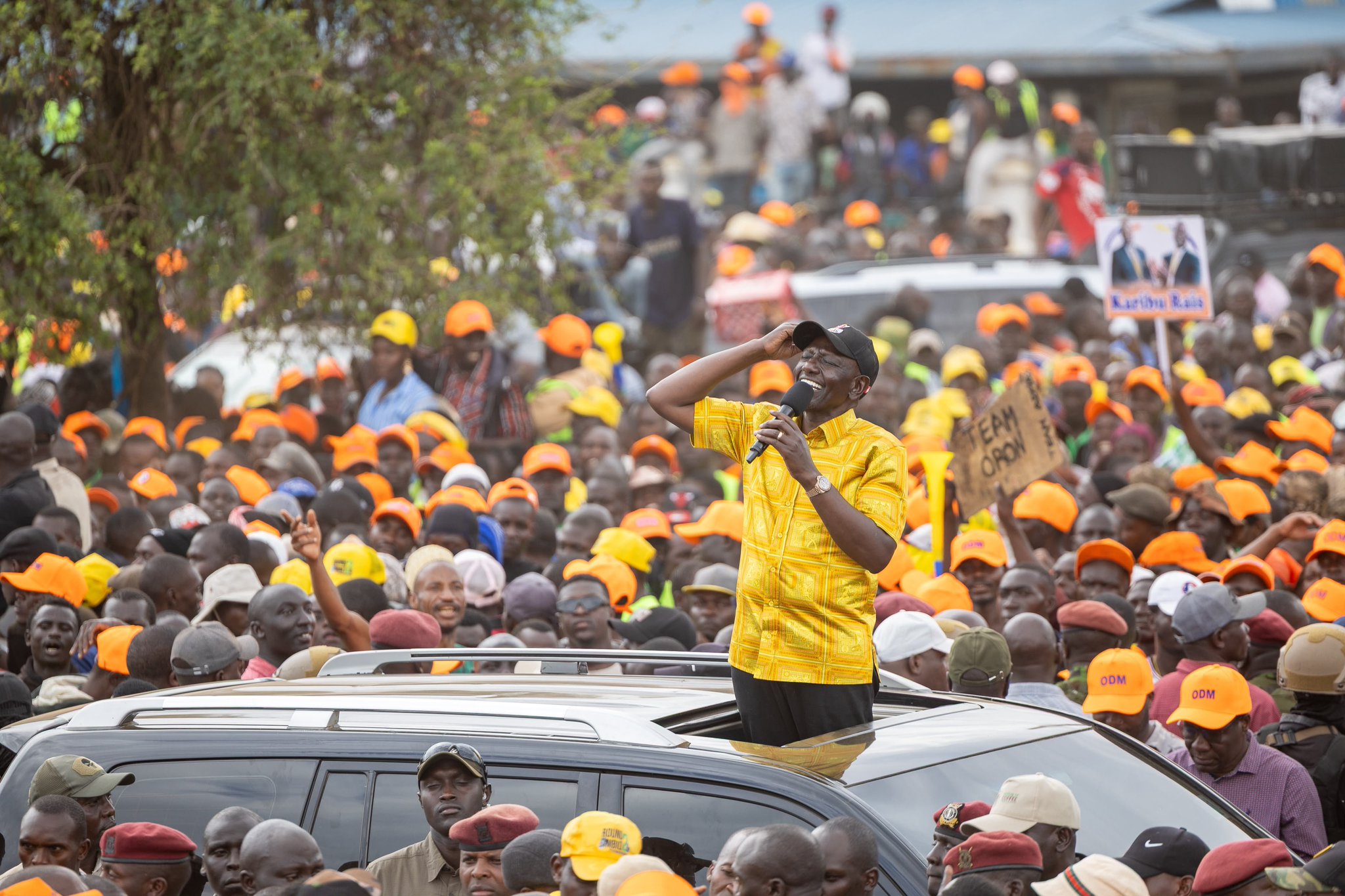
The sheer scale and visual presentation of the gathering was striking, with yellow UDA colours dominating the political spectacle. Social media claims that the crowd was “bought” were predictable.
But the argument that a Kenyan political rally can be assessed as either completely organic or completely manufactured is too simplistic.
Modern political rallies are mobilised events.
Parties organise transport. Leaders mobilise supporters. Local networks activate their structures. Political entrepreneurs compete to demonstrate strength. Some participants attend out of conviction; others because they expect opportunities, access, entertainment, transport or political patronage.
None of this automatically makes the crowd fake.
The more useful journalistic question is what happens after the crowd disperses.
Does the political enthusiasm survive at the polling station?
That is where the real test begins.
Siaya is a different political proposition
President Ruto should not mistake a successful rally in Kisumu for a political breakthrough in Siaya.
Siaya is one of the places in Kenya where political symbolism carries an unusually heavy historical burden.
It is the home of Jaramogi Oginga Odinga and the late Raila Odinga’s political legacy. Raila’s influence shaped generations of political behaviour in the county, even though his death has fundamentally altered the political equation.
Ruto understands this.
His remarks in Kisumu were therefore carefully calibrated.
He has increasingly presented his relationship with the late Raila Odinga not simply as a political alliance but as a continuation of a broader national project. During the current tour, the President has said he wants to preserve and advance Raila’s development legacy.
And on Monday, the President framed the 2027 election in deliberately national rather than ethnic terms, arguing that it should usher in a new chapter of unity, inclusion and shared national purpose.
That is a message designed for Siaya.
But development must survive the politics
There is an important caveat.
The President’s development record in Siaya should not be judged by the number of rallies he holds or the size of crowds he attracts.
It should be judged by whether projects announced are completed, whether roads remain usable, whether water reaches households, whether electricity connections translate into productive activity and whether public investment creates durable jobs.
This is not a theoretical concern.
During previous engagements with Siaya, Ruto announced major interventions including blue-economy infrastructure, markets, electricity connections and agricultural initiatives. In 2025, the Presidency said the government would invest Sh1 billion in blue-economy infrastructure in the county, including the Usenge Pier and a fish market, alongside plans for markets and last-mile electricity connections.
The current tour therefore provides an opportunity to ask the harder question: What has moved from presidential promise to measurable delivery?
That is the standard against which both national and county leadership should ultimately be judged.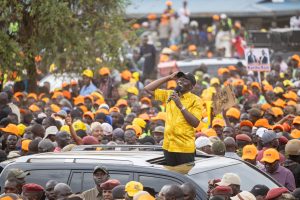
Why the boda boda meeting is clever politics
If the President really wants to get to the heart of the Siaya voter, meeting boda boda operators is arguably more strategically intelligent than another gathering of politicians.
The reason is simple.
Political elites speak to one another.
Boda boda operators speak to everybody.
They interact with farmers, traders, students, teachers, civil servants, patients, business owners and rural households. They know which roads are passable, which markets are busy, which businesses are struggling and which political messages resonate in neighbourhoods.
They are therefore a remarkably effective transmission belt for political sentiment.
More importantly, the sector represents a constituency that responds naturally to the language of economic empowerment.
A motorcycle is an asset.
A rider’s income is daily.
Fuel prices matter immediately.
Road conditions matter immediately.
Police enforcement matters immediately.
Access to credit matters immediately.
Insurance matters immediately.
The cost of repairing a motorcycle matters immediately.
A rider does not experience the economy through a quarterly GDP report. He experiences it every morning when he starts his engine.
That is why the President’s encounter with the sector could prove more politically valuable than a perfectly choreographed rally.
Even “buying allegiance” would miss the larger point
There will inevitably be accusations that the President is attempting to “buy” political allegiance.
That is the nature of election-season politics.
But even if political persuasion is part of the motivation, there is nothing inherently illegitimate about a president seeking support from an important economic constituency.
The ethical question is what is being offered.
If the meeting produces empty promises and short-term political inducements, its value will disappear after the election.
If, however, it produces serious interventions on affordable credit, road safety, rider training, insurance, market access, digital payments, licensing, motorcycle financing and protection from exploitation, then political engagement could produce a genuine public dividend.
The distinction matters.
A government should be allowed to campaign for votes.
Citizens should equally be allowed to ask what they are getting in return.
The real Siaya test
There is another reason the boda boda meeting deserves attention.
Ruto’s greatest challenge in Siaya is not persuading politicians to stand beside him.
It is persuading ordinary voters that his government understands their economic frustrations.
The President’s administration has repeatedly framed its agenda around the bottom of the economic pyramid. The latest Kenya National Bureau of Statistics labour survey is explicitly designed to measure informal employment and other labour-market realities, underlining the importance of this segment of the economy to national planning.
The boda boda sector is therefore precisely where a “Bottom-Up” political philosophy should become tangible.
If it does, Ruto may have found an unusually direct route into the economic consciousness of Siaya.
If it does not, the meeting will become just another campaign photograph.
2027 begins before the ballot
The most revealing feature of the President’s Nyanza tour is therefore not any single speech or rally.
It is the movement from leaders to citizens.
First comes the political class.
Then the public spectacle.
Then the economic constituencies.
That progression may tell us more about the President’s strategy than the official itinerary does.
Ruto has correctly identified that Nyanza cannot be approached merely through old political alliances. Raila Odinga’s death has changed the architecture of political loyalty, and the 2027 contest will inevitably test whether those loyalties can be transferred, fragmented or reconstructed.
His appeal to Raila’s legacy is part of that strategy.
His development projects are another part.
His spectacular rallies provide the imagery.
But the boda boda rider may provide the reality check.
The President says the 2027 election should mark the end of tribalism, division and discrimination and the beginning of a politics centred on national unity, inclusion and shared national purpose.
That is an ambitious promise.
In Siaya, the first place to test whether that promise has substance may not be the VIP tent.
It may be the motorcycle stage.
And if Ruto can convince the man who wakes up every morning wondering whether he will make enough money to take food home that national transformation has something tangible to offer him, then the President will have done more than stage another political rally.
He will have touched one of the most sensitive nerve endings in the Siaya electorate.
The road to 2027 may therefore run not only through State House, Parliament and party headquarters—but through the boda boda stage, one motorcycle at a time.



