 ADVERT
 ADVERT
The Lake Victoria Water and Sanitation Project is not merely an infrastructure investment—it is an investment in public health, dignity, economic productivity and sustainable urban growth.
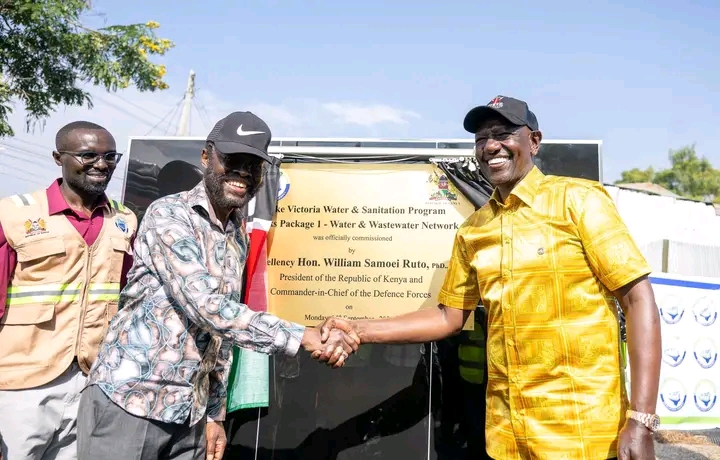
The commissioning of the Lake Victoria Water and Sanitation Project in Kisumu City by President William Ruto offers a timely reminder of a simple but often overlooked truth: no city can call itself modern if its people cannot reliably access clean water and safe sanitation.
Water and sanitation are not secondary public services to be addressed after roads, housing, markets and hospitals have been built. They are the infrastructure upon which these investments ultimately depend.
For Kisumu, an important commercial and administrative hub in the Lake Victoria region, strengthening water and sanitation systems has significance far beyond individual households. It touches businesses, schools, hospitals, industries, public institutions and the wider environmental health of the city.
The project therefore deserves to be understood not merely as another government infrastructure initiative, but as part of the essential architecture of a dignified urban future.
 ADVERT
A city cannot grow on inadequate infrastructure
Rapid urbanisation is placing unprecedented pressure on Kenya’s cities. As populations grow and new residential and commercial areas emerge, existing water networks and sewerage systems can quickly become inadequate.
The consequences are familiar: unreliable supply, pressure on existing infrastructure, unsafe water sources, poorly managed wastewater and growing environmental risks.
This is why water and sanitation must be incorporated into urban planning from the outset.
A new housing estate without adequate water and sewerage is not complete urban development. A modern hospital without dependable water is compromised. A commercial centre without proper wastewater management creates risks for both public health and the environment.
The lesson is straightforward: urban development cannot be sustainable when its supporting infrastructure is treated as an afterthought.
Water is a matter of dignity
For ordinary households, the importance of reliable water requires little explanation.
A dependable water supply makes it easier for families to maintain hygiene, prepare food safely, care for children and conduct their daily lives without the uncertainty associated with unreliable sources.
But the significance goes deeper.
When people can turn on a tap and expect water to flow, they gain something that infrastructure statistics rarely capture: certainty and dignity.
They spend less time searching for water and more time working, studying, caring for their families and participating in economic activity.
That is why water infrastructure should ultimately be measured not only in kilometres of pipelines or additional connections, but in the quality of life it creates.
Sanitation completes the equation
Supplying water without addressing sanitation leaves half the job unfinished.
A modern urban system must safely collect, transport, treat and dispose of wastewater. Without effective sewerage and wastewater management, the benefits of improved water supply can be undermined by pollution and public-health risks.
This is particularly important for Kisumu because of its relationship with Lake Victoria.
The lake is not simply a geographical landmark. It is an ecological and economic resource supporting millions of people across the region.
Poorly managed urban wastewater can place enormous pressure on aquatic ecosystems. Better sanitation systems can therefore serve two purposes simultaneously: protecting human health and reducing environmental degradation.
For a city on the shores of Lake Victoria, this responsibility is particularly profound.
The infrastructure beneath the infrastructure
One of the challenges of water and sanitation projects is that much of their most important infrastructure is invisible.
Roads, bridges and buildings immediately command public attention. Pipelines, sewerage networks, treatment facilities and underground systems rarely do.
Yet when these hidden systems work, an urban economy functions more efficiently. When they fail, the consequences can quickly become visible.
This makes investment in water and sanitation an investment in the invisible infrastructure of urban prosperity.
Reducing water losses is equally important. Every drop lost through inefficient networks represents wasted resources and additional pressure on a utility that must serve a growing population.
The objective, therefore, should not simply be to build more infrastructure, but to create systems that are efficient, properly maintained and capable of delivering value over decades.
Affordable housing needs more than walls
The connection between water, sanitation and affordable housing is also critical.
A house cannot be considered truly adequate merely because its walls and roof are complete. A decent home requires access to basic services that allow people to live safely and comfortably.
This makes water and sanitation fundamental to the success of Kenya’s broader housing agenda.
If new urban settlements are constructed without adequate utility infrastructure, the country risks creating neighbourhoods where buildings exist but the conditions required for dignified living do not.
Affordable housing must therefore be approached as part of an integrated urban-development strategy—not simply as a construction programme.
Hospitals need water to deliver healthcare
The same principle applies to healthcare.
Hospitals and health centres depend on reliable water for cleaning, hygiene, patient care and infection prevention. Effective sanitation is equally indispensable.
A health facility without dependable water is operating with a fundamental vulnerability.
Improving water and sanitation services to major institutions can consequently strengthen the capacity of those institutions to perform their core functions.
This is one reason the benefits of the Kisumu project should not be calculated only by the number of households connected. The wider institutional and economic benefits matter just as much.
The real test begins after commissioning
However, commissioning a project is only the beginning.
The history of public infrastructure is filled with projects that generated excitement at launch but struggled later because of inadequate maintenance, weak management, insufficient financing or poor accountability.
The true measure of the Lake Victoria Water and Sanitation Project will therefore be what happens after the cameras leave.
Will water flow consistently?
Will sewerage systems remain functional?
Will leaks and breakdowns be addressed promptly?
Will utilities have the capacity to manage growing demand?
Will consumers have effective mechanisms for reporting failures and demanding accountability?
These questions matter because infrastructure is an asset only for as long as it remains functional.
Kisumu must plan for tomorrow
The project should also stimulate a wider conversation about how Kenya plans for urban growth.
Cities should not wait for existing infrastructure to collapse under population pressure before expanding capacity.
Planning must anticipate new housing, commercial centres, industrial activity, population growth and climate-related pressures.
Water and sanitation should consequently be embedded in every serious urban-development plan from the beginning.
This is particularly important for cities such as Kisumu, whose economic importance is likely to increase as the Lake Victoria region becomes more integrated commercially and geographically.
Development requires cooperation
The success of such infrastructure will also depend on cooperation between national and county governments, utilities, development partners, communities and private-sector actors.
Government can finance and coordinate major investments, but utility managers must maintain them. Communities must protect public infrastructure and use services responsibly. Businesses must comply with environmental and sanitation requirements.
Development partners can provide technical and financial support, while citizens must remain engaged in demanding transparency and quality service delivery.
A commissioning ceremony may mark the completion of construction, but sustainable service delivery requires a much longer partnership.
From infrastructure to prosperity
Reliable water and sanitation can also strengthen Kisumu’s economic prospects.
Businesses need predictable utilities. Industries require reliable water and responsible wastewater management. Hotels, restaurants, markets and institutions all depend on functioning public utilities.
In this sense, water infrastructure is also economic infrastructure.
A city with dependable basic services is better positioned to attract investment, support enterprise and improve productivity.
This is why the conversation around water should move beyond consumption and household welfare. The question is also about the kind of economy and city Kenya wants to build.
The measure of government is what citizens experience
For citizens, government development programmes are ultimately judged less by the number of launches and more by the services they experience.
A commissioned project becomes meaningful when a mother has reliable water at home, when a hospital can maintain proper hygiene, when a business can operate without constant disruption and when wastewater is safely managed rather than discharged into the environment.
That is where public investment acquires its real meaning.
The credibility of development programmes is built when citizens can see and feel their benefits long after official ceremonies have ended.
A foundation for a dignified urban Kenya
The Lake Victoria Water and Sanitation Project offers Kisumu an opportunity to strengthen one of the most fundamental foundations of urban life.
Its significance extends beyond pipes, treatment plants and sewerage networks. It is about health. It is about dignity. It is about productive households, functioning institutions, thriving businesses and a healthier environment.
Kenya’s urban future will not be determined only by how many roads it builds, how many houses it constructs or how many markets it opens.
It will also be determined by whether those cities have the basic systems required to make urban life safe, productive and dignified.
For Kisumu, the real opportunity is therefore to turn this investment into a long-term model of integrated urban development—one where water, sanitation, housing, healthcare, environmental protection and economic growth reinforce one another.
The commissioning may be a milestone. But the real achievement will be measured in the years of reliable service that follow.


