 ADVERT
 ADVERT
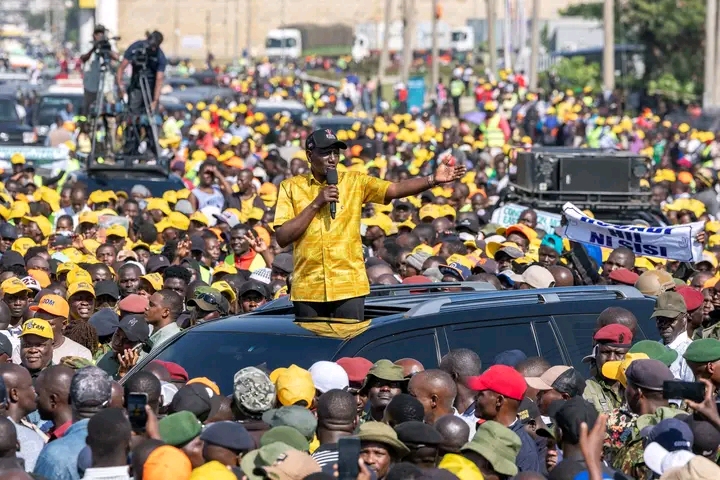
There are moments in politics that are carefully choreographed, and there are others that acquire a meaning far beyond the immediate political theatre. President William Ruto leading residents of Siaya in singing the Kenyan national anthem after Kenya secured the right to host the 2029 World Athletics Championships belonged to the latter category.
On September 15, as the country celebrated Nairobi’s successful bid to host the 2029 championships, Ruto asked the Siaya crowd to stand, remove their hats and join him in singing the national anthem. For several minutes, the political identities of the gathering appeared to give way to something larger—the national flag.
It was a striking scene in a county that has historically been associated with opposition politics.
For the ordinary voter watching, the significance may have had little to do with the technicalities of international athletics administration. It was about the symbolism of a President standing in Siaya and asking citizens to celebrate an achievement that belongs to every Kenyan.
The image inevitably contrasted with the increasingly competitive political mobilisation taking place at the grassroots as Kenya moves towards the 2027 General Election.
 ADVERT
Ruto’s four-day development tour of Nyanza combined inspections of government projects with increasingly direct political messaging. In Siaya, the President used his platform to caution residents against what he described as political experimentation, specifically taking aim at the emerging Linda Mwananchi movement.
His message was straightforward: voters should be cautious about entrusting their future to political formations whose promises and organisational credentials are yet to be tested.
That is a political argument from the President and should be understood as such. Linda Mwananchi leaders, like other opposition politicians, have the constitutional right to organise, mobilise and present an alternative political programme to Kenyans.
But beneath the political contest lies a more important question for Siaya and the country: can political competition coexist with national unity without turning communities against one another?
The anthem moment offered a powerful illustration of what that might look like.
A national anthem is not an endorsement of UDA, ODM, Linda Mwananchi or any other political formation. It belongs to the Republic.
And in a politically charged county such as Siaya, the spectacle of residents joining a President in singing it offered a reminder that political disagreement does not have to become national fragmentation.
Ruto’s political opponents are entitled to challenge his administration. The President is equally entitled to defend his record, promote his development agenda and ask voters to support his political programme.
The real danger emerges when political competition becomes so personalised that every road, bridge, hospital, housing project, electricity connection or water scheme is interpreted exclusively through the prism of partisan allegiance.
Siaya’s development needs are considerably larger than any political party.
During his tour, Ruto inspected the Ukwala Affordable Housing Project and other infrastructure initiatives across the county. Whatever one’s political allegiance, such projects deserve to be assessed on their tangible outcomes: whether they are completed, whether they serve their intended beneficiaries and whether they improve the economic and social lives of ordinary citizens.
This is where the politics of the anthem becomes more consequential.
A Siaya resident can support Governor James Orengo and still acknowledge a useful national government project. A supporter of Ruto can criticise aspects of his administration. An opposition voter can sing the national anthem alongside the President without changing political allegiance.
That distinction is vital if Kenya is to prevent electoral competition from becoming permanent social conflict.
The 2029 World Athletics decision provided precisely the kind of occasion around which such unity can be built. Kenya’s athletics story transcends political parties. Generations of Kenyan athletes have transformed the country’s name into a global sporting brand, while the successful bid to host the world’s premier athletics championships represents recognition of that legacy.
The achievement also places responsibilities on the country. Winning the hosting rights is only the beginning. Kenya must now deliver the infrastructure, organisation, transport systems, accommodation, security, tourism opportunities and sporting facilities required to stage a successful global championship.
The same principle applies to Siaya’s development agenda.
A presidential visit can produce impressive photographs. A national anthem can create a memorable moment. A political rally can generate enormous enthusiasm.
But ultimately, voters will judge government by what remains after the motorcade leaves.
Completed housing units.
Functional hospitals.
Reliable electricity.
Passable roads.
Working water systems.
Bridges that open economic corridors.
Jobs and enterprises that survive beyond political campaigns.
That is where the politics of development becomes real.
For decades, Kenyan politics has too often encouraged citizens to view one another through political and ethnic lenses. Campaign seasons can transform neighbours into rivals, political disagreements into personal hostility and legitimate competition into a struggle for communal supremacy.
The challenge for today’s political class is to demonstrate that Kenya can conduct fierce democratic competition without tearing apart the social fabric that holds the country together.
Ruto’s Siaya anthem moment will inevitably be interpreted through different political lenses. Supporters may see it as evidence of a President reaching beyond traditional political boundaries. Critics may see it as political symbolism deployed during an increasingly competitive period. Both interpretations will form part of the public conversation.
But the underlying national message requires no partisan interpretation.
Kenya can disagree and still sing together.
A voter does not have to surrender political independence to appreciate a national achievement. Nor does supporting an opposition politician require hostility towards every initiative of the government.
That is the maturity Kenya’s democracy increasingly demands.
The 2027 contest will come and go. Political alliances will be formed, broken and rebuilt. Candidates will rise and others will disappear from the political stage. Parties will change names, colours and coalitions.
The Republic will remain.
That is perhaps what made the Siaya scene so powerful.
For a few minutes, the President was not asking the crowd to vote for him. He was asking Kenyans to sing for Kenya.
And as the voices rose in unison after the country’s athletics triumph, the symbolism was difficult to miss: the flag must remain bigger than the party, the anthem bigger than the politician and Kenya bigger than the competition for power.



