 ADVERT
 ADVERT
The nurses’ revolt in Siaya has exposed a much bigger question than whether health workers should return to their wards.
It has exposed the uncomfortable fault line between devolution, national political power and the basic right of citizens to receive healthcare.
And at the centre of that fault line stand two of Kenya’s most politically consequential figures: President William Ruto and Siaya Governor James Orengo.
The timing could hardly be more politically charged.
The national nurses’ strike was called off last week after the Kenya National Union of Nurses and Midwives and the Council of Governors signed a Return-to-Work Formula, ending a 43-day industrial action and giving the parties 45 days to work on the implementation of the long-delayed 2017 Collective Bargaining Agreement.
 ADVERT
But while Nairobi celebrated a national breakthrough, Siaya nurses were not celebrating.
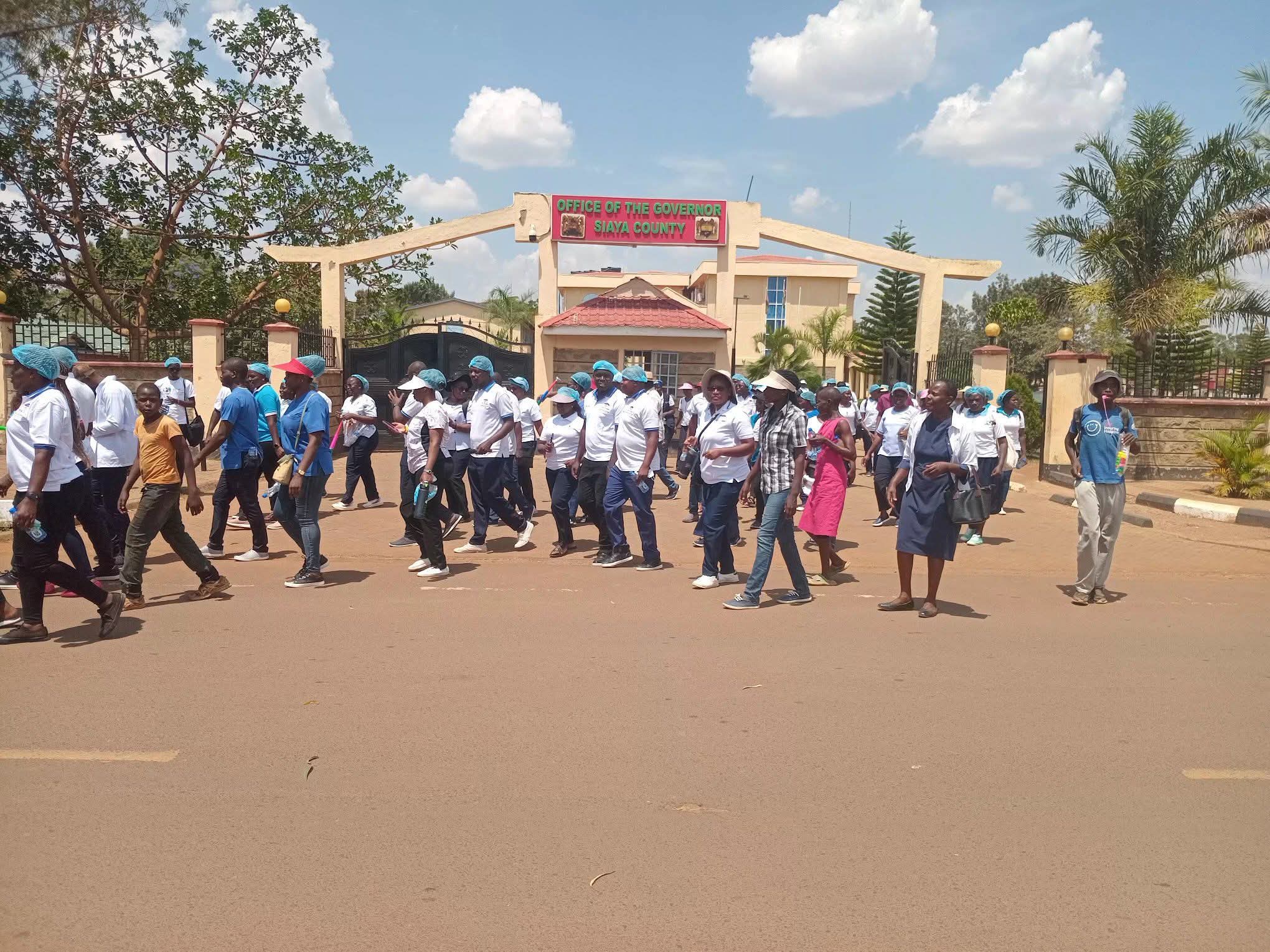
Instead, they took their anger to the streets of Siaya town, rejecting the national settlement and insisting that their own grievances remain unresolved.
That is where the story becomes particularly interesting.
A national deal meets a local rebellion
The national agreement may have ended the strike on paper, but it has not ended the dispute on the ground.
Siaya nurses are effectively saying that Nairobi cannot negotiate away grievances that they believe are specific to their county.
Their most explosive claim is that some of them have gone for seven months without receiving their salaries.
That allegation should not be accepted merely because it is politically convenient for one side — nor dismissed because it is embarrassing to the other.
It demands evidence.
Payroll records. Bank statements. County payment schedules. Statutory deductions. Employment records.
If seven months’ salaries are genuinely outstanding, then Siaya has a potentially serious administrative failure on its hands.
If the claim is exaggerated or inaccurate, the county government should be equally prepared to demonstrate that publicly.
This is where investigative journalism, rather than political rhetoric, becomes essential.
Who owes what to whom? Since when? Why? And where has the money gone?
Those are the questions that should now be asked.
The ghost town inside a hospital
On Monday, Siaya County Referral Hospital provided a disturbing visual metaphor for the crisis.
The normally busy corridors were unusually quiet.
The waiting areas had only a handful of patients.
The hospital appeared almost suspended between normal operations and paralysis.
Yet behind the doors of the maternity, newborn and Kangaroo Mother Care units, another reality persisted.
Mothers still needed assistance.
Premature babies still needed specialised care.
Newborns still needed monitoring.
Life, in other words, had refused to wait for politicians and negotiators to settle their differences.
That contrast should haunt every person involved in this dispute.
Because while politicians negotiate, unions demonstrate and county officials issue statements, patients remain the unwilling participants in the experiment.
The question Orengo cannot escape
Governor Orengo has a legitimate defence.
Healthcare is a devolved function, but the current nurses’ dispute is also part of a much wider national crisis involving the implementation of the 2017 CBA, UHC employment arrangements, allowances and the financing of county health services.
He cannot reasonably be blamed for every problem facing nurses in Kenya.
But neither can he hide behind Nairobi.
The nurses demonstrating in Siaya are his county employees.
Their grievances are being directed at the county administration.
And the governor ultimately carries political responsibility for the performance of the institutions under his administration.
Indeed, this is precisely what devolution was supposed to accomplish: bring government closer to the citizen and make responsibility easier to identify.
When a patient walks into Siaya County Referral Hospital, he or she does not experience the constitutional division of functions between Nairobi and Siaya.
They experience government.
If there is no nurse, the patient does not care whether the explanation is SRC, Treasury, the Council of Governors, KNUN or the county payroll.
They simply see a government that has failed to deliver.
That is the uncomfortable reality Orengo must confront.
And Ruto cannot simply point to devolution either
The President has his own uncomfortable questions.
Ruto’s administration cannot claim to be transforming healthcare while a nationwide nurses’ dispute paralyses public hospitals.
The national government may not directly employ county nurses, but it has enormous influence over the financial and policy environment in which counties operate.
More importantly, the political consequences of a collapsing public health system ultimately land at State House as much as at the county headquarters.
The President therefore has a responsibility to help broker a sustainable solution.
But there is a danger here.
The nurses’ crisis must not become another theatre in Kenya’s perennial national-versus-county political warfare.
Ruto should resist the temptation to weaponise county grievances against governors.
Orengo, equally, should resist the temptation to blame every county failure on Nairobi.
The patient has no interest in either political strategy.
Why the seven-month salary claim matters
The allegation of seven months’ unpaid salaries is perhaps the most politically explosive element of the Siaya dispute.
It raises questions that cannot be answered through press conferences.
Were the nurses properly captured on the county payroll?
Were funds budgeted?
Were they released?
Were salaries processed?
Were statutory deductions made?
Were some categories of nurses treated differently?
Were there administrative disputes over employment status?
Were national UHC arrangements involved?
And, most importantly, who knew about the problem and when?
There is also a historical dimension.
Siaya has previously experienced disputes over nurses’ pay and allowances. In 2024, for example, the county government announced the release of millions of shillings owed to nurses over longstanding claims.
That history makes today’s allegations even more deserving of scrutiny.
A government that repeatedly finds itself negotiating with its own healthcare workers over delayed payments has a systems problem — not merely a public-relations problem.
The political calculation
There is another layer that should not be ignored.
Siaya is not just another county.
It is politically symbolic territory, and Orengo remains one of the country’s most prominent opposition figures.
Ruto’s administration has a political interest in demonstrating that government can deliver in opposition-controlled regions.
Orengo, on the other hand, has an equally important political interest in demonstrating that devolution under his leadership can deliver services effectively.
That creates a potentially combustible dynamic.
Every road project, hospital improvement, electricity connection and government programme in Siaya can acquire political meaning.
So can every failure.
The nurses’ dispute therefore has the potential to become more than an industrial disagreement. It could become a referendum on whether political differences can be separated from service delivery.
That is precisely why both leaders should tread carefully.
The nurses are not the only ones under examination
It would also be intellectually dishonest to portray the nurses as completely beyond scrutiny.
Industrial action is a powerful weapon because its consequences are immediate.
When nurses withdraw their services, patients suffer first.
That gives healthcare unions enormous leverage — but also imposes enormous responsibility.
The union must defend legitimate employment rights without allowing vulnerable patients to become bargaining chips.
The national agreement was negotiated for a reason.
If every county branch could independently reject a national settlement, the agreement would become almost impossible to implement.
But if the national agreement leaves legitimate county-specific grievances unresolved, then returning nurses to work without addressing those issues merely postpones the next crisis.
That is not a solution.
It is a timeout.
The bigger scandal would be learning nothing
The greatest danger is that everyone eventually claims victory.
The union will say it defended its members.
The Council of Governors will say it ended the strike.
The national government will say it saved the healthcare system.
County governments will say they have complied.
And politicians will move on to the next campaign issue.
Meanwhile, the underlying problems will remain.
Until the next strike.
Until the next demonstration.
Until the next hospital corridor falls silent.
Until another mother arrives at a public facility and discovers that the service she desperately needs is unavailable.
That is why the Siaya dispute deserves something more serious than political point-scoring.
A forensic audit, not another political meeting
The immediate answer should be remarkably simple.
Audit the claims. Publish the numbers. Establish responsibility. Pay what is legitimately owed. Fix the payroll. Restore services.
The county government should provide a clear account of outstanding nurses’ salaries and employment obligations.
KNUN should provide the evidence supporting its claims.
The Council of Governors should clarify which grievances are covered by the national Return-to-Work Formula and which remain county-specific.
And the national government should help close the financial and policy gaps that counties cannot resolve alone.
No side should fear transparency.
If Orengo’s administration is right, the records will vindicate it.
If the nurses are right, the records will expose the failure.
Either way, the public deserves the truth.
The Orengo–Ruto moment
The real test of both leaders is therefore not whether they can win the political argument.
It is whether they can rise above it.
For Orengo, this is a test of devolved governance.
For Ruto, it is a test of national leadership.
For KNUN, it is a test of responsible unionism.
And for the people of Siaya, it is a test of whether devolution has actually brought government closer to them — or merely moved the location of bureaucratic failure.
The haunting image from Siaya County Referral Hospital is not the demonstration.
It is the silence.
The empty corridors.
The reduced activity.
And, behind closed doors, nurses continuing to care for mothers and newborns because life does not understand industrial action.
That is the political lesson both Ruto and Orengo should take from Siaya.
A government can survive an embarrassing headline.
A politician can survive a bruising negotiation.
But a public health system cannot survive indefinitely on promises, blame games and temporary settlements.
The nurses are demanding their rights.
The government must protect the patients.
The real measure of leadership is finding a way to do both.



