 ADVERT
 ADVERT
There is a haunting lesson in the biblical story of King Saul: political authority can survive the loss of political grace, but commanding respect after the centre of power has shifted is an altogether different struggle.
The story of Saul is not being invoked here as a theological judgment on Gladys Atieno Nyasuna Wanga. It is a political metaphor. In the biblical account, Saul remained king after the spirit of God had departed from him, but the political tide was already turning towards David. His title remained; his authority remained; his crown remained. Yet the effortless legitimacy that once surrounded him increasingly became difficult to command.
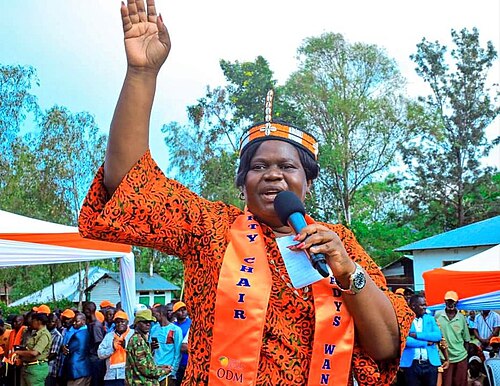
That is the uncomfortable metaphor now hovering over the political fortunes of Homa Bay Governor and ODM national chairperson Gladys Wanga.
The latest episode — reports that a helicopter carrying Wanga was denied landing in Narok ahead of a strategic ODM meeting — has become a powerful symbol of the changing political weather around her. The reported incident should, however, be treated as precisely that until independently confirmed. What is beyond dispute is that Narok has become an important theatre in ODM’s attempt to hold together its support among the Maa community, with Wanga herself leading the party’s recent mobilisation there and in Kajiado.
And therein lies the paradox.
 ADVERT
Wanga is not a political lightweight. She is Homa Bay governor, ODM national chairperson and one of the most recognisable women in Kenya’s opposition politics. She has held elective office since 2013 and has been one of ODM’s most forceful public defenders. In 2026 she has remained at the centre of the party’s negotiations over its relationship with President William Ruto’s administration.
But political stature is not a permanent possession.
The woman who once appeared to embody the Odinga family’s confidence in a new generation of female political leadership now finds herself operating in a far more complicated landscape — one in which the old political guarantees are no longer guaranteed.
That makes the question unavoidable: what went wrong?
Wanga herself has provided an important part of the answer to the origins of her political journey. In a 2019 interview, she said she was not personally known to Raila Odinga before entering politics in 2013. It was Ida Odinga who first took an interest in her, recognised her potential and mentored her into politics. Wanga described Mama Ida as the person who “took interest and saw the potential” in her.
That history matters.
It means the Wanga story cannot simply be reduced to a politician who independently fought her way to the top. Her ascent was also a story of political mentorship, trust and association with one of Kenya’s most influential political families.
For years, she appeared to understand that ecosystem remarkably well.
She became one of Raila’s most dependable defenders. She rose from Woman Representative to governor. She became one of the most prominent women in ODM and eventually its national chairperson.
But the post-Raila era has changed the rules.
The death of Raila Odinga removed the political centre around which many competing ambitions had previously revolved. What followed was not merely a succession of personalities but a contest over what ODM should become, who should control its machinery and which political actors could claim ownership of Raila’s legacy.
Wanga placed herself firmly inside the establishment that emerged around the party’s new direction.
Her increasingly public confrontation with Edwin Sifuna illustrates the stakes. Wanga disowned Sifuna as ODM Secretary-General in March, while the party pursued disciplinary proceedings against him. The Political Parties Disputes Tribunal subsequently upheld his removal after finding that he had been given an opportunity to defend himself. Sifuna has since signalled his intention to pursue a different political vehicle and a presidential bid.
That is more than an ordinary party quarrel.
It has become a struggle over political inheritance.
And the danger for Wanga is that politics is rarely kind to those who confuse formal authority with organic influence.
One can be the chairperson of a party and still discover that political loyalty is increasingly transactional. One can occupy an impressive office and still find that crowds, local networks, influential politicians and emerging movements are no longer automatically aligned with one’s position.
That is why the Wanga-Magwanga rupture in Homa Bay is particularly significant.
Oyugi Magwanga was not an ordinary deputy governor. He had previously contested the gubernatorial seat and had his own political following. According to accounts of the 2022 contest, Raila Odinga intervened to persuade him to accept the running-mate position after Wanga secured the ODM ticket. Wanga and Magwanga subsequently won the election together.
Their relationship eventually collapsed spectacularly.
Magwanga resigned in February 2026, citing irreconcilable differences and frustrations, while Wanga’s office maintained that his focus on future political ambitions had compromised the collective responsibilities of the deputy governor’s office. Magwanga has since declared his intention to challenge Wanga for the governorship in 2027.
This is precisely where political arithmetic becomes more complicated than social-media narratives.
It is not enough to ask whether Magwanga is more popular than Wanga. There is no reliable current evidence establishing that proposition across Homa Bay. The more consequential fact is that a former deputy who entered the Wanga administration through an arrangement associated with party unity is now positioned as a challenger to the very governor he helped elect.
That alone tells us how dramatically the political equation has changed.
Then there is the unfinished symbolism of the Ida Odinga legacy.
The proposed Ida Odinga Library and Resource Centre at Ogande Girls’ High School was presented as an ambitious educational project, with plans including a 500-user library, amphitheatre, ICT hub and creative centre. Years later, The Standard reported questions over the project’s completion despite substantial fundraising and a Sh55 million contribution from President William Ruto.
This is not necessarily Wanga’s project or Wanga’s responsibility. But politically, unfinished flagship promises have a way of becoming metaphors for an entire generation’s expectations.
Where is the politics of transformation that once accompanied the Wanga brand?
Where is the promise that proximity to the Odinga political establishment would translate into an enduring Homa Bay development story?
And perhaps most importantly, where is the political imagination that once made Wanga look like one of the country’s emerging national figures?
The temptation is to explain her difficulties through avarice, ambition or an alleged hunger for power. That would be too easy — and probably too simplistic. Ambition is the fuel of Kenyan politics. Every serious politician wants more influence, a larger constituency and a greater place at the national table.
The real question is not whether Wanga became ambitious.
The question is whether she misread the price of political independence.
Politics, particularly within historically powerful movements, is an art of give and take. National stature is often built not merely by winning battles but by knowing which battles should be postponed, which allies should be accommodated and which personal ambitions should occasionally be sacrificed for a larger political project.
Perhaps Wanga believed the institutional authority she had accumulated was strong enough to withstand every political disagreement.
Perhaps she calculated that her record, position and networks could compensate for any estrangement from the Odinga family.
Perhaps she simply believed that ODM had become bigger than any individual family.
All are legitimate political hypotheses. None can responsibly be presented as established fact.
What can be established is that Wanga is now operating in an ODM that is visibly fractured over its post-Raila direction. She has publicly insisted that the party will negotiate with the government from a position of strength, while critics and rival factions accuse the current leadership of abandoning aspects of Raila’s political tradition. Wanga, for her part, has dismissed dissenting voices as a minority and defended the party’s broad-based-government strategy.
That disagreement is the heart of the matter.
There is an emerging political argument over what constitutes fidelity to Raila’s legacy: loyalty to the institutional ODM that Raila built, or loyalty to the democratic, social-justice and grassroots politics associated with his public career.
Some politicians have already made their interpretation clear. Funyula MP Wilberforce Oundo, for instance, recently argued that Raila’s political spirit had moved towards Sifuna and the Linda Mwananchi movement. That is Oundo’s political interpretation, not an established fact.
And this is where Wanga faces perhaps her most difficult challenge.
She cannot simply inherit Raila’s political mantle because she was close to him.
Nor can Sifuna inherit it merely because he was once his political foot soldier.
Political legacies are ultimately tested by voters, institutions, ideas, performance and the ability to build coalitions beyond the immediate circle of the departed leader.
Raila’s death therefore created an extraordinary political laboratory. Those who served closest to him are now being tested without the enormous personality that previously held competing interests together.
For Wanga, the test is particularly severe because her political identity became so closely associated with the Odinga establishment.
The blue-eyed political protégé has now become an establishment figure herself.
And establishments eventually have to answer the question every politician fears: what remains when the patronage, emotional loyalty and historical association that helped build your stature begin to fade?
Saul discovered that a crown could not manufacture David’s loyalty.
Wanga’s challenge is different but politically familiar: an office can confer authority, but only political relationships, performance and public confidence can sustain influence.
The answer will not be found in helicopter landing permissions.
It will not be found in who shouts loudest at ODM rallies.
It will not even be found in whether Wanga or Sifuna claims to be the true custodian of Raila’s legacy.
It will be found in whether Wanga can rebuild political bridges without surrendering her principles, demonstrate tangible results in Homa Bay, accommodate rivals without appearing weak, and persuade a changing Kenyan electorate that her politics is bigger than the political family that first opened the door for her.
That is the real Wanga paradox.
She rose because she understood the power of political alliances.
She now faces the harder test of proving that she can survive when those alliances are tested.
And unlike Saul, whose biblical story had a predetermined ending, Wanga’s political story remains unfinished.
The next chapter will be written not by the Odinga family, not by ODM’s headquarters, not by political commentators — but by the voters and political actors who decide, through their choices and alliances, whether Gladys Wanga remains a central figure in Kenya’s next political era or becomes another powerful politician whose moment at the centre passed sooner than expected.



